





No matter how many photographs you have saved, how many drone videos you have watched, or how many honeymoon brochures you have dog-eared, the Maldives has a way of making reality feel sharper and more vivid than the fantasy. It starts at Velana International Airport, where the ordinary chore of collecting luggage and finding a taxi is replaced by something closer to a scene from a private member’s club. A seaplane waits on the tarmac, gleaming and ready to lift you above a constellation of atolls. Or a branded speedboat idles at the jetty, its polished wood and white leather already suggesting that you are no longer a tourist but a guest. You leave the real world behind, and more often than not you leave your shoes too, because in the Maldives luxury is not about heels or polished loafers; it is about barefoot elegance, the feel of sand between your toes and the soft certainty that no one is going to ask you to dress for dinner unless you want to. Even time gets a reset. Many resorts run on “island time,” a gentle hour off the clock followed in the capital Malé, so the distinction between lunch and sunset becomes delightfully blurred. It all sounds like the pinnacle of escape already. But the notoriously discreet, celebrity-favourite hotel brand Aman has just announced a project that is expected to take things to an entirely new level. Aman is opening its first-ever hotel in the Maldives, with the first guests due in 2028. The name of the property is Amanolu, and simply knowing that Aman is arriving is enough to set hearts racing in the world of luxury travel.
Every Aman property has a name that feels less like a brand and more like a mantra. Amanolu combines two ideas: “Aman” comes from the Sanskrit word for peace, and “Olu” refers to the water lily found throughout the Indian Ocean region, a flower that rises unbothered from still water. Put them together and you get something like “peaceful water lily,” which is a poetic name for a retreat tucked into the secluded Vaavu Atoll. The location is deliberately private, a short seaplane ride away from the more familiar bustle of Malé, yet close enough to the clear, coral-filled waters that make this part of the Indian Ocean so hypnotic. The architecture is being handled by Kerry Hill Architects, a firm with a long track record of creating buildings that feel as if they grew out of the landscape rather than landed on it. The design draws inspiration from the Maldives itself: white coralline beaches, turquoise lagoons, and the pristine island setting. That means low-lying pavilions, natural materials, open-sided spaces that let the ocean breeze move through, and interiors that use texture and shadow instead of glitz. Think timber, stone, linen, deep verandas, and water always visible in the distance. Aman is not a brand that shouts; it whispers. And in a setting as flamboyant as the Maldives, whispering may be the most radical luxury of all. The announcement did not include a full list of every amenity, but what it did reveal is enough to inspire a decade of daydreaming.
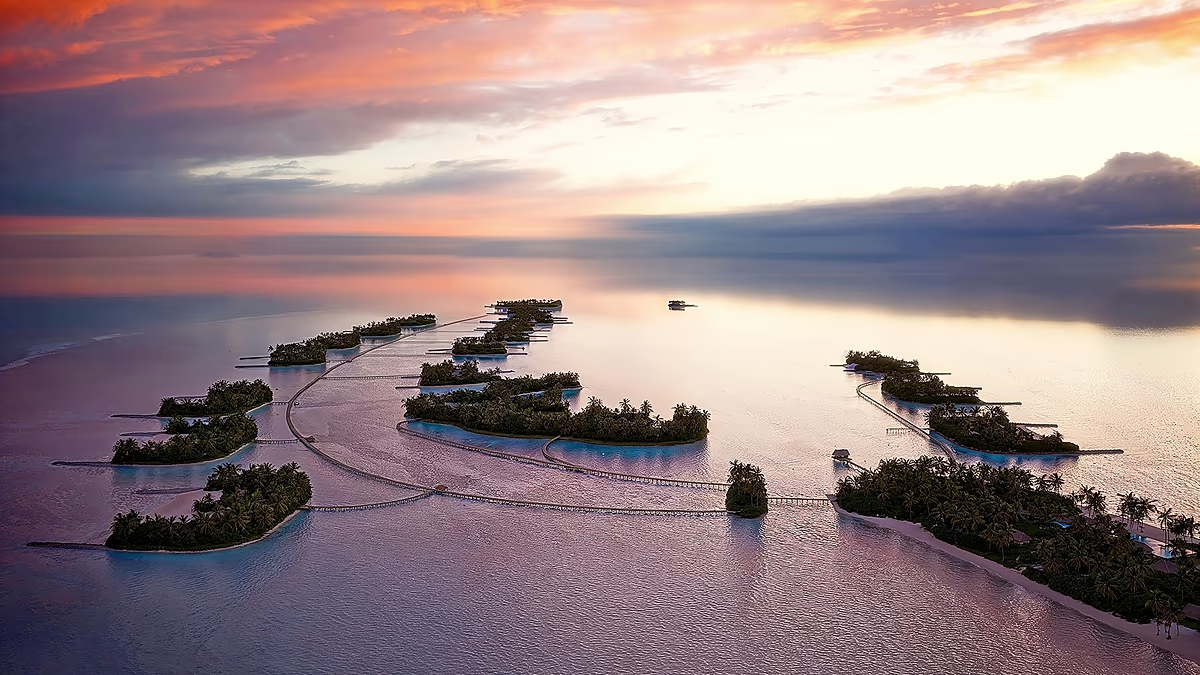
The heart of Amanolu will be a 52-room hotel, and while 52 rooms may sound relatively small, in the world of private-island luxury, small is precisely the point. Fewer rooms mean more space, more silence, and more personalised attention. But the hotel itself is only the beginning. Amanolu has been planned as a small archipelago of experiences, with separate islands devoted to different moods. There will be a dedicated wellness island, home to an Aman Spa and the brand’s signature Spa Houses. This is not the kind of spa where you book a massage at a front desk and then wait in a robe. Aman’s wellness philosophy is more immersive: guided breathwork at dawn, Ayurvedic treatments, yoga pavilions open to the ocean, cold plunges and steam rooms, and long, slow meals prepared from ingredients that travelled from the garden or the sea rather than from a supermarket shelf. For those who prefer adrenaline to stillness, another island is being designed specifically for activity. This will offer diving, snorkelling and watersports, with house reefs and coral gardens just a short boat ride away. You can spend the morning drifting over a coral wall with turtles and reef sharks, and the afternoon on a paddleboard or wakeboard, depending on your energy level. And of course, no Aman hideaway would be complete without a serious food and beverage programme. Amanolu will be home to several restaurants and bars, though the brand is being characteristically secretive about the details. Will there be a Japanese omakase counter? A Maldivian seafood grill on the beach? A bar that requires a boat ride? We will have to wait to find out. In the meantime, we can assume that the kitchens will be taken seriously, because Aman knows that a peaceful holiday is a well-fed holiday.
Yet for all its beauty and carefully curated calm, the most thrilling part of Amanolu might not be the hotel at all. It is the collection of 16 branded residences. The word “residence” in the travel world can mean many things, but here it means something almost absurd: each residence will occupy its very own island. Not a wing. Not a building. An entire island, with its own shoreline, its own breeze, and its own privileged relationship with the sun. Some residences will be oriented to catch the sunrise, so that the first light of day slips through louvred doors while you are still half dreaming. Others will face west, perfectly positioned for those long, apricot-coloured sunsets that feel like the reason you came to the Maldives in the first place. A few lucky homes will have beaches on both sides, which means uninterrupted water views from morning until night, a horizon that never runs out, and the ability to decide on a whim whether to swim with coffee in the east or with champagne in the west. Each residence will have five bedrooms, making it a genuine home rather than a hotel suite, and will come with its own private beach and a 25-metre swimming pool. There will also be dedicated staff accommodation, a quietly glamorous detail that tells you exactly who this property is for. This is for people who want to bring their family, their friends, their chef, perhaps their yoga teacher, and disappear into their own personal atoll. It is the ultimate version of “getting away from it all,” because the “it all” is left entirely behind.
At this point, the question that inevitably hovers over any Aman announcement is the price. Aman does not publish rates for its resorts, and it certainly does not publish the price of a private island residence, but we can safely say that the entry fee will be astronomical. A night in an Aman suite anywhere in the world usually costs more than a weekend in a nice city hotel; a multi-bedroom private island in the Maldives, complete with staff and a 25-metre pool, is in another financial galaxy entirely. And that is precisely the point. Aman has never pretended to be accessible. Its entire ethos is built on scarcity, discretion, and the quiet confidence of people who do not need to look at price tags. The residences, in particular, will likely be sold or offered on long-term lease to a tiny circle of individuals who value privacy above everything else. For the rest of us, Amanolu will remain a dream, a screensaver, a bucket-list item with an asterisk that reads “if I ever win the lottery.” But dreaming is part of the fun. We can picture the seaplane touching down in 2028, the first barefoot footsteps in perfect white sand, and the first dinner served on a private beach under a bowl of stars. We are entirely convinced that Amanolu will be magnificent. Our bank accounts, however, are raising their hands in protest. Perhaps the wisest approach is to treat this as the ultimate aspirational escape: save the photos, plan the fantasy, and if fortune ever smiles, book the seaplane.
Until 2028 arrives, there is a strange comfort in knowing that a place like Amanolu is being built. In a world that grows louder, faster, and more crowded by the day, a project devoted entirely to silence, space, and slow ocean light feels like a small act of rebellion. Amanolu will not solve any global problems, but it will offer something increasingly rare: a pause. A chance to live on “island time” in full seriousness, to abandon shoes and schedules, and to watch a water lily drift in a lagoon while remembering that peace is not a luxury reserved for the very wealthy, but a state of being we all deserve. Of course, the luxury part is real, and the price of admission will keep most of us firmly on the shore of reality. But that does not make the vision any less beautiful. Aman has spent decades proving that a hotel can be more than a place to sleep; it can be a philosophy, a sanctuary, and a portal to a more attentive way of living. Amanolu, with its Sanskrit name and its constellation of private islands, seems likely to become the purest expression of that idea yet. For the Maldivian resorts that already exist, the bar is already high. For Aman, apparently, it was never high enough. We will be watching from afar, barefoot in spirit if not in fact, counting the days until the seaplane is real and the sand is underfoot.