





1. The Aluminum Foil Travel Trend: A Modern Myth Takes Flight
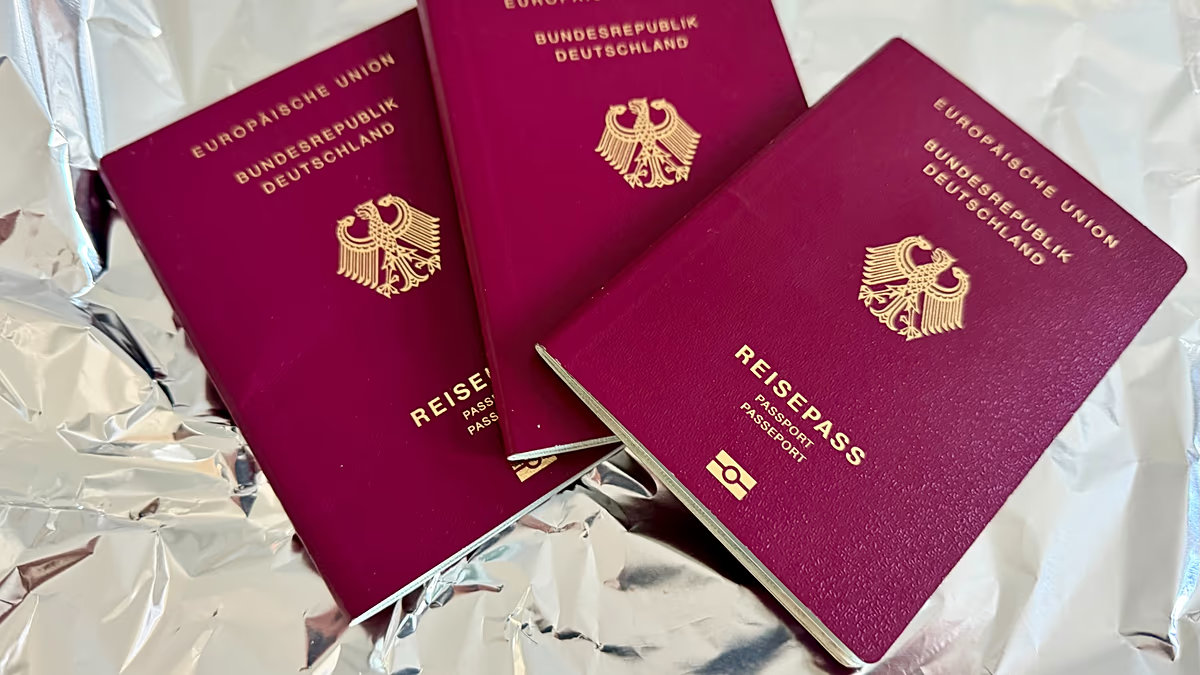
Imagine you are at a bustling international airport, the air thick with the scent of jet fuel and the murmur of hundreds of travelers. As you glance around the departure lounge, you notice a fellow passenger fumbling with a roll of shiny kitchen aluminum foil, meticulously wrapping their passport like a precious, leftover slice of pizza. This is not a scene from a quirky indie film, but a genuine, viral trend that has taken hold across social media platforms like TikTok and Reddit. Intrigued and slightly baffled, you watch as they carefully encase their travel document in the crinkly metal, believing it to be an impenetrable shield against a silent, invisible threat. The theory behind this peculiar practice is rooted in a modern-day fear: the specter of digital data theft, where malicious actors could allegedly “skim” sensitive information from your passport without you ever knowing, just by walking past you in a crowded terminal. The idea is that the foil acts as a makeshift Faraday cage, blocking the radio waves that transmit your personal data and keeping your identity safe from these ghostly digital pickpockets.
This practice has quickly spread from the fringes of the internet to the mainstream travel consciousness, fueled by well-intentioned advice and a general anxiety about our increasingly digital world. People are swapping tips on the best way to fold the foil, how many layers are needed, and whether it’s better to wrap the passport before or after checking in. It has become a talking point, a shared secret among the “well-prepared,” and a source of amusement for those who witness it. The sight of a traveler solemnly swaddling their most important document in a material more commonly associated with baking is a powerful metaphor for our times: a desire for security in an age of invisible threats, even if the solution is more symbolic than practical. The trend speaks to a deep-seated need for control, a way to actively do something to protect ourselves in a world where our personal information feels increasingly vulnerable, even if that something is ultimately based on a misunderstanding of how the technology actually works. It’s a fascinating case study in how a simple piece of household material can become a symbol of modern anxiety, passed from person to person across the digital world, creating a global community of foil-wrapped travelers.
2. Deconstructing the Magic: What’s Actually Inside Your Passport?
To understand why this trend is so unnecessary, we first need to pull back the curtain and look at the technology it’s trying to defeat. The modern passport is a marvel of security engineering, a far cry from the simple booklets of the past. At its heart lies a small, embedded microchip—often referred to as an RFID (Radio-Frequency Identification) chip—that is cleverly integrated into the document’s data page. This isn’t some high-powered transmitter broadcasting your life story to the world. It’s a passive device that requires a very specific and powerful reader to even activate it. Think of it less like a radio station and more like a tiny, sleep-sleeping digital archive that only wakes up when a dedicated and properly configured device is placed almost directly on top of it. The chip contains all the vital information that is printed on your passport’s data page: your digital photograph, your full name, date and place of birth, your sex, height, eye color, and even your place of residence. In many countries, like Germany, it also stores two fingerprints that are securely recorded during the application process.
The range for this data to be read is the crucial point. It is not a long-range system. For a reader to successfully access the information on the chip, it must be brought within a few centimeters of the passport itself. In practice, this means the reader would almost have to be physically resting on the passport cover to get a clear signal. This isn’t a technology that can be used to scan people from across a crowded airport concourse. The physical limitations of RFID technology, especially in passports which are designed to minimize accidental reads, are a significant barrier to any kind of “drive-by” data theft. The very design of the chip and its antenna is meant to be short-range, requiring a deliberate and close-up scan. This is a far cry from the popular imagination of a villain with a hidden scanner in a backpack, walking through a crowd and silently harvesting hundreds of identities. The physics of the system simply don’t allow for it. The threat, therefore, is not the looming digital boogeyman it’s often made out to be, but a highly localized, technically demanding, and easily noticeable operation that would require being uncomfortably close to the target.
3. The Experts Weigh In: Why the Foil is More Fuss Than Function
Given these technological realities, it’s no surprise that security experts and passport authorities view the aluminum foil trend with a mixture of amusement and gentle exasperation. They are unanimous in their assessment: this protective measure is largely superfluous and, frankly, useless in the real world. The chances of an unauthorized person successfully reading your passport’s chip are so incredibly low as to be practically nonexistent. You are far more likely to be struck by lightning than to have your passport data skimmed in this manner. The experts emphasize that the data on the chip is not only difficult to access due to its short range but is also heavily protected by sophisticated encryption and security protocols. To even begin to attempt an unauthorized read, a criminal would need specialized, expensive equipment and would have to be positioned within inches of your passport, a highly suspicious act that would likely draw immediate attention in any security-conscious environment like an airport.
Furthermore, specialists point out that the foil itself is an unreliable tool for the job. While it’s true that a properly constructed enclosure of conductive material can block radio waves (a principle known as a Faraday cage), a hastily wrapped passport does not create a perfect seal. The foil often has creases, gaps, and tears, which can act as antennas and potentially even amplify a signal in some unintended ways. It provides, at best, a very imperfect barrier that could easily be compromised. So, what does the aluminum foil actually achieve? In the minds of experts, it offers nothing except a false sense of security and a great deal of inconvenience. It adds an extra, fiddly step to every border control interaction, as you have to carefully unwrap your passport, present it for scanning, and then re-wrap it before you can move on. This not only slows you down but also creates unnecessary queues and frustration for other travelers. The only guaranteed outcome of this trend is that you will receive a series of puzzled looks from fellow passengers and possibly a knowing sigh from a weary border control officer who has seen this all before. It transforms a simple, efficient process into an awkward ritual that serves no practical purpose.
4. The Built-In Fortress: How Your Passport is Already Safe
Beyond the physical limitations of the chip, the data itself is shielded by a robust layer of digital security, making it a formidable fortress that is incredibly difficult to breach. The security protocols are so advanced that they rival those used in modern banking. A key component of this is something called Basic Access Control (BAC). In simpler terms, this is like a secret handshake between your passport and the border control reader. The machine-readable zone (MRZ) at the bottom of your passport’s data page—those two lines of numbers, letters, and symbols—contains a unique key. To access the data on the chip, the reader must first scan this MRZ and use that information to establish a secure, encrypted communication channel with the chip. Without access to this printed key, it is virtually impossible for an unauthorized reader to even begin the process of extracting data. The chip will simply refuse to communicate, remaining a silent, impenetrable vault.
The security doesn’t stop there. Even if a highly sophisticated criminal could bypass the BAC, the data stored on the chip is itself protected by advanced encryption. This means that even if they were to intercept the data being transmitted, it would appear as a meaningless jumble of characters that would take an impossibly long time to decrypt with current technology. The system is designed with multiple layers of defense, ensuring that the integrity and privacy of your identity are maintained from the moment the document is issued until it expires. In many countries, such as Germany, there is an additional layer of protection in the form of strict data protection laws. The information on the chip is not stored in any central government database. The local passport authorities hold only the same basic information that was kept before electronic passports were introduced. The sensitive biometric data, like your fingerprints, exist solely on the chip in your passport. In fact, the law explicitly mandates that all fingerprint data used during the passport’s production be irrevocably deleted from government systems the moment you collect your document. This means the passport is the only place that information exists, making it a self-contained, highly secure physical token of your identity.
5. The Psychology of the Foil: A Security Blanket for the Digital Age
So, if the technology is safe and the experts are clear, why is this trend so popular? The answer lies not in the realm of technology but in the far more complex world of human psychology. We are living through an era of profound digital anxiety. We are constantly bombarded with news of data breaches, identity theft, and sophisticated cybercrimes. This pervasive sense of vulnerability leaves many people feeling like they have little control over their digital selves. In this context, wrapping a passport in aluminum foil is not a logical security measure but an emotional one. It is a tangible, physical action that provides a powerful sense of agency and control in a world that often feels chaotic and opaque. It’s a modern-day security blanket, a ritual that offers a psychological comfort that far outweighs its actual practical benefits. The simple act of performing this ritual can alleviate anxiety, giving the traveler a feeling of being proactive and prepared, even if the perceived threat is largely a phantom.
This behavior is amplified and validated by the power of social media. When you see a video on TikTok with millions of views, or a viral thread on Reddit, it gives the practice a veneer of legitimacy. It becomes a piece of shared knowledge, a “life hack” that makes you feel smarter and more savvy than the average traveler. The trend becomes a self-perpetuating cycle: the more people see others doing it, the more credible and necessary it seems. The foil acts as a kind of visual affirmation, a way of showing fellow travelers, and yourself, that you are part of a group that is “in the know.” It’s a social signal, a quiet declaration of vigilance. The act is a coping mechanism, a way to externalize an internal worry. By physically encasing the passport, people are, in a way, trying to create a safe, controlled boundary around a piece of their identity. It’s a symbolic action that provides a sense of empowerment, a feeling that you are actively doing everything in your power to safeguard your personal information, regardless of what the actual threats may be. In the end, the aluminum foil is not for the passport; it’s for the person holding it.
6. The Verdict: Ditch the Foil, Keep Your Passport Safe
In the final analysis, the great aluminum foil passport-wrapping trend is a harmless, if slightly silly, response to a threat that, for all practical purposes, does not exist for the average traveler. The journey from a concern about digital pickpocketing to a global social media craze is a perfect illustration of how fear, misinformation, and the desire for simple solutions can combine to create a phenomenon that is entirely disconnected from the technical reality. The technology inside your passport is sophisticated, secure, and designed to be incredibly difficult to access without authorization. The physical constraints of RFID technology, combined with the powerful encryption and security protocols that protect the data, make the risk of being skimmed in a public place virtually nil. The experts have spoken, and they are clear: the foil is nothing more than a bulky, inconvenient, and ultimately futile attempt to secure something that is already secure.
So, the next time you prepare for a trip, you can confidently leave the aluminum foil in the kitchen where it belongs. Your passport is a marvel of modern security, built to withstand the most determined attempts at forgery and fraud. Instead of spending your time at the airport meticulously wrapping your documents in shiny metal, you can spend that time doing something far more productive: enjoying a cup of coffee, reading a book, or simply watching the fascinating parade of humanity that passes through any international terminal. The most effective way to protect your passport is to treat it with the care it deserves—keep it in a secure, designated pocket in your bag, don’t leave it lying around, and be aware of your surroundings. The real risks are not invisible hackers with powerful scanners, but the more mundane dangers of simply losing your passport or having it stolen. Let go of the foil, embrace the peace of mind that comes from understanding the actual technology, and focus on the excitement of your journey. After all, the best travel tip is not about creating a useless metal shield, but about traveling with an informed, relaxed, and open mind. The world is waiting for you, passport in hand, ready for adventure, not wrapped in yesterday’s leftovers.