






It has been a genuinely rough stretch for the tourism industry, and nowhere has that been felt more acutely than in the Middle East. Regional conflict and its ripple effects have made travel to the area deeply unpredictable, and even though global tourism enjoyed a record-breaking 2025, the geopolitical climate cast a long shadow over 2026. Visitor numbers dropped, air capacity shrank, and hotel bookings suffered across the Gulf and wider region. At Arabian Travel Market (ATM) in Dubai, where industry leaders gathered this week, much of the conversation naturally revolved around these disruptions. But underneath the concern, there was a quieter, more hopeful theme: recovery is coming. The ATM Travel Trends Report 2026, released during the event and co-produced with Tourism Economics, forecasts that international travel across the Middle East, North Africa and South Asia will rebound by 17% in 2027. Put that in perspective, it is more than twice the projected global growth rate of 8%. International visitor spending in the Middle East alone is expected to climb by $116 billion (€100.58 billion) between 2025 and 2030, a jump of 57%. Dave Goodger, Managing Director EMEA of Tourism Economics, spoke about the findings with a sense of measured optimism. He said the coming years represent something more meaningful than a simple bounce-back. “Over the next five years we see travel expanding on a structural basis rather than just a cyclical rebound,” he explained. “International travel has never mattered more. This year is disrupted by an uncertain economic and geopolitical backdrop, but consumers are treating travel as essential.” That single line captures the mood of the industry right now: travel is no longer a luxury to be postponed at the first sign of trouble; it has become a fundamental part of how people see their lives and their futures.
The way people spend their travel budgets is shifting too, and one of the most fascinating trends to emerge from the report is what analysts call the “premiumisation” of travel. Luxury has always been an important part of the Middle East’s tourism appeal, and the report notes that nearly 80% of prospective visitors to the region prioritise luxury when they travel. But premiumisation is not just about five-star hotels and private jets. It means travellers are choosing to spend more on the specific parts of a holiday that genuinely matter to them, whether that is upgrading to a better airline cabin, booking a once-in-a-lifetime experience, or dining at a restaurant they have dreamed about for years. At the same time, they are looking to save money elsewhere, perhaps by choosing a more modest hotel or cutting back on extras that do not add emotional value. “People want those luxury experiences, they want those premium experiences, but they will save money where they can,” Goodger said. The report found that 35% of travellers are more interested in premium experiences than they were two years ago, and this appetite for elevated experiences is running alongside a deep sense of price-consciousness rather than replacing it. In a separate conversation with Euronews Travel, Goodger described this greater price-consciousness as a “global challenge” that is visible across Europe, North America, China and other Asian markets. “People are price conscious, they’re looking for value, but they are looking for valuable experiences,” he said. That might mean spending less on accommodation to free up money for the experiences that inspired the trip in the first place. As he put it, travellers are not simply hunting for the cheapest possible package holiday. Instead, they are making deliberate choices: “I will downgrade on the hotel, but I still really want to do that experience that I’m doing while I’m there.” It is a more thoughtful, more intentional way of travelling, one that prioritises memories over material comforts.
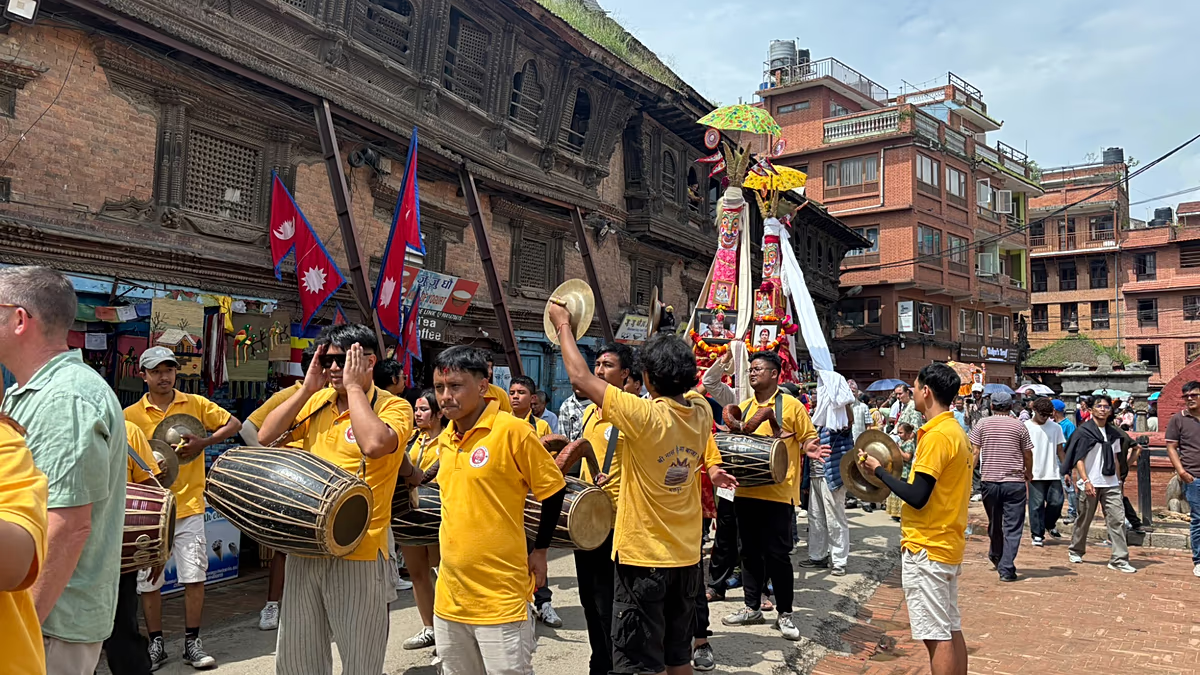
Another major shift is the growing appetite for lesser-known destinations. The report reveals that 56% of travellers are more interested in exploring new places than they were two years ago, and among those considering travel to the MENASA region, that figure rises to 68%. This is a remarkable opportunity for secondary cities, rural regions, and destinations that have long lived in the shadow of famous neighbours. But it does not mean Paris, London, or Rome are losing their magic. Goodger was quick to point out that first-time international travellers still dream of standing in front of the Eiffel Tower or seeing Buckingham Palace with their own eyes. Those iconic moments remain a rite of passage. What is changing is what happens after that first trip. Repeat visitors, people who have already seen the great landmarks, are increasingly venturing further afield, exploring new regions and seeking out secondary destinations that feel undiscovered. “They’re the ones that are going to the new destinations, the new regions, the secondary destinations,” he told Euronews Travel. This ties into a broader movement toward experience-first travel. Travellers are no longer starting with a destination and then looking for things to do. Instead, they are choosing an experience or a passion first, and then building an entire trip around it. Culture and authentic experiences rank among the top priorities highlighted by Tourism Economics, and there is a clear surge of interest in activities, food, and sport. Whether it is learning to cook a traditional dish in a local home, attending a prestigious tennis match, or hiking through landscapes that feel worlds away from everyday life, people are hungry for immersion. “People are looking for experiences,” Goodger said at ATM. “They want new experiences. They want these cultural experiences.” In many ways, this signals the end of the checklist-style holiday. The modern traveller wants to feel something, not just see something, and that is reshaping how destinations market themselves and how travel companies design their offerings.
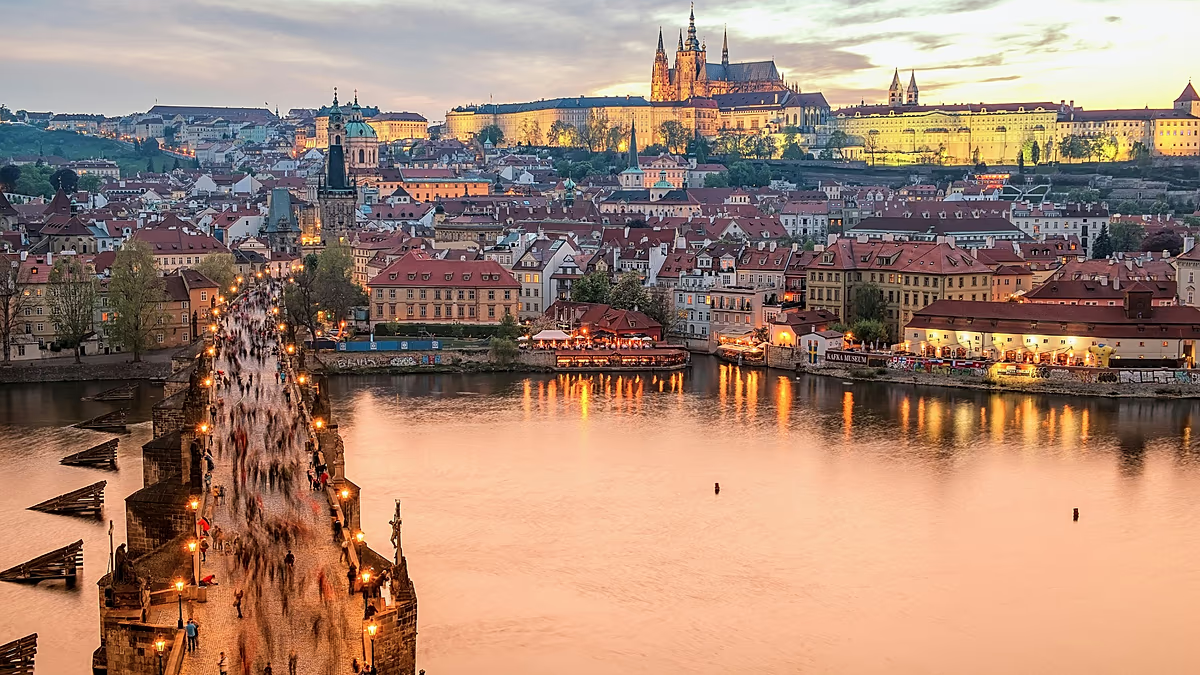
Mass tourism is also beginning to influence when and where people choose to travel. According to the Tourism Economics research, three in ten travellers now actively avoid certain destinations because of overcrowding concerns. That is a significant number, and it is growing. Overtourism remains a particularly pressing issue in Europe, where famous cities have struggled with congestion, rising housing costs, and the environmental toll of too many visitors. But Goodger noted that the shift away from crowded destinations is still “very subtle.” People are not abandoning the great cities entirely; they are just becoming more selective. One of the most interesting emerging trends is the flattening of seasonality. Traditionally, destinations have experienced intense peaks during summer or holiday periods, followed by long, quiet off-seasons. That pattern is starting to change. “We are seeing a bit of a flattening of seasonality,” Goodger said. “People are looking outside of peak season for travel, just so they can have that experience without the crowds.” Travellers are increasingly willing to take their holidays in shoulder months, or even during what used to be considered the off-season, in exchange for a more relaxed atmosphere, lower prices, and a chance to experience a place the way locals do. This is a win-win situation. It benefits popular destinations that are trying to spread visitor numbers more evenly across the year, and it also opens doors for lesser-known places looking to attract travellers away from overcrowded hotspots. Instead of fighting for a spot on a crowded beach in August, travellers might now choose a quieter coastal town in September, or a mountain village in May, and discover something far more memorable. The result is a tourism landscape that is slowly becoming more balanced, more sustainable, and ultimately more enjoyable for everyone involved.
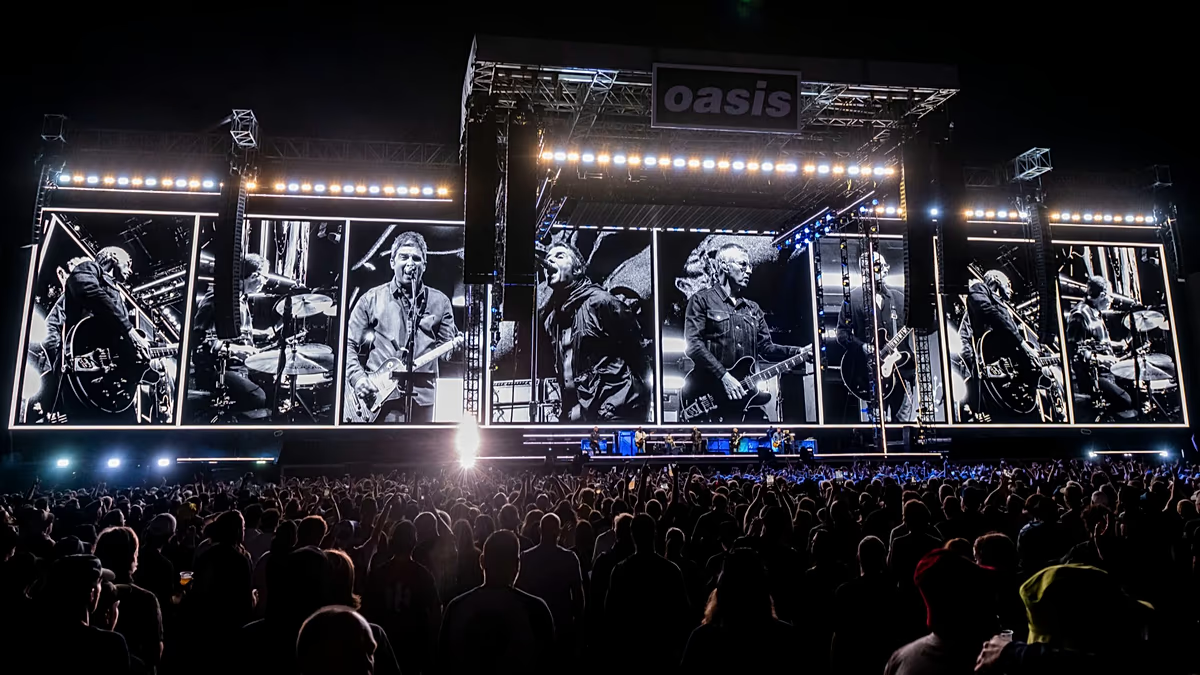
Events are playing an increasingly powerful role in driving travel decisions as well. The report found that three in ten travellers are now more interested in event-related travel than they were just two years ago. People are crossing borders specifically to attend concerts, sporting matches, cultural festivals, and religious gatherings. Goodger highlighted “sporting, cultural [and] religious events” as especially strong drivers of travel, particularly in the Middle East, where major investments in sports infrastructure and entertainment venues are beginning to pay off. Business events are also booming, with association meeting attendance in the Middle East nearly doubling over the past decade. This convergence of leisure and business travel is creating new opportunities for destinations that can host large-scale gatherings. But perhaps the most transformative development is the growing use of artificial intelligence for trip discovery and planning. Travellers interested in visiting the Middle East are particularly “tech-forward,” according to Goodger, and AI chatbots are already playing a significant role in how they plan their journeys. The report found that 28% of prospective visitors to the Middle East had used an AI chatbot to plan a trip, compared to just 12% of travellers interested in other regions. This has profound implications for how destinations and tourism businesses market themselves. Instead of traditional keyword searches, travellers are now asking conversational questions: “Where can I go for a week of good food and warm weather that isn’t too crowded?” or “What’s a hidden gem in Jordan with great hiking and history?” AI can answer these questions in ways that bring lesser-known destinations into consideration, often bypassing the usual list of famous cities entirely. For destinations, this is a wake-up call. “It’s absolutely crucial for the destinations to be discoverable through those different platforms,” Goodger said. The discovery landscape is changing rapidly, and the places that will thrive in the next era of tourism are those that understand how to make themselves visible to AI-driven travellers.
Taken together, these trends paint a picture of an industry that is not merely recovering but transforming. The challenges of the past year, from regional conflict to economic uncertainty, have forced tourism players to rethink their assumptions and adapt to a new reality. Consumers still want to travel, and they still view it as essential to their well-being, but they are travelling differently. They are more deliberate about where they go, when they go, and why they go. They want premium experiences but are willing to make trade-offs to afford them. They are curious about new places, but still drawn to the icons that have always inspired wanderlust. They are increasingly concerned about crowds and are adjusting their timing and choices accordingly. They are motivated by events, and they are turning to artificial intelligence to help them make decisions. The Middle East and the wider MENASA region are poised to benefit from these shifts, with growth forecasts that outpace the global average by a significant margin. The $116 billion increase in visitor spending expected by 2030 is not just a number; it represents millions of travellers who will come to the region seeking unforgettable moments, authentic connections, and experiences that will stay with them long after they return home. Industry leaders at ATM Dubai were understandably cautious about the immediate challenges, but there was a clear sense of confidence in the long term. As Dave Goodger said, over the next five years travel will expand on a structural basis, not merely as a cyclical rebound. That is a powerful statement of faith in the resilience of the human desire to explore. In a world that often feels divided and uncertain, the fact that people continue to prioritise travel, to save up for it, to plan for it, and to protect it even in hard times, says something deeply hopeful about who we are. The next era of tourism will not be defined by sheer numbers alone. It will be defined by a richer understanding of what travellers truly value: meaning, variety, authenticity, and the simple joy of discovering something new. And if the forecasts are right, the Middle East will be at the heart of that story.