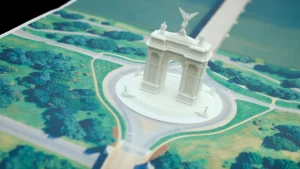






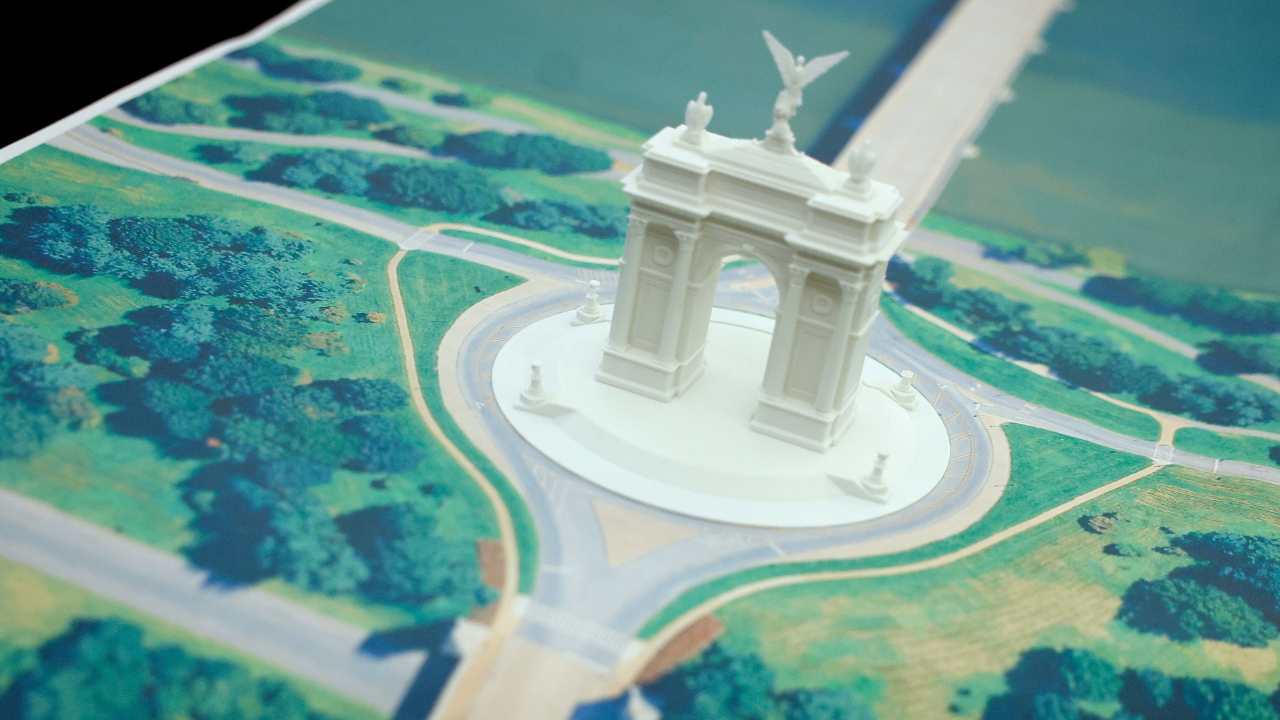
In the hush of early morning, when mist drifts off the Potomac and the white marble of the Lincoln Memorial catches the first light, Washington, D.C., can feel less like a political capital than a shrine. It is into this carefully cultivated atmosphere of reverence that President Donald Trump has sent the blueprints for a towering spectacle: a 250-foot-tall triumphal arch at Memorial Circle, a structure he has promised will be the largest of its kind in the world. The proposed monument, with golden eagles, lions, and a winged Lady Liberty crowning its massive form, is meant to evoke the imperial arches of antiquity and to celebrate American greatness. But to a group of veterans and preservationists, the design represents something very different: a violation of the sacred quiet of Arlington National Cemetery and the historic sightline that connects the Lincoln Memorial, Arlington House, and the cemetery where more than 400,000 service members rest. The arch would be planted at the edge of that landscape, near the threshold where visitors cross the Potomac from the Lincoln Memorial into the grounds of Arlington. Its defenders say it would be a patriotic symbol, a dramatic gateway to honor the nation’s heroes. Its opponents see it as an act of architectural violence—an enormous monument that would literally stand between the living and the dead, interrupting a view designed to communicate a single, powerful message: that the sacrifices of Americans are not isolated moments but part of one continuous story. That story, they say, should not be obscured by the vanity of a single era or the ambition of one man.
At the center of this fight are three men who carry with them the memories of Vietnam and a lifetime of devotion to the soldiers who did not come home. Michael Lemmon, Shaun Byrnes, and Jon Gundersen are not professional activists or politicians. They are veterans who have spent decades tending graves, attending funerals at Arlington, and keeping faith with those who served. Alongside them is Calder Loth, an architectural historian who has devoted his career to understanding why certain buildings and spaces matter beyond their physical form. Their legal challenge is being led by Nicolas Sansone, an attorney with the Public Citizen Litigation Group. In an interview with Fox News Digital, Sansone described the plaintiffs’ deep personal connections to Arlington. ‘Our plaintiffs are three Vietnam veterans and an architectural historian. All of them have a deep personal relationship with Arlington National Cemetery. Two of our veteran plaintiffs hope to be buried there.’ Those words are important. These are not outsiders trying to impose their views on a community they know nothing about. They are men who plan to be laid to rest in the very soil they are fighting to protect. Every funeral they have attended, every flag they have watched fold, every rifle salute that echoed across the hills is part of the reason they cannot sit silently while a 250-foot arch is planted in the middle of a view they have come to associate with gratitude, grief, and redemption. They are not opposed to monuments, and they are not blind to the desire to celebrate American greatness. But they believe a monument should belong to the people, not to one presidency; it should be chosen through deliberation, not imposed by fiat; and it should never be built at the expense of the sacred dead.
The core of the lawsuit rests on a deeply American idea: that the capital city was designed with intention, not accident. Washington, D.C., was not thrown together haphazardly. It was laid out on a deliberate plan that used sightlines to connect the nation’s most important symbols. One of those sightlines runs from the Lincoln Memorial on the east side of the Potomac River across the river to Arlington House, the Greek Revival mansion built by George Washington Parke Custis and later known as the Robert E. Lee Memorial, sitting high on the hills of Arlington National Cemetery. Throughout the 20th century, urban planners took pains to protect this view. Memorial Circle, where the arch would be built, sits directly within this symbolic corridor. Sansone explained that the capital has been ‘laid out in a very deliberate way to create this uninterrupted view’ between the Lincoln Memorial and Arlington House. ‘So our plaintiffs,’ he said, ‘are really sort of concerned about the impact that this sort of enormous structure is going to have on that sort of historic symbolic view that each of them finds really meaningful.’ The proposed arch would not be a small addition to the landscape. At 250 feet, it would be more than twice as tall as the columns of the Lincoln Memorial and much taller than any nearby structure. It would interrupt the sightline with a vertical shaft of stone and metal, drawing the eye away from the two profound monuments at either end of the bridge. The administration has acknowledged as much. In a planning document, the National Park Service wrote that the project will have ‘adverse effects on historic properties’ and that ‘such adverse effects cannot be fully avoided while retaining the location-dependent purpose of the undertaking.’ In other words, the government knows the arch will damage the historic scene; it simply considers that damage necessary to achieve its symbolic goal. Opponents find that admission chilling.
The legal battle is racing against time. Earlier this month, the Trump administration announced that excavation work for the arch would begin within the next two weeks, leaving the plaintiffs little room to maneuver. They have asked a federal judge to issue a temporary restraining order that would force the administration to halt all work until the courts can determine whether the project is legal. Their central claim is straightforward: the arch cannot be built without authorization from Congress. The Constitution gives Congress, not the President, the power to authorize public property and monuments in the capital. The Trump administration, however, insists that it already has that authority. It points to a 1925 law that originally authorized a pair of 166-foot columns in Washington, D.C., which were never built. According to administration officials, that old law ‘grandfathers’ the current project, meaning they do not need to go back to Congress for a new vote. The plaintiffs see that reasoning as a dangerous stretch. Sansone called the administration’s argument profoundly flawed. ‘Congress’s authorization to have a particular project built at a particular time subject to a specific price cap by a now-disbanded commission can’t reasonably be relied on to authorize a totally different independent project that’s going to cost way more money centuries into the future,’ he said. In other words, a 1925 decision to build two small columns—for a specified amount of money, under a commission that no longer exists—has nothing to do with a 250-foot triumphal arch costing many times more, designed more than a century later. To allow such a reinterpretation, the plaintiffs argue, would gut the congressional role in monument planning and give any sitting president unchecked power to reshape Washington’s historic core.
At the heart of the dispute is a deeper disagreement about how democratic decisions should be made. Sansone framed it as ‘sort of an institutional question of who gets to decide: Is it one person, the person sitting in the White House, or should it be a sort of democratic deliberative process to sort of figure out what these monuments should look like, where they should be situated, what they should commemorate, and the like?’ That is perhaps the most important question in the case. Should a monument of this size and significance be the vision of a single President, announced and executed at the stroke of a pen? Or should it emerge from the messy, slow, and sometimes frustrating process of public debate, hearings, expert testimony, congressional review, and community input? The plaintiffs argue that the latter is the only way to create a monument that genuinely belongs to the nation. The Trump administration, by contrast, has treated the arch as a priority project that should move quickly, without waiting for committees or studies. The administration’s appeal to the 1925 law is part of that strategy: it transforms a forgotten, unbuilt project into a legal loophole large enough to drive a 250-foot arch through. But the law, the plaintiffs say, was intended for a very different undertaking. It created a specific commission, placed a price cap on the work, and authorized two columns—not one enormous arch. Using that law to authorize a new, unrelated structure would invite chaos. If an old authorization can be repurposed centuries later, then almost anything can be justified, and the careful legal framework that governs American monuments would collapse. That is why the plaintiffs are not merely asking the court to delay the project. They are asking the court to say that monuments require consent—and that consent must be informed, deliberate, and contemporary.
Ultimately, this case is about the stories a nation tells itself. The view from the Lincoln Memorial toward Arlington House is not just a pretty picture. It is a conversation written in stone: across the river, from the president who saved the Union to the home of the Confederate general he fought against, and then to the thousands of white crosses and stars of David in the cemetery beyond. For generations, Americans have stood at the Lincoln Memorial, looked across the Potomac, and felt the weight of sacrifice. That view has been called a memory palace, a sacred way, and a living history book. To block it with a colossal triumphal arch would be to replace contemplation with assertion, memory with monument, humility with grandeur. It would turn a place of quiet reflection into a stage. The three veterans and the architectural historian who are suing to stop the project hope that the courts will see it the same way. They are not trying to deny the country a monument. They are asking that the monument be worthy of the ground it stands on. They are asking that before the first stone is placed, the American people—through their representatives—should debate what that monument means. And they are asking that Arlington National Cemetery, with its hundreds of thousands of graves, be treated as something more than a backdrop for a single leader’s ambition. In the end, the question is not whether the arch should exist. The question is who should decide, and what we are willing to sacrifice to build it. For the men who fought and bled for this country, the answer is not a 250-foot spectacle, but a promise kept: that the dead will not be forgotten, and that the living will not let vanity eclipse honor.