





Paragraph 1: The Bitter Cake and the Weight of a Date
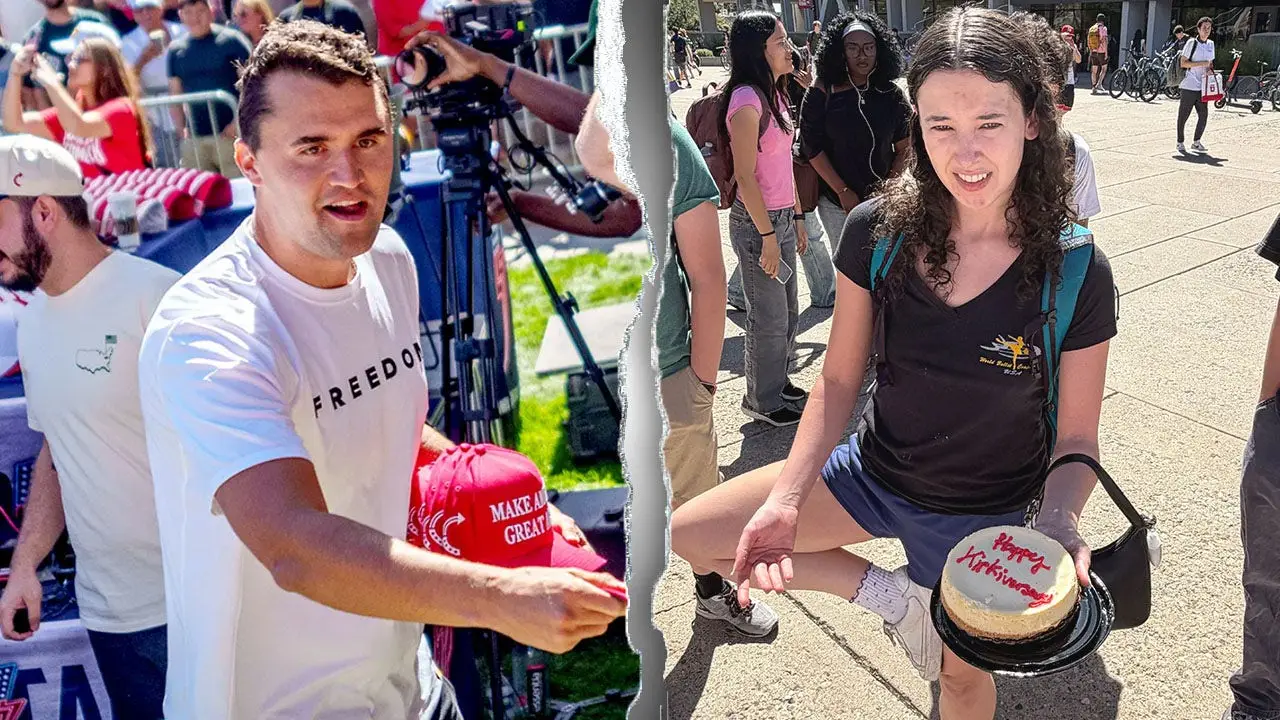
The air on the University of Utah campus carried the crisp, biting edge of an early autumn morning, but the chill that settled over the College Republicans’ table on September 10, 2026, had nothing to do with the weather. It was a manufactured frost, delivered on a plain white platter. A young woman, her face a mask of studied neutrality, approached the group’s table where they were conducting their usual outdoor outreach, and presented them with a cake. It was a stark, white confection, but the message scrawled in dripping red icing made her intentions brutally clear: “Happy Kirkiversary.” The word was a grotesque portmanteau, a twisted celebration timed to coincide with the one-year anniversary of the assassination of conservative commentator Charlie Kirk, a man who had been gunned down in broad daylight on a neighboring campus just under an hour away. For the students at the table, the cake was not a joke; it was a slap in the face, a deliberate provocation laced with a dark, visceral glee. The sticky sweetness of the frosting did nothing to mask the bitterness of its message. It was a tangible, edible piece of political violence, frosted with the blood of a man they admired. The sight of it sent a jolt of raw, visceral anger through Riley Beesley, the chapter chairman, and Rylie Barnes, a fellow member. They were young, idealistic, and already weary from navigating a campus that often felt hostile to their beliefs. Now, they were being taunted with the murder of a national figure, a killing that had sent shockwaves through the conservative movement and left a deep, unhealed wound in the broader political landscape. In this charged atmosphere, the cake was more than a prank; it was a signal that the leftward tilt of the academic world not only tolerated but actively celebrated the annihilation of its political opponents. The laughter that likely accompanied its delivery was a sound of pure mockery, a sound that threatened to drown out any notion of civil discourse or shared humanity on a campus that purported to be a bastion of learning and debate.
Paragraph 2: The Viral Spark and the Hunt for a Name
For Rylie Barnes, the initial shock quickly curdled into a simmering fury. The image of that cake, with its mocking red letters, burned in her mind. She felt not just insulted, but fundamentally violated. This was a celebration of a man’s untimely and violent death, a death that had repercussions far beyond the immediate family, touching a whole political community that felt under siege. In a moment of raw, unfiltered emotion, she snapped a photo of the cake and posted it to her X account. She intended it as an indictment, a way of exposing the grotesque moral bankruptcy she saw in the act, a call to arms for others who would share her disgust. However, she vastly underestimated the speed and ferocity of the digital mob she was unleashing. The post went viral with shocking velocity, rocketing through the far-right and mainstream conservative corners of the internet. The comment sections erupted in a storm of outrage, demands for retribution, and calls for the identification of the cake-bearer. It did not take long for the internet’s vast, decentralized intelligence network to go to work. An anonymous X user, playing digital detective, scoured the university’s social media, event photos, and public directories, eventually putting a name to the face. The student was identified as Sara Larsen. The moment her name appeared, the floodgates opened. Her personal accounts were flooded with abuse, threats, and expletive-laden condemnations. What began as an attempt to highlight a tasteless act of political mockery swiftly mutated into a full-blown doxxing campaign, laying bare the brutal mechanics of online vigilantism. In response, the University of Utah’s College Democrats rallied to Larsen’s defense, issuing a statement accusing the College Republicans of “waging a campaign of hate” against them. They painted Barnes and Beesley as the true aggressors, framing the public exposé of a student’s identity—and the subsequent torrent of harassment—as a malicious act of political retribution. The campus was now split down the middle, with two student organizations no longer debating policy but locked in a vicious, escalating cycle of accusation and counter-accusation that left no room for nuance, empathy, or a simple desire to understand the other side.
Paragraph 3: The Bureaucratic Quagmire and a Scrutinizing Eye
As the online firestorm raged, the university administration found itself thrust into the role of reluctant referee in a fight it had no desire to mediate. On Wednesday, an email arrived in the inboxes of both Riley Beesley and Rylie Barnes, sent by Jose Morales Diaz, the assistant director of the Student Rights and Responsibilities office. The language was cautious, precise, and steeped in legalistic caution. The email stated that the university had received information that, if accurate, might go against its stated priorities regarding campus safety and the Student Rights and Responsibilities policy. The accusation was stark: “allegedly involves you attempting to doxx another University of Utah student over a political issue.” The email requested a closed-door meeting, explicitly prohibiting the recording of the conversation, signaling a desire for confidentiality that would typically protect both the accuser and the accused. The meeting was scheduled for the following morning, giving the students just hours to prepare, to process the chilling weight of being formally investigated for their response to a provocation they considered to be far more egregious. But then, in a move that only added to the confusion and suspicion swirling around the case, the university abruptly canceled the meetings. No explanation was given. This sudden reversal left Beesley and Barnes in a purgatory of uncertainty, not knowing whether the investigation had been dropped, suspended pending further review, or had escalated to a higher echelon of administration. Beesley, speaking with a mixture of defiance and frustration, fiercely condemned the act of doxxing, asserting that his group had had no hand in releasing Larsen’s information, stating that they had merely posted a photo of a shocking event. He challenged the university’s apparent focus, arguing that the administration was ignoring the root cause: the “distasteful, vile, and disgusting” celebration of murder on campus. Later, the university released a carefully worded press statement reaffirming its commitment to simultaneously protecting freedom of expression and the safety of its students, acknowledging the allegations of harassment, threats, and the inappropriate sharing of personal information while refusing to comment on specific student disciplinary actions due to federal privacy laws. It was a diplomatic dodge that satisfied no one, leaving both sides feeling that the institution had failed to uphold justice and merely sought to weather the storm.
Paragraph 4: A Memory of Violence and the Fear of Being Next
To understand the depth of Riley Beesley’s visceral revulsion toward the cake, one must look back to a cold day in January of the same year. Beesley and his fellow College Republicans were engaging in their routine tabling activity, setting up their literature and attempting to engage passersby in respectful debate, a cornerstone of democratic society they had been taught to believe in. Suddenly, a person approached the table, and in a chilling voice, declared, “You should die,” followed by the horrifying words, “I am going to Kirk you.” The phrase was a dark, disturbing euphemism, a shorthand for assassination, an explicit reference to the murder of Charlie Kirk. The threat was so specific, so violently targeted, that it shattered the illusion of campus safety. A 21-year-old named Dean Stewart was subsequently arrested, and criminal proceedings were still ongoing. For Beesley, that encounter left an indelible psychological scar. It taught him that his political identity, his very existence as a conservative on campus, could make him a target for lethal violence. It taught him that the hostility was not just rhetorical; it was a tangible, physical threat that could be acted upon. So when Sara Larsen delivered that cake with its mocking “Kirkiversary” message, Beesley did not just see a bad joke. He saw the same hatred that had threatened his own life months earlier, now given a decorative frosting and a public platform. He saw a culture that had normalized political murder to the point where it was considered acceptable entertainment for a college student. In his mind, the cake was not an act of political satire; it was an act of psychological warfare. It was a reminder that he was part of a demographically dwindling minority on campuses, a group that could be publicly mocked and physically threatened with impunity. His anger, his call for the name to be known, was rooted in a primal need for acknowledgment and a desperate plea for the administration to recognize the asymmetric threat they faced, a threat that far outweighed the discomfort of a bad joke. He saw the university’s investigation into him not as a pursuit of justice, but as a cowardly deflection of its own responsibility to protect students from a hostile and radical environment.
Paragraph 5: The Lonely Exile of a Doxxed Student
In the wake of the digital fury, a solitary apology appeared on X, posted from an account bearing Sara Larsen’s name. The tweet, the only one visible on a profile created years prior, read: “Upon reflection, it was wrong for me to celebrate, or perpetuate the celebration of, Charlie Kirk’s death. I apologize for doing so sincerely. Nobody should be murdered or persecuted for their speech.” The sincerity of the apology was immediately called into question by skeptics who saw it as a calculated damage-control strategy crafted under the blinding heat of public scrutiny. Yet, regardless of her motives, the human toll on Larsen was immense and undeniable. Within 48 hours, her life had been dismantled. She was no longer an anonymous student; she was a symbol of left-wing radicalism for some, and a victim of right-wing bullying for others. The flood of threats caused her to fear for her physical safety, forcing her to look over her shoulder on her way to class. Her social connections frayed as friends and acquaintances, fearing collateral damage from the firestorm, distanced themselves. Her professional future, which once seemed full of promise, was now clouded by a permanent digital record. A simple internet search of her name would reveal the incident, the abuse, and the accusation, potentially closing doors in internships and careers that demanded a clean public record. The initial “joke” had metastasized into a life-altering catastrophic event. The apology, whether born of genuine remorse, fear, or a desperate attempt to rebuild her life, revealed a profound loneliness. She was a young woman cornered by the consequences of a thoughtless action, caught in a machine of outrage beyond her control. She had tried to swim in the murky waters of political provocation, and the riptide had dragged her out to sea. The empathy that might have existed for a student who made a horribly misguided mistake was evaporated by the partisan lens through which both sides viewed the tragedy, leaving her as a tool in a political war rather than a flawed human being seeking redemption.
Paragraph 6: The Echo Chamber of a Fractured Nation
The saga at the University of Utah is far more than a campus dispute; it is a profoundly unsettling microcosm of a nation tearing itself apart at the seams. It exposes the terrifying feedback loop where grief and anger are weaponized on both sides of the political chasm. The left, horrified by the mere existence of a conservative opposition that they perceive as fascist, celebrates violence against those they view as enemies. The right, feeling besieged and marginalized by an elite academic culture that mocks their values, responds with equal ferocity, ready to destroy any individual who dares to taunt them. In this environment, nuance is the first casualty. The university, caught in the crossfire, is unable to perform its essential function of fostering a space for intellectual exchange because the very concept of “free speech” has been corrupted to mean “the right to threaten my enemies without consequence.” Calls to harm someone are not protected speech, yet the challenge lies in distinguishing between a violent threat and a tasteless joke that implicitly condones violence. The cake was not a direct threat to Beesley or Barnes, but it was a threat to the very concept of a safe political space, a promise that the same fate could await them. Conversely, the posting of the photo led to the doxxing of Larsen, which was an explicit, tangible threat to her safety. Both sides have retreated into their respective echo chambers, where the story is told solely through the lens of their own victimhood. The original act of violence—the assassination of Charlie Kirk—has been so thoroughly commodified and debated that the actual human loss is almost forgotten, replaced by a symbolic martyrdom used to justify further animosity. As the students retreat to their corners, the digital dust settles, but the scars remain. This incident serves as a haunting warning of a future where a college campus, meant to be a place of learning and enlightenment, becomes a frontline in a culture war, leaving behind a legacy of fear, division, and a profound lack of trust in the institution that was meant to protect them. The only true victim in the end is the concept of civil discourse itself, as a once-vibrant educational environment becomes a battleground where a simple slice of cake can ignite a fire that threatens to consume everything in its path.