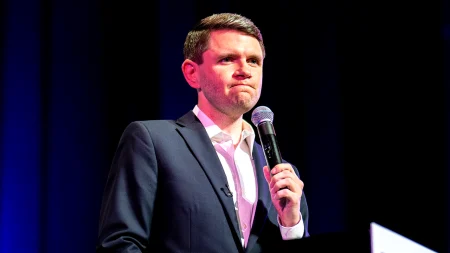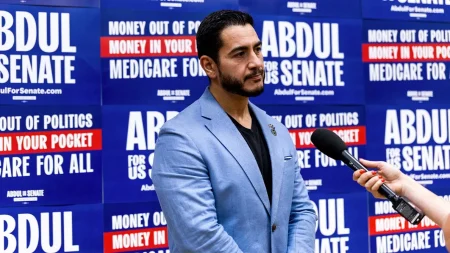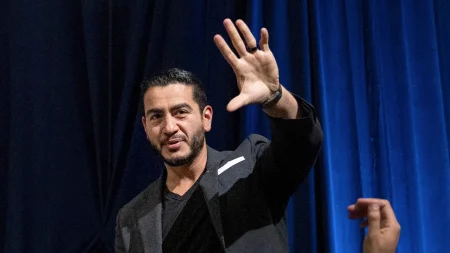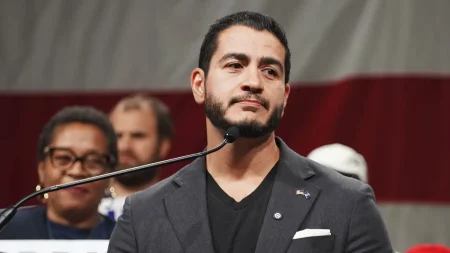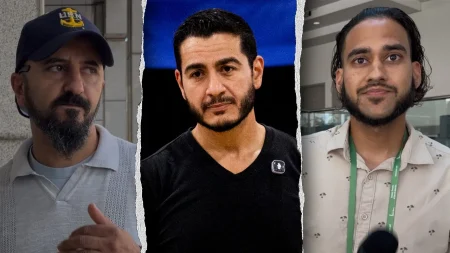






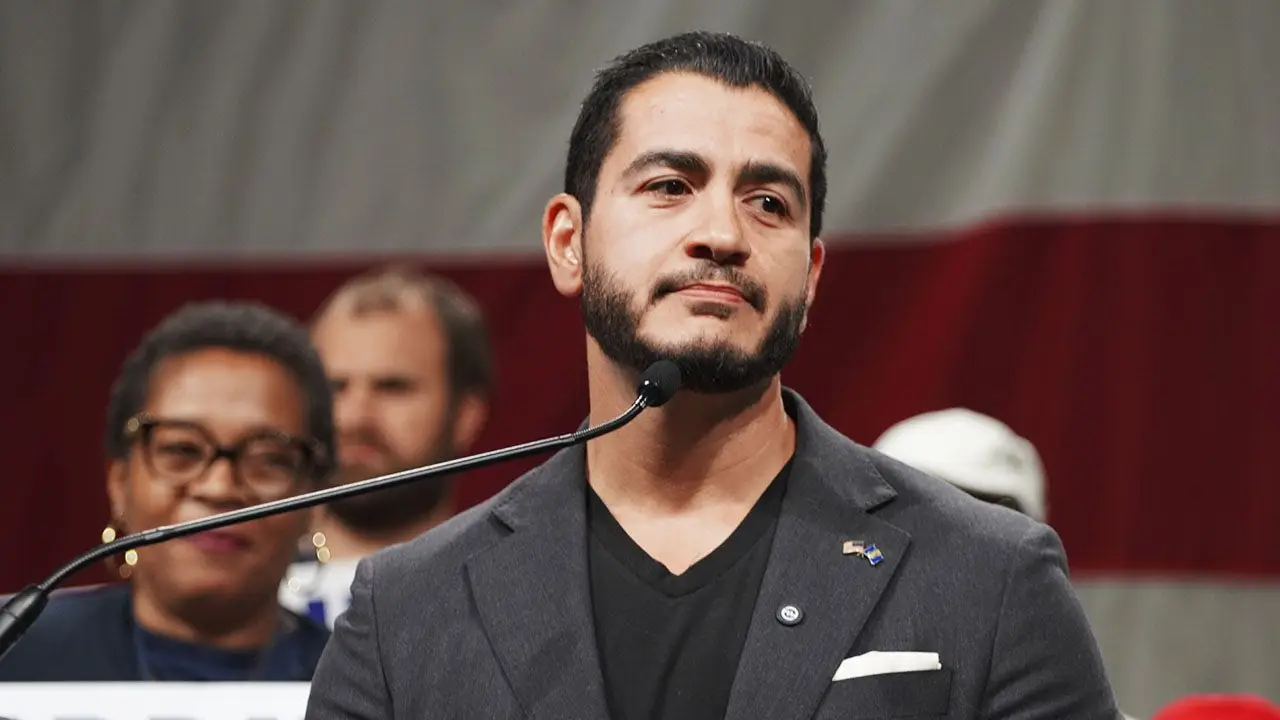
On a sweltering Tuesday evening in Detroit, an empty podium told part of the story. Abdul El-Sayed, the Democratic nominee for Michigan’s open U.S. Senate seat, stood alone on the debate stage, ready to make his case to voters. His Republican opponent, Mike Rogers, was nowhere to be found. Rogers had been invited to the FOX 2 Detroit debate on Aug. 5, the day after Michigan’s primary, and El-Sayed had accepted almost immediately. But Rogers never formally declined until the morning of the event, citing concerns that moderator Roop Raj was biased against him. So instead of a classic head-to-head showdown, voters got something stranger and more revealing: an hour-long, unopposed interrogation of one candidate, with the other candidate’s absence hanging over every answer. For El-Sayed, it was a chance to finally address some of the most uncomfortable questions that have dogged his campaign—questions about a controversial left-wing streamer, his views on Israel, his campaign money, and his alleged socialist ties. But it was hardly a friendly forum. The moderator pressed hard, the studio audience listened closely, and El-Sayed sometimes gave answers that were more artful than direct.
The most explosive topic was Hasan Piker, the hugely popular Twitch streamer whose online commentary has repeatedly sparked outrage. Piker has millions of followers, but he has also made remarks that many Jewish Americans found deeply offensive, including comments about Jewish people and about 9/11. Two days before the debate, El-Sayed had appeared on CBS’s “Face the Nation” and seemed reluctant to fully condemn Piker. On Tuesday night, Raj asked him directly: Can you “completely, 100%” disavow the offensive comments? “Absolutely,” El-Sayed said. He then went further, specifically addressing Piker’s recent remarks about Jewish Americans and Jewish Michiganders, saying he disavowed them “entirely.” He acknowledged that there were “many, many things” Piker had said that he disagreed with, including the comments about 9/11. But even as he drew that line, El-Sayed refused to write off Piker or his audience. He argued that speaking with someone does not mean endorsing all of their views, and he framed his willingness to engage with the streamer as an attempt to offer Piker’s millions of followers “a pathway back into our politics.” It was a delicate dance—condemning the words while defending the relationship—and it showed just how much pressure El-Sayed is under from Jewish voters and pro-Israel groups who see Piker as beyond the pale.
The tension only deepened when the conversation turned to Israel. Raj pressed El-Sayed on whether the United States should continue recognizing Israel as a Jewish state. It was a yes-or-no question, but El-Sayed did not give a yes-or-no answer. Instead, he spoke about equal rights to peace, dignity, and self-determination for both Palestinians and Jewish Israelis. Then he turned the question around, suggesting that the very premise was designed to force people to accept an unjust status quo. “People ask this question about the right of the state that actually exists to exist, but I never get asked about the right of the state that does not exist to exist,” he said. He pointed out that no one asks him whether the state that exists has a right to use American tax dollars “to do heinous things,” or whether kids in Detroit have a right to their own tax dollars. For El-Sayed, the issue was not just about Israel and Palestine—it was about who gets to define the terms of the debate. His refusal to answer directly may frustrate voters who want clarity, but it also reflects the tightrope he walks in a state with significant Arab American and Muslim populations, many of whom are deeply critical of Israel, alongside a Jewish community that wants assurances about the U.S.-Israel relationship. He has tried to position himself as a bridge between those worlds, but nights like this show just how hard that is.
Campaign money was another flashpoint. Fox News Digital had previously reported that El-Sayed’s campaign received more than $115,000 from at least 41 individuals who worked for, previously worked for, or held leadership roles with the Council on American-Islamic Relations, or CAIR. CAIR has faced years of controversy, including allegations of ties to Hamas, a designation as an unindicted co-conspirator in the 2007 Holy Land Foundation terrorism-financing case, and terrorist designations by the United Arab Emirates and by state officials in Florida and Texas. When Raj asked El-Sayed whether he would return those contributions, El-Sayed did not give a direct answer. Instead, he defended CAIR as a civil rights organization and accused Rogers of trying to turn the election into a “culture war” focused on El-Sayed’s ethnicity and Muslim faith. He said Rogers wanted to make the race “about the color of my skin or how I pray.” But El-Sayed was also happy to attack Rogers over money. He repeatedly criticized the Republican for being beholden to corporations and questioned Rogers’s attendance at fundraisers hosted by the American Israel Public Affairs Committee, or AIPAC. El-Sayed has previously called AIPAC donations “legalized bribery,” and on Tuesday he seemed to suggest that Rogers had no moral high ground when it came to campaign finance. The exchange captured the broader theme of the night: two candidates accusing each other of selling out, but only one of them was in the room to defend himself.
El-Sayed also faced questions about his relationship with the Democratic Socialists of America, or DSA. He has repeatedly rejected the socialist label and described himself as a capitalist, but his history with socialist organizations has followed him throughout the campaign. On Tuesday, he was direct: “I’m not a part of the organization.” But he did not stop there. He went on to defend his view of capitalism, arguing that the real threat to free markets is not government regulation but corporate consolidation. “We don’t live in capitalism. We live in corporatism,” he said. “You don’t have to be a socialist to believe that people deserve health care. You don’t have to be a socialist to believe that we need good roads.” It was a populist appeal aimed at working-class voters, and it allowed him to distance himself from the socialist label while still embracing the kind of progressive policies that socialists support. Still, the questions did not come out of nowhere. Fox News Digital previously reported that El-Sayed spoke at six events held by DSA chapters between 2017 and 2020, including a 2019 fundraiser where he served as the keynote speaker. Socialist organizers have described him as a “longtime friend of Detroit DSA,” though El-Sayed told the Wall Street Journal in July that he was “not technically or practically DSA.” The DSA has not endorsed his Senate campaign, but prominent democratic socialists have supported him or been affiliated with his candidacy. For El-Sayed, the distinction between being a member and being an ally is crucial—but his critics see it as a semantic dodge.
By the end of the night, the debate was less about Mike Rogers and more about what Abdul El-Sayed believes, who he associates with, and how he handles pressure. He tried to turn the evening into a statement about inclusion, saying he believes in an America that is big enough for everyone, including Mike Rogers, Donald Trump, and JD Vance. He accused his opponents of believing that “some people are more American than others” and of thinking that if you pray differently or your family comes from somewhere else, there is “an asterisk on your American identity.” Raj pointed out that JD Vance is the father of children with an Indian-American woman, and that the second lady is an Indian-American woman who came to this country. El-Sayed acknowledged that there is diversity within the Republican Party. But his broader point was clear: he sees himself as the candidate of a multiracial, multi-faith coalition, and he sees Rogers as the candidate of exclusion. The two men are scheduled to meet again on Oct. 8 in Grand Rapids and Oct. 21 in Detroit, but after Tuesday’s no-show, it is unclear whether those debates will happen. For now, El-Sayed got his moment on stage, alone, under the lights, answering the hardest questions his opponents could ask. Whether that helps him or hurts him in November is still an open question—but at least he showed up.