






The U.S. Senate was supposed to be the place where cryptocurrency finally grew up, shedding its rebellious, unregulated adolescence and stepping into the orderly world of American finance. A sweeping bill known as the Clarity Act, championed by President Donald Trump and backed by some of the biggest names in the digital asset industry, was the vehicle for that transformation. For more than a year, Senator Cynthia Lummis, a Wyoming Republican and the bill’s primary architect, had worked to craft a package that would fold crypto into the nation’s existing web of financial rules, giving investors, businesses, and regulators a clear map for the road ahead. But on Tuesday, that carefully built momentum slammed into a wall. The bill failed to clear a key procedural hurdle in the Senate, meaning it couldn’t move to formal debate and amendment. Democrats, for the most part, delivered the fatal blow, but a handful of Republicans with lingering doubts also refused to get on board. And with the Senate calendar already crowded and the midterm elections looming, there was little hope of reviving it. Lummis, exhausted and blunt, declared the effort dead. “I think we’re done. It’s over,” she said. When asked whether the bill would ever return to the floor, she simply replied, “Nope.” It was a stunning collapse for a measure that had seemed destined for at least a real fight, and it left the future of crypto regulation in the United States more uncertain than ever.
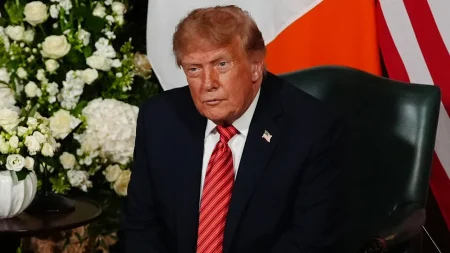
The opposition was not a single, tidy block. Among Senate Democrats, one of the biggest sticking points was ethics, specifically the language intended to slow down the Trump family’s rapidly expanding crypto empire. That concern wasn’t abstract. According to President Trump’s financial disclosure forms, his income exploded between 2024 and 2025, jumping from just over $620 million to roughly $2.2 billion, a surge of about 250 percent. Much of that increase came from his various crypto ventures, which are managed by his sons, Don Jr. and Eric. For Democrats, that created an uncomfortable conflict: the president was not only endorsing a major piece of financial legislation, he was also personally and financially invested in the very industry it would regulate. Senator Cory Booker, a New Jersey Democrat, told Fox News Digital before the vote that he hadn’t even seen the final version of the bill, but what he had seen was troubling. “I haven’t seen the final bill yet, but what I’ve seen is bad,” he said. The ethics provisions, which were added in an attempt to address these very concerns, simply didn’t go far enough for Booker and many of his colleagues. They worried that the bill would bless an arrangement in which a president’s family could profit handsomely from a regulatory framework being written in his own administration. That perception problem, more than any single technical flaw, made it nearly impossible for the bill to win Democratic support.
Other Democrats focused on a different set of fears: that the Clarity Act would make it easier for criminals, terrorists, and foreign bad actors to move money around the world without detection. Senator Andy Kim, a New Jersey Democrat, was among those who wanted much stronger guardrails against money laundering and illicit finance. He noted that he had only reluctantly supported the earlier GENIUS Act, a separate crypto-related measure, and he was not about to repeat that experience without meaningful changes. “I have not seen the kind of engagement yet from the Republican side when it comes to countering terrorist financing and cartel financing. That would get me to a yes,” Kim said. “I’m still engaged. I didn’t get on board with the GENIUS Act till the very last vote.” His words captured a broader frustration among Democrats: the bill seemed to prioritize industry growth and innovation over protecting the financial system from being exploited. They wanted to see tougher enforcement tools, clearer reporting requirements, and stronger cooperation with international regulators. Without those provisions, they argued, the bill was less about bringing crypto into the light and more about handing the industry a rubber stamp. For many Democrats, the choice was simple: better to have no bill than a bill that left dangerous loopholes wide open.
But it wasn’t just Democrats who had misgivings. A small group of Republicans also balked, and their concerns added another layer of complexity to the math. Senator John Cornyn, a Texas Republican, was still undecided right up until the vote. He worried about how bringing crypto into the regulated banking system might affect deposit yields at community banks, a bread-and-butter issue for smaller financial institutions in his home state. He also wanted stronger assurances that digital currencies wouldn’t be “diverted for criminal purposes.” Yet even with those concerns, Cornyn believed the right move was to let the bill proceed and then improve it through amendments. He pointed to an older, more collaborative style of legislating, where the Senate would vote to begin debate, offer changes, and then make a final judgment. “What we used to do around here is something called legislate,” Cornyn said. “You know where you’d actually vote to get on the bill, but then you amend it, and then you decide whether you’re going to support it on the back end.” His frustration was palpable: the procedural vote, which required 60 votes to advance, had become an all-or-nothing moment, and there was no room for the messy, iterative work that once defined the Senate. In the end, even a midnight-hour update designed to win over fence-sitters couldn’t bridge the divide. Lummis and her allies had already accommodated more than 120 requests from critics, and she made it clear that she had reached the limit of her patience.
The failure of the Clarity Act doesn’t exist in a vacuum. The Senate is now facing a crowded and politically charged agenda, with midterm elections fast approaching and no shortage of major legislative priorities demanding attention. Every failed bill consumes time and political capital, and leaders are already looking for the next thing they can actually pass. For Republican leadership, that means pivoting to a cause with broad, bipartisan appeal: college sports. Senator Ted Cruz, a Texas Republican, has been pushing a bill designed to protect student-athletes and rein in the enormous sums of money flowing through collegiate athletics. Senate Majority Leader John Thune, a South Dakota Republican, indicated that the collapse of the crypto bill opens the door to move forward on that effort. “We committed to ensure that we got a vote on college sports,” Thune said. “So we’ll see if we have 60 [votes]. I don’t know the answer for sure to that yet. I hope we do.” The shift is telling. Crypto regulation, once seen as a future-defining issue, has become just another casualty of a divided and time-poor Senate. For the cryptocurrency industry, the defeat is a serious setback. Without a clear federal framework, companies continue to operate in a patchwork of state rules and uncertain enforcement, facing the constant threat of lawsuits, investigations, and sudden regulatory changes. The lack of clarity makes it harder for American businesses to compete globally, drives innovation overseas, and leaves everyday investors vulnerable to fraud and volatility.
In the end, the story of the Clarity Act is a reminder that in Washington, even the most powerful backing and the most elaborate negotiations can collapse under the weight of distrust, timing, and competing priorities. President Trump wanted a signature achievement in the crypto world. Industry leaders wanted legal certainty. Senator Lummis wanted to build a legacy as the person who finally gave digital currency a proper home in American law. Instead, all they got was a procedural defeat and a terse “it’s over” from the woman who spent a year trying to make it happen. The bill’s demise also exposes a deeper truth about modern American politics: lawmaking is not just about policy, it’s about relationships, incentives, and the willingness to take risks. Democrats weren’t willing to hand Trump and his family a victory they feared would be exploited. Republicans weren’t willing to ignore the concerns of their own base or the banks in their districts. And the calendar, as always, was unforgiving. Crypto will not disappear, of course. The technology is too embedded in the global economy, too popular with younger investors, and too lucrative for major financial players to ignore. But for now, it will remain in a strange limbo, neither fully embraced nor fully rejected by the federal government. That uncertainty may be the most predictable outcome of all: in a polarized Senate, where every vote is a political calculation, the easiest decision is often no decision at all. The Clarity Act is dead, but the question of how America should handle crypto is far from settled.