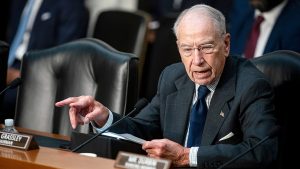






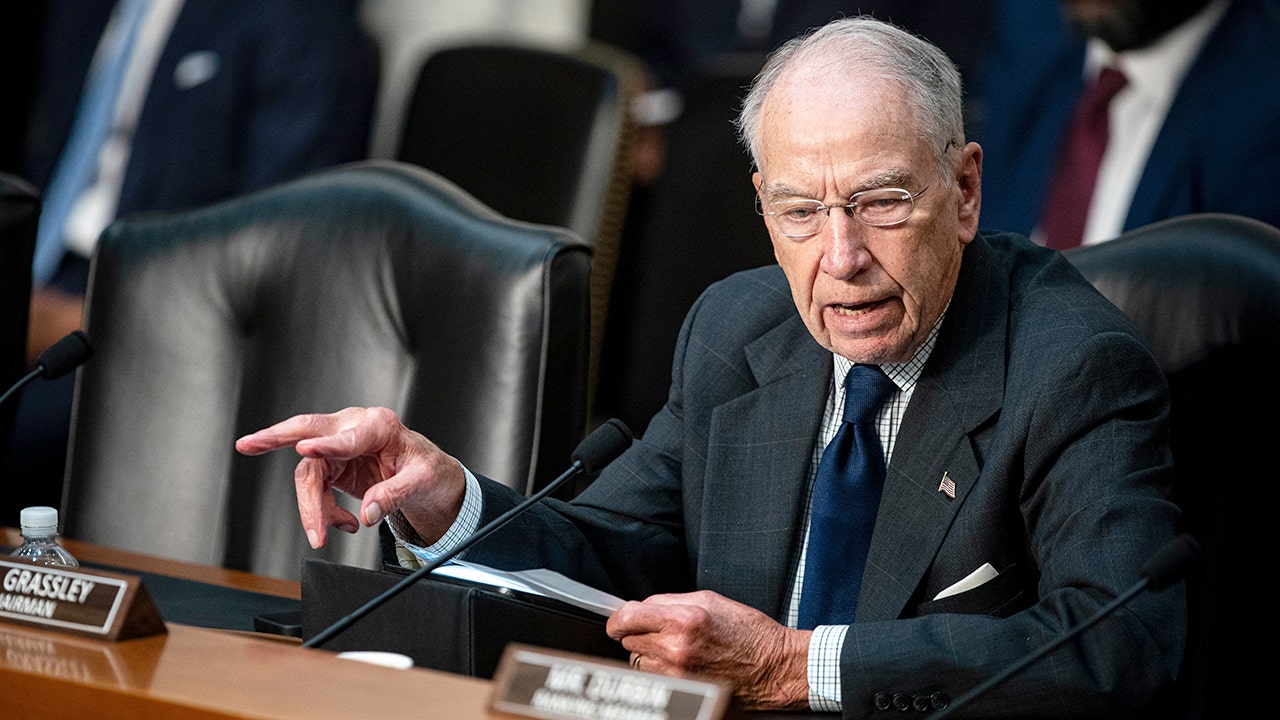
One afternoon in a crowded Senate hearing room, Chuck Grassley, the fiery Republican senator from Iowa, held up a stack of unclassified emails and declared that they were proof of something far darker than political scandal. The emails came from the heart of Operation Crossfire Hurricane, the Justice Department investigation launched during the Obama administration to determine whether Donald Trump’s 2016 presidential campaign had colluded with Russia. For years, Grassley and other Republicans had argued that this investigation was never a good-faith effort to protect national security, but rather a weaponized operation designed to sabotage a sitting president and his supporters. Now, with a new batch of messages between FBI agents, Grassley said he had finally exposed what he called the “Deep State” in action. It was a dramatic moment, complete with a familiar cast of characters: agents, accusations, political firestorms, and a former president who turned the entire saga into a rallying cry. But the truly striking part of the document release was not just its focus on the past. Tucked inside the emails was a request from a former FBI agent to open a criminal investigation into Elon Musk—the billionaire leading the Department of Government Efficiency, or DOGE, under the second Trump administration. In Grassley’s telling, this single email proved a dangerous pattern: a government apparatus willing to twist federal power against the president’s political enemies. “The previous Democrat administrations under Obama and Biden conducted secret, insidious and downright evil operations that almost took down our government,” Grassley said at the Oversight hearing with FBI Director Kash Patel. “That’s arguably worse than Watergate.”
To understand why these emails matter, you have to remember the chaotic climate of 2016 and the years that followed. Operation Crossfire Hurricane began as a probe into whether members of the Trump campaign had coordinated with Russian interference in the election. It consumed Washington, produced endless headlines, and was eventually handed off to special counsel Robert Mueller in May 2017. Mueller’s investigation lasted nearly two years, finding that Russia did interfere in the 2016 election but ultimately not establishing that the Trump campaign conspired with Moscow. Yet the investigation left a permanent scar on American politics, convincing millions of Americans that federal agencies had been secretly aligned against the president. Grassley, as chairman of the Senate Judiciary Committee, has spent years trying to document that suspicion. He has released repeated rounds of FBI documents, many connected to Crossfire Hurricane and other operations like Arctic Frost and Round River, all in an effort to show that the Justice Department was being used as a political hammer. “The overall sustained efforts by the Deep State in the dark corners of the bureaucracy is worse than anything Trump has been accused of,” Grassley said. “At least he’s upfront and open so people can judge.” It’s a powerful line, but the documents themselves are what give it teeth. They show agents, often behind closed doors, expressing enthusiasm for investigating political figures, using theories that critics say would never have survived scrutiny if the target had been a Democrat.
At the center of this latest release are three former FBI agents: Kevin Gounaud, Walter Giardina, and Timothy Thibault. Gounaud, who left the bureau in February, became the face of the most bizarre email in the batch. The story starts in the winter of 2025, when Musk, acting as a special government employee overseeing DOGE, announced on his social media platform X that every federal employee would be expected to report five things they had accomplished in the past week. It was a blunt, unorthodox management move, and it infuriated many bureaucrats. But Gounaud, according to the emails, saw something more sinister. He wrote to fellow agents proposing a criminal investigation of Musk, arguing that Musk’s use of X, a private platform he owned, meant he could profit from official government business. “Musk used a non government system (twitter) to relate information that allegedly was for official purposes,” Gounaud wrote. “In doing so, because he is monetized (he is a majority owner of twitter) he likely generated income for himself based on Twitter’s monetization model and/or advertising revenues.” Then came the comparison that made Grassley laugh out loud: “His use of twitter in this and other instances is conceptually similar to Hillary Clinton’s misuse of a private email server for government business.” Remember, Clinton’s email server became a massive political scandal that dominated 2016. To equate Musk’s tweet about work accomplishments with Clinton’s use of a private server was, to Grassley, just plain absurd. He mocked the agent in a post on X: “Here is an email I released 2day showing an FBI agent who was ready2 open a CRIMINAL CASE all bc Elon Musk asked govt bureaucrats 2 report 5 things they did in a wk. Compare that 2 Iowans who work frm sunup to sundown EVERY DAY Washington rlly is an island surrounded by reality.”
But Gounaud was not the only one whose actions raised eyebrows. The document dump also revealed that Walter Giardina, an agent who was later fired by FBI Director Kash Patel over accusations of political weaponization, emailed at least seven times over a four-week period beginning in January 2017, begging to be assigned to the Crossfire Hurricane investigation. This was no small detail. At the time, the investigation was transitioning into what would become the Mueller probe, and Giardina was eager to be part of it. The emails show Giardina in correspondence with Timothy Thibault, another agent who had previously been accused by Grassley of violating the Hatch Act, which forbids federal employees from engaging in partisan political activity. That accusation stemmed from Thibault resharing a post on Twitter from the Lincoln Project, a group of anti-Trump Republicans, which called the president a “psychologically broken, embittered, and deeply unhappy man.” The U.S. Office of Special Counsel investigated and ultimately dismissed the claim, but the pattern, Grassley argued, was troubling. Here were agents with obvious political leanings, actively seeking to join high-profile investigations involving politicians they disliked. Giardina also sent several emails to former Supervising Agent Joe Pientka, who had been involved in the earlier Russia probe. The sheer persistence of Giardina’s requests—seven emails in a single month—suggested more than professional ambition. It suggested a hunger to be at the center of a story that could define the future of a presidency.
Grassley’s larger point, however, goes beyond these individual emails. He has long argued that the FBI’s public insistence, repeated by officials over the years, that “agents don’t get to pick their cases” is a myth. The documents, he says, prove otherwise. Here was Gounaud, eager to open a case against Musk. Here was Giardina, desperate to work on Crossfire Hurricane. And in earlier releases, the committee had also flagged an effort to open an investigation into Senator Kyrsten Sinema, then a Democrat who later became an independent. Taken together, Grassley argued, all of this undercuts the narrative that the FBI is a neutral, nonpartisan institution. He noted that, based on records known to date, Gounaud’s proposed case against Musk didn’t advance. But the attempt alone, he said, was enough to expose the mindset. “His efforts, as well as the case he tried to open on Senator Sinema, undercut public statements by former FBI officials that agents don’t get to pick their cases,” Grassley said. The implication is sobering: if a career FBI agent felt comfortable floating an investigation into the world’s richest man simply because he was working for President Trump, what else was happening in the dark corners of the federal bureaucracy? The question hangs over every document release, every headline, and every hearing. Grassley wants Americans to believe that this is systematic, not isolated—a machine that turns the machinery of justice into a political weapon for the party in power.
The broader pattern is what makes this story so human, and so unsettling. Over the past decade, Grassley and the Senate Judiciary Committee have steadily released documents from a variety of FBI operations, including Arctic Frost and Round River, painting a picture of federal law enforcement agencies that are willing to cross lines when they believe their political opponents are a threat. The emails from Crossfire Hurricane are part of that larger mosaic. To Grassley, the same bureaucratic impulse that drove agents to investigate Trump in 2016 is the same impulse that led Gounaud to investigate Musk in 2025. It doesn’t matter whether the target is a real estate magnate turned president or a tech entrepreneur tasked with slashing government waste. What matters is the assumption that political opponents can be investigated, and that the immense power of the FBI can be used to quiet, embarrass, or destroy people who stand in the way of the administrative state. In his hearing with Director Patel, Grassley drew a direct line from the Obama-era investigation to the modern-day DOGE fight, arguing that the “Deep State” never went away—it simply adapted. He went so far as to call the conduct “worse than Watergate,” a reference to the scandal that brought down President Richard Nixon and unleashed a wave of institutional reform. But Watergate, Grassley said, was different because Nixon’s sins were revealed by brave whistleblowers and then corrected. What happened under Obama and Biden, he claimed, was more insidious because it was secret, sustained, and protected by the very agencies meant to enforce the law.
When the dust settles, the question is what all of this means for the average American. For Grassley, the answer is simple: trust in government is earned only when power is held accountable. The release of these emails, he says, is not about relitigating 2016 or settling scores with Hillary Clinton or Robert Mueller. It’s about showing the public that federal agents are not above politics, and that the FBI must be watched just as carefully as it watches others. The Fox News Digital report noted that the FBI had not commented on the latest release, and no doubt supporters of the bureau will point out that an agent’s email requesting an investigation is not the same as an investigation actually opening. But Grassley’s point is more subtle: even a request that goes nowhere reveals a culture. It reveals what agents think is acceptable, what they believe their superiors will tolerate, and how they view themselves as guardians not of justice, but of their own worldview. As he sat in the hearing room, surrounded by clips from other investigations and stories of whistleblowers, Grassley seemed to be delivering a warning. “Washington really is an island surrounded by reality,” he mused, after mocking the FBI agent’s desire to investigate Musk over a simple tweet. That line—part joke, part lament—captures the heart of his argument: ordinary Americans, who work from sunrise to sundown, don’t have time for the political games played by the powerful. They just want to live their lives without being crushed by a government that has forgotten who it serves. The emails, Grassley hopes, will remind them that the battle over justice is not just a game played in faraway courtrooms. It’s a battle for the soul of a nation, and every newly released document is another reason to keep asking questions.