






As autumn settles over Europe, something shifts in the air. The tourist crowds of summer thin out, the strong sunlight softens into a golden haze, and the continent seems to exhale. It is in these cooler months, between October and November, that many travellers turn their attention away from beaches and busy city squares and toward something deeper: culture, heritage, and the stories that shaped the world around us. According to the European Travel Commission, culture and heritage are among the primary motivations for Europeans when planning trips at this time of year, and the data supports what many of us feel intuitively — that there is something special about wandering through an old palace when the leaves are falling and the days are shorter. Travel company TUI Musement has also found that 94% of people say they are interested, or very interested, in experiences connected to history, culture, and heritage during their next city break. Even closer to home, eight out of ten respondents said they have visited a monument or landmark near where they live. There is a hunger for the past, for tangible connections to earlier lives and grander visions, and autumn offers the perfect mood to satisfy it.
To help feed that curiosity, TUI Musement has released a new ranking of the 30 most popular castles and palaces in Europe for 2026, based on the accumulation of Google reviews. By comparing the volume of reviews recorded in 2023 and in the current ranking period, the list reveals not just which monuments are loved, but which ones are rising in the public imagination. Spain emerges as the country with the greatest representation, with six of the 30 castles and palaces located there, including two in the top ten: the magnificent Alhambra in Granada and the Royal Palace of Madrid. Ever-popular Prague Castle manages to hold onto its first-place position, while Schönbrunn Palace in Vienna has climbed into the top three, and Buda Castle in Budapest is the only new entry on the list, thanks to a remarkable 65% increase in accumulated Google reviews compared with 2023. The full top ten reads like a grand tour through Europe’s most evocative spaces: Prague Castle in Czechia, Buckingham Palace in the United Kingdom, Schönbrunn Palace in Austria, the Palace of Versailles in France, Wawel Castle in Poland, the Alhambra and the Royal Palace of Madrid in Spain, the Tower of London in the United Kingdom, Neuschwanstein Castle in Germany, and Bran Castle in Romania. Each one has its own personality, its own ghosts, its own reasons for drawing us in.
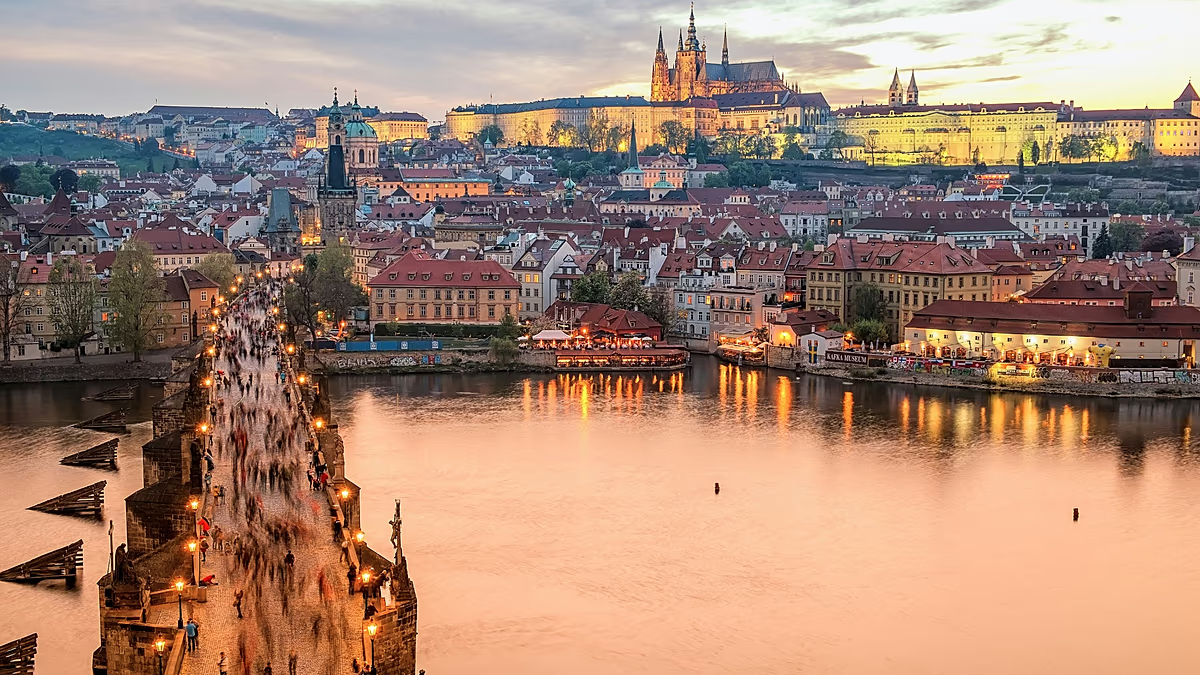
Few travellers who have ever stood before Prague Castle will be surprised to see it in the top spot. With 199,000 Google reviews — a 31% increase over 2023 — it is one of the largest and most historically layered palace complexes in the world. A single visit offers a sweeping journey through centuries of Bohemian and European history, and a ticket takes you through landmarks as varied as the soaring Gothic grandeur of St Vitus Cathedral, the ceremonial halls of the Old Royal Palace, and the impossibly charming, colourful lane known as Golden Lane, where alchemists and artisans once made their homes. It is the kind of place where the past feels alive, not preserved behind glass but woven into the very stones. In second place is Buckingham Palace, arguably London’s most recognisable royal landmark. One of the three official residences of the British monarchy, it is an enormously popular attraction for visitors from across the world. Thousands gather outside its gates each day to watch the Changing of the Guard, tapping their feet to the military band and hoping for a glimpse of the guards in their famous bearskin hats. In the summer, of course, visitors have the rare chance to step inside the building itself and tour its iconic state rooms, where chandeliers blaze, silk walls glow, and the pomp of royal ceremony becomes something you can touch. Then there is Schönbrunn Palace in Vienna, which has climbed two places from its 2023 ranking to claim third. This year, the palace is celebrating the 30th anniversary of its designation as a UNESCO World Heritage Site, and it offers an extraordinarily rich experience of the Habsburg world. Wandering through its endless rooms and across its immaculate gardens, it is not hard to imagine the young Mozart performing for the empress, or Maria Theresa shaping the destiny of an empire. The yellow facade is unmistakable, but the real magic lies in the way it makes history feel intimate.
In fourth place is the Palace of Versailles, an essential chapter in French history and the former residence of the kings of France. To walk through Versailles is to walk through turning points in the fate of a nation. The Hall of Mirrors, with its crystal reflections and painted ceilings, seems to shimmer with the vanity and ambition of Louis XIV, the Sun King, whose absolutism transformed a royal hunting lodge into the most dazzling court in Europe. Yet the same halls also witnessed the fall of the monarchy, and later, the signing of the Treaty of Versailles, which brought the First World War to an end. The palace is vast, but its power lies in how it compresses so much human drama into one breathtaking, manicured landscape. Fifth place belongs to Wawel Castle in Kraków, which has slipped two places since 2023 but still remains one of Europe’s major cultural treasures. Perched on a hill above the Vistula River, Wawel was not only the former residence of Poland’s kings but also the site of their coronations. It is a symbol of national identity, a place where the country’s soul seems to reside. And at the foot of the castle sits the famous Dragon’s Den, a cave with a fire-breathing dragon statue that has become one of the city’s best-loved symbols. It is a reminder that even the grandest palaces have room for folklore, myth, and a little playful imagination. From Poland, the ranking moves to Spain, where the Alhambra in Granada claims sixth place. This extraordinary complex of palaces, gardens, and fortresses is nothing short of breathtaking, a place where water murmurs in marble courtyards, light filters through intricate carved screens, and the mountains of the Sierra Nevada stand watch in the distance. Once home to the Nasrid sultans and later to the kings of Castile, the Alhambra is a poetic blend of Islamic and Christian influences. Its most iconic spaces — the Nasrid Palaces, the Generalife gardens, the Alcazaba fortress, and the Palace of Charles V — each tell their own story of conquest, beauty, and coexistence.
The seventh spot belongs to the Royal Palace of Madrid, which has moved up one position after increasing its number of accumulated Google reviews by 47% since 2023. This vast palace still functions as the official residence of the Spanish royal household, hosting receptions and state events, but members of the public can also wander through some of its most dazzling interiors. The throne room, the Gasparini room with its intricate rococo detail, and the royal chapel are just a few of the highlights that make this palace a celebration of Spanish grandeur. It is a living building, one that continues to participate in history even as it preserves the past. In eighth place, we return to London and the iconic Tower of London. This ancient fortress is a place where English destiny was shaped in the most dramatic and sometimes brutal ways. It was here that Anne Boleyn was executed, here that the young Prince Edward V and the Duke of York disappeared mysteriously, and here that centuries of monarchs fortified their power against enemies both foreign and domestic. Today, it is home to the legendary Crown Jewels, guarded not only by Yeoman Warders in their Tudor uniforms but also by a group of plump, watchful ravens, whose presence, legend says, protects the kingdom. There is a dark romance to the Tower, a sense of secrets and sorrows that clings to its walls and draws visitors into the darker corners of history. Rising to ninth place is Neuschwanstein Castle in the Bavarian Alps, which has climbed the rankings thanks to a significant increase in reviews — and it is easy to see why. With its soaring towers, fairy-tale silhouette, and dramatic alpine setting, Neuschwanstein looks like a castle from a dream. Commissioned by King Ludwig II of Bavaria, known as the “Mad King” or “Swan King,” it was built as a private refuge and a monument to the king’s obsession with art, architecture, and medieval legend. It is said to have inspired Disney’s Sleeping Beauty Castle, and to walk through its halls is to step into a world of romantic longing, myth, and beautiful melancholy.
Finally, rounding out the top ten is Bran Castle in Romania, also famously known as “Dracula’s Castle.” Perched dramatically on a rocky hill in Transylvania, it has become a must-visit for lovers of the spooky and the mysterious. The connection to Bram Stoker’s vampire is more legend than historical fact, but the castle leans into the myth with theatrical flair, and the surrounding landscape — dark forests, jagged peaks, and misty valleys — does nothing to dispel the gothic atmosphere. Beyond the Dracula stories, however, Bran Castle also offers a genuine glimpse into centuries of Romanian history, serving first as a frontier fortress and later as a royal residence. It is a place where the imagination can run wild, but it is also a place of real heritage, full of artefacts and rooms that testify to the resilience and complexity of the people who lived and worked there. Behind the top ten lies a deeper truth: castles and palaces are more than just beautiful buildings. They are repositories of memory, witnesses to triumph and tragedy, and mirrors of the values and ambitions of their time. In autumn, when the crowds have gone and the light is low, they are at their most atmospheric. There is something almost magical about walking through a stone corridor in October, hearing your footsteps echo, and feeling the weight of all the lives that have passed through the same halls. Whether you are drawn by the royal splendour of palaces, the defensive power of fortresses, or simply the chance to stand somewhere older than your own country, these places invite us to slow down and listen. They remind us that history is not a distant, abstract thing — it is something we can walk through, touch, and feel. And as the weather turns cool, there is no better time to pull on a warm coat, step into the past, and let a castle tell you its story.