





The era of explosive post-pandemic travel is officially over. In the first half of 2026, international tourism grew by just 0.4% compared to the same period last year, according to the latest World Tourism Barometer from UN Tourism. That number may seem small, but it speaks volumes about where global travel stands today. After years of pent-up demand, roaring comebacks, and destinations flooded with visitors eager to make up for lost time, the industry has entered a much more cautious phase. Travelers are still moving across borders, but they are doing so more deliberately, influenced by everything from geopolitical tensions and extreme weather to stretched household budgets and shifting tastes. The days of automatic, double-digit growth are gone, replaced by a fragile, uneven, and deeply interconnected tourism landscape. The report, published in mid-September 2026, paints a picture of an industry that is no longer simply rebounding, but recalibrating. It suggests that the global tourism recovery has matured into something more complex, where success depends less on sheer volume and more on adaptability, resilience, and the ability to read a rapidly changing world. For travellers, this means more choices, more unpredictability, and a growing awareness that even the most far-flung destinations are not isolated from global events. For the tourism sector, it means the easy wins are behind them, and the real work of building durable, responsible, and crisis-proof travel economies has only just begun.
Europe, despite the global slowdown, remained a star performer, welcoming around 350 million international tourists between January and June. That is a solid 3% increase over the same period in 2025, and only Africa, with its 4% growth, did better. But behind that encouraging headline figure, the European story was far from uniform. Southern Mediterranean Europe and Central Eastern Europe both posted 4% growth, while Northern Europe managed a respectable 3%. Western Europe, however, saw arrivals fall by 1%, a decline that UN Tourism attributes at least partly to the heatwaves that swept through the region in June and a noticeable drop in long-haul demand during the second quarter of 2026. What does that look like on the ground? Imagine sun-drenched southern cities experiencing scorching temperatures, and travellers deciding to stay closer to home, or heading north, or simply postponing their trips altogether. Imagine long-haul visitors from Asia and the Americas reconsidering expensive, complicated journeys to Europe and opting for shorter, simpler, and often cheaper alternatives instead. The result is a continent where tourism is growing, but not everywhere, not evenly, and not without pain. Some destinations thrived, while others felt the squeeze of climate change and cautious consumers. Western Europe’s dip is a reminder that even the world’s most popular travel region cannot take its appeal for granted. The old assumptions about European tourism, that it will always grow, that visitors will always come, no longer hold. Instead, destinations must compete for attention, offering not just beautiful sights, but comfortable conditions, fair prices, and a sense of safety in an increasingly turbulent world.
Beyond Europe, the global picture was even more striking. The Middle East, which had been one of the fastest-recovering regions in recent years, saw international arrivals plummet by 22% in the first half of 2026. South Asia recorded a 5% decline, and Southeast Asia slipped by 1%. These are not just numbers on a spreadsheet; they represent missing tourists, empty hotel rooms, cancelled tours, and livelihoods under pressure. The causes are complex, but one factor stands out above the rest: regional conflict and its ripple effects. Travel is often the first casualty of instability, and even countries far from the immediate danger zones suffer when airlines reroute, insurance premiums rise, and travellers simply decide to avoid an entire region. UN Tourism Secretary-General Shaikha Al Nuwais captured this reality powerfully, saying: “The Middle East situation has touched destinations far beyond the region itself and serves as a clear reminder that, in such a connected world, resilience needs to be built everywhere and not just when a crisis begins.” Her words are a stark warning to the global tourism industry. No destination is an island. A crisis in one part of the world can reshape travel patterns everywhere. The report also notes that the conflict has partly shifted tourism demand toward nearby and more accessible destinations, especially within Europe and Asia Pacific. That means while some countries lost visitors, others gained as travellers rerouted their plans to places perceived as safer, closer, or more convenient. It is a zero-sum game in some respects, but it is also a reminder that tourism is not just about beautiful landscapes and luxury hotels. It is about perception, trust, and stability. And in a world where disruptions can spread instantly, building resilience has to be a constant practice, not a reactive emergency measure.
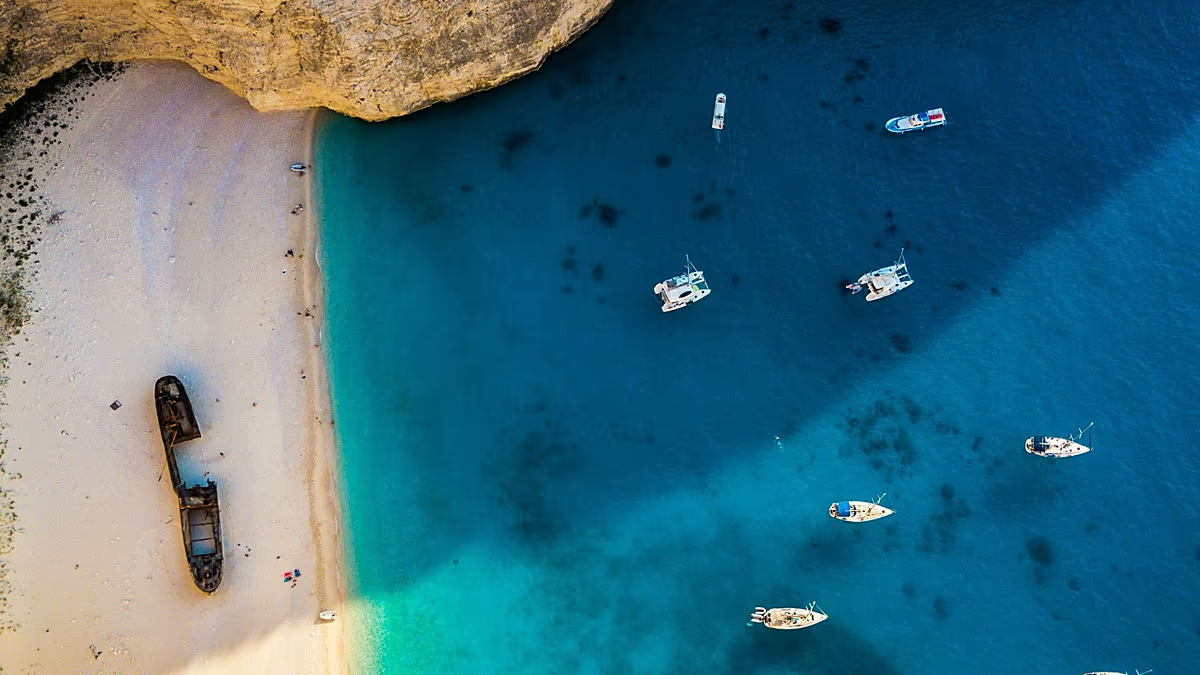
Amid the slowdown, there were still dazzling bright spots, and they reveal a great deal about what modern travellers are looking for. In Europe, Moldova recorded the biggest jump in tourist arrivals, with an impressive 25% rise in the first half of the year. That might seem surprising for a country often overlooked by mainstream tourism, but it makes sense in a world where travellers are increasingly hunting for less crowded, more authentic, and better-value experiences. Greece and Ireland each posted 15% growth, proving that countries with strong cultural identities, reliable tourism infrastructure, and compelling marketing can still pull in visitors even during a global plateau. Globally, the winners are even more diverse and, in many ways, unexpected. El Salvador led the world with a stunning 37% increase, followed by Paraguay at 34%, Bhutan at 31%, Vanuatu at 30%, Palau at 29%, Mongolia at 27%, Uzbekistan at 25%, and South Korea at 21%. These destinations are not the classic playgrounds of international tourism. They are emerging players, lesser-known corners of the world, and countries that have invested heavily in making themselves more accessible, more appealing, or simply more visible. Some have relaxed visa rules, improved airports, or leaned into niche travel markets like adventure tourism, eco-tourism, and cultural immersion. Others have benefited from a genuine curiosity among travellers to see somewhere new before the crowds arrive. The takeaway is clear: while the overall market is growing slowly, it is also fragmenting. The big winners are not necessarily the traditional powerhouses, but the places that offer something different, something memorable, and something that feels, for better or worse, not like everywhere else. This is the new geography of tourism, less predictable, more scattered, but full of opportunity for those willing to adapt.
Looking ahead, the cautious mood is set to persist. UN Tourism projects that international arrivals will grow by only 1% to 2% for the whole of 2026, a significant downgrade from the 3% to 4% growth forecast that was issued back in January. That downward revision matters. It shows that the optimism felt at the beginning of the year has been tempered by reality. Economic uncertainty continues to weigh on consumers, with high inflation, fluctuating exchange rates, and the rising cost of flights and accommodation making overseas trips feel like a luxury rather than a given. Geopolitical tensions remain unresolved, and their effects on travel are proving stubbornly difficult to shake. Climate change is also no longer a distant threat, but a present-day disruptor, with heatwaves, wildfires, floods, and storms already altering travel seasons and driving people away from certain regions. All of these forces are intertwined, and together, they are putting a brake on the industry’s momentum. Yet a 1% to 2% growth is still growth. It is important not to mistake this forecast for a crisis. The tourism industry is not collapsing; it is maturing. It is moving from a phase of reckless, often chaotic expansion into a period of steadiness, where success requires careful planning and genuine adaptability. Destinations that thrive in this environment will be those that listen to travellers, invest in sustainable practices, diversify their source markets, and prepare for shocks before they happen. Those that rely on past glories, endless marketing, or cheap gimmicks will find themselves struggling to keep up. The next few years will not be a golden age of effortless growth, but they may well be a golden age of thoughtful, resilient, and more responsible tourism.
For anyone who loves to travel, or who works in the industry, the message from this report is ultimately about resilience. The numbers tell a story of a world still in motion, but moving carefully, watching the horizon for danger. The near-flat 0.4% growth in the first half of 2026 is not a failure; it is a pause, a breath, a moment of recalibration. It is the sound of an industry learning that it cannot control the weather, the markets, or the geopolitics, but it can control how prepared it is. Secretary-General Shaikha Al Nuwais’s call to build resilience everywhere, not just when a crisis begins, is the defining challenge of our time. For destinations, that means diversifying their tourism products, investing in digital infrastructure, supporting local communities, protecting natural and cultural assets, and creating a genuine welcome that goes beyond hashtags and photo opportunities. For travellers, it means recognising that every trip is a vote, a choice about where to spend money, how to behave, and what kind of tourism to support. The destinations that are growing fastest, from El Salvador to Moldova, are proof that travellers are hungry for authenticity, for safety, for value, and for experiences that leave them richer than they arrived. In a world of uncertainty, that hunger will not disappear. It will only become more selective. The tourism industry’s future belongs not to the biggest, but to the most resilient; not to the loudest, but to the most thoughtful. And for those who are willing to adapt, the road ahead, though slower, is still full of promise.