





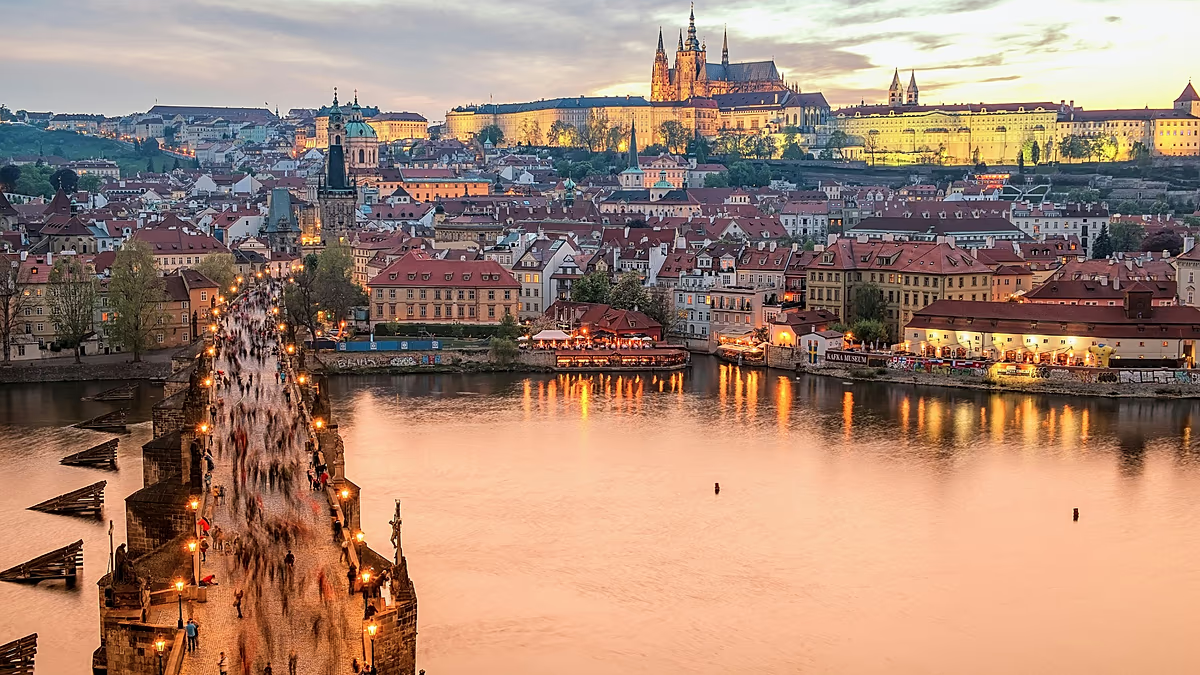
As autumn settles across Europe, bringing crisp air and golden leaves, a different kind of travel story is unfolding. More and more European travelers are choosing to spend their October and November days immersed in culture and heritage rather than simply chasing summer sun. The European Travel Commission has noticed this shift, and its research points to a growing appetite for meaningful experiences over hurried sightseeing. TUI Musement’s latest findings reinforce the idea: 94% of people say they are interested, or very interested, in enjoying history, culture and heritage during their next city break, and eight out of ten respondents admit they have visited a monument or landmark close to where they live. This enthusiasm for the past is the reason behind a new ranking of Europe’s 30 most popular castles and palaces for 2026. The list, compiled by TUI Musement, uses accumulated Google reviews to measure popularity, comparing review volumes from 2023 and 2026. The results reveal a continent rich in royal stories, with Spain leading the way by placing six of its castles and palaces in the top 30. The Alhambra in Granada and the Royal Palace of Madrid both make the top ten, while Prague Castle in Czechia continues to hold the crown as Europe’s most popular castle. Schönbrunn Palace in Vienna has moved into the top three, and Buda Castle in Budapest is the only new entry, thanks to a remarkable 65% increase in Google reviews since 2023. For anyone planning an autumn city break, these numbers are more than statistics. They are a map of the places that speak most deeply to travelers, offering a chance to wander through corridors where emperors once walked, to stand in courtyards where destiny was decided, and to feel the texture of history beneath modern feet.
The top ten list is beautifully varied, stretching from Central Europe to Britain, France, Spain, Germany and Romania. At number one is Prague Castle, a sprawling complex that is as much a small town as it is a fortress. Few who have wandered its courtyards will be surprised to see it at the head of the ranking. With almost 199,000 Google reviews, it has gained 31% more than in 2023, and one visit explains why. The castle holds more than a thousand years of history, and a single ticket lets you explore St Vitus Cathedral, whose Gothic spires dominate the skyline; the Old Royal Palace, where Bohemian kings once ruled; and the enchanting Golden Lane, a row of colorful, tiny houses where castle guards and artisans once lived. It is one of the largest castle complexes in the world, but it never feels overwhelming; instead, it feels like a living chronicle of Czech identity. Right behind Prague is Buckingham Palace, perhaps London’s most recognisable landmark. As one of three official residences of the British monarchy, it draws enormous crowds each year. Thousands come to watch the Changing of the Guard, a ritual of red uniforms and marching bands that has become inseparable from the idea of London. In summer, visitors can step inside the palace and wander through the opulent state rooms, where chandeliers, crimson velvet and gilded ceilings evoke the grandeur of the British crown. The palace is not just a tourist destination; it is a working symbol of constitutional monarchy, where the royal family still carries out official duties. Third place belongs to Schönbrunn Palace in Vienna, which has climbed two spots since 2023. This year marks the 30th anniversary of its designation as a UNESCO World Heritage Site, and the palace offers an intimate look at the Habsburg dynasty that shaped Austrian history for centuries. From the sweeping gardens to the lavishly decorated rooms, Schönbrunn invites visitors into the world of empresses and emperors, where politics and pleasure were woven together in a delicate courtly dance. These three castles and palaces are more than architectural masterpieces; they are places where the past becomes tangible, and where travelers can feel the weight of history beneath their feet.
Fourth on the list is the Palace of Versailles, a name that resonates far beyond France. Versailles is not simply a palace; it is an instrument of power, a monument to the absolute monarchy of Louis XIV, and later a witness to revolution and reconciliation. Its Hall of Mirrors remains one of the most celebrated rooms in the world, where light pours through seventeen arches of glass and reflects off crystal chandeliers and gold-covered details. Visitors can wander through the royal apartments, where every piece of furniture and art was chosen to project authority, and then step outside into the vast, manicured gardens, where fountains and geometric parterres stretch toward the horizon. Versailles tells the story of France from the Sun King’s absolutism to the signing of the Treaty of Versailles in 1919, which ended the First World War and redrew the map of Europe. It is a place where beauty and tragedy coexist, and that complexity is part of its power. In fifth place, Wawel Castle in Kraków may have slipped two positions since 2023, but it remains one of Europe’s major cultural treasures. For centuries, Wawel was the residence and coronation site of Polish kings, a symbol of national pride that survived partition, occupation and war. The castle complex is a layered tapestry of Romanesque, Gothic, Renaissance and Baroque architecture, and at its foot sits the famous Dragon’s Den, a limestone cave beneath Wawel Hill. According to legend, a dragon once terrorized the city, and a statue at the cave’s entrance still breathes fire for delighted visitors. Wawel is not only a monument to monarchy; it is also a symbol of Polish resilience. As the ranking moves to Spain, the sixth and seventh spots are particularly notable. Granada’s Alhambra, standing sixth, is a breathtaking ensemble of palaces, gardens and fortresses set against the snow-capped Sierra Nevada. Built as a seat for the Nasrid sultans, then later claimed by the Catholic kings, the Alhambra is a masterpiece of Islamic art and architecture. The Nasrid Palaces, with their intricate tilework and horseshoe arches, are overflowing with poetic inscriptions; the Generalife gardens offer fragrant walks and serene fountains; the Alcazaba fortress provides panoramic views over the city; and the Palace of Charles V stands as a Renaissance interpretation of imperial ambition. A stone’s throw away in spirit, the Royal Palace of Madrid takes seventh place, one position higher than before, after a 47% surge in Google reviews. Unlike many museums, it still serves as a venue for official receptions and royal household events, yet the public can tour the throne room, the Gasparini room and the royal chapel. Together, these Spanish palaces illustrate a complex history of Muslim and Christian kingdoms, conquest and coexistence, and they have become magnets for curious travelers.
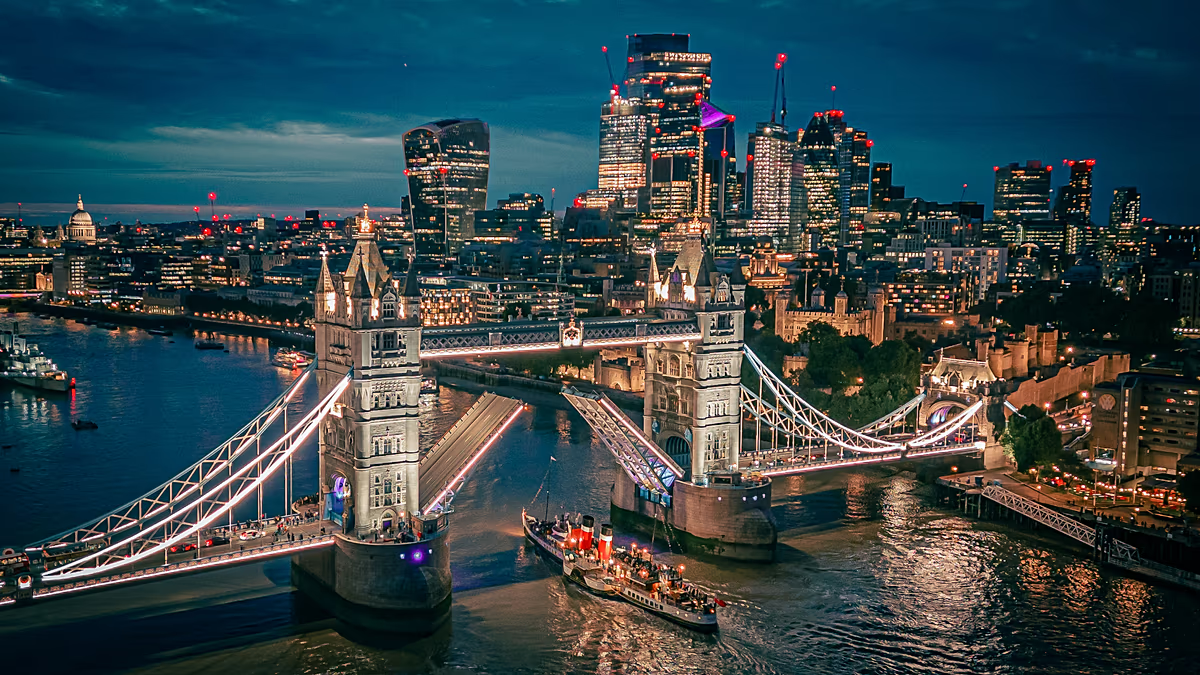
The eighth position returns to London with the Tower of London, a fortress that has served as royal palace, prison, armory and treasury over nearly a thousand years. Its very name evokes execution and mystery. It was here that Anne Boleyn was beheaded, and here that the young princes, Edward V and the Duke of York, disappeared under mysterious circumstances, their fate still debated by historians. The Tower’s thick stone walls and narrow staircases hold secrets that no amount of guided tours can fully reveal. Today, it is perhaps best known as the home of the Crown Jewels, a dazzling collection of crowns, sceptres and orbs still used in coronation ceremonies. The Yeoman Warders, known as Beefeaters, march through the courtyards in their Tudor uniforms, and a group of ravens live within the grounds, protected by superstition that the kingdom will fall should they ever leave. There is something haunting yet fascinating about the Tower; it forces visitors to confront the darker chapters of English history while also marvelling at the beauty of royal regalia. Ninth place belongs to Neuschwanstein Castle, perched dramatically in the Bavarian Alps. This is the castle that seems to have stepped out of a fairy tale, with white towers and turrets rising above forests and waterfalls. It was commissioned by King Ludwig II of Bavaria, a man often called the “Mad King” or the “Swan King” for his eccentric, introverted nature and his obsession with art, architecture and medieval legends. Ludwig filled his dream palace with murals depicting the operas of Wagner, whom he passionately supported, and with rooms that evoke an imaginary medieval world. Neuschwanstein is not a fortress in the traditional sense; it was built as a fantasy, a private refuge for a king who preferred myth to politics. It has become one of the most photographed buildings in Europe, and its popularity continues to grow as more and more travelers leave reviews after gazing at its fairytale silhouette. Finally, rounding out the top ten is Bran Castle in Romania, often called “Dracula’s Castle.” Perched on a rocky cliff in Transylvania, it is inseparable from Bram Stoker’s vampire legend, even though the historical connections are complex. For travelers with a taste for the spooky, Bran Castle is a must, and the surrounding region has become a pilgrimage site for fans of gothic fiction. Yet beyond the Dracula myth, Bran Castle holds genuine Romanian history. It served as a frontier fortress protecting the mountain passes, and later became a royal residence beloved by Queen Marie of Romania. Its rooms are filled with furniture, weapons and art that tell a more nuanced story, one of border defense, commerce and royal family life. The castle’s presence in the top ten reflects a broader truth: travelers are drawn to places where history and legend intertwine, where reality is stranger than fiction, and where the landscape itself feels enchanted.
Beyond the top ten, the overall ranking offers a fascinating snapshot of what European travelers are flocking to see. Spain’s strong presence, with six castles and palaces in the list of thirty, speaks to the country’s rich and layered past, as well as its success in preserving and promoting historic sites. The United Kingdom and Germany also feature heavily, but the changes since 2023 are just as interesting as the positions themselves. The fact that Buda Castle in Budapest made its first appearance with a 65% increase in reviews suggests that travelers are rediscovering the Hungarian capital and its royal heritage. The Alhambra and the Royal Palace of Madrid continue to climb, powered by word-of-mouth and social media, while Schönbrunn’s rise to third place indicates a growing interest in the Habsburg legacy. Some attractions have slipped in the rankings, but that does not mean they are less loved; it simply means that the field is getting more crowded, and that more castles and palaces across Europe are capturing the public imagination. This is largely due to the way people travel today. A city break is no longer just about meals and shopping; it is about visiting monuments that have stood for centuries, understanding why they were built, and connecting with the stories of the people who lived and died within their walls. The booking data from TUI Musement supports this, showing that 94% of respondents are actively seeking cultural experiences. Even more telling is that eight out of ten people say they have visited a monument or landmark close to where they live. That local curiosity is important. It means heritage tourism is not just an international phenomenon but a personal one. People are realizing that history is all around them, and that a castle can be both a distant dream and a familiar neighborhood treasure. Autumn is particularly well suited to this kind of travel. The summer crowds have gone, the weather is crisp and often golden, and the softer light makes ancient stone look even more magical. A visit to any of these places in October or November feels more intimate, more contemplative, more like stepping into another time. The ranking, then, is more than a popularity contest; it is an invitation to slow down, look upward, and let the centuries speak.
In the end, these castles and palaces are much more than tourist stops. They are living monuments, places where the ambitions of kings and queens, the faith of entire peoples, and the everyday lives of servants, soldiers and artisans are layered into every stone. As autumn settles over Europe, from the leaf-strewn paths of Prague to the misty hills of Transylvania, travelers are rediscovering the value of heritage. The research from the European Travel Commission and TUI Musement confirms what many have always felt: culture is not a niche interest but a central motivation for travel. When we visit a place like Buckingham Palace or the Tower of London, we are not just checking a box; we are participating in a shared human story. When we wander through the halls of Schönbrunn or the gardens of Versailles, we begin to understand how power, beauty and memory shape nations. And when we stand before the Alhambra or Neuschwanstein, we are reminded that beauty can be born from very different visions of the world, Islamic and Christian, real and imaginary. The ranking of Europe’s most popular castles and palaces for 2026 is a useful guide, but it is also a celebration of the continent’s astonishing diversity. Spain’s six entries, Germany’s fairy-tale fortresses, Romania’s gothic citadels, and Poland’s royal hilltop all have something unique to offer. There is no single type of castle that defines Europe; there are only endless variations on a theme of permanence and imagination. So this autumn, whether you are a seasoned traveler or someone who has never thought much about palaces, consider adding one of these places to your itinerary. You may be surprised to find that the past is not as distant as it seems. The stones are still warm, the courtyards still echo with footsteps, and the stories, like the castles themselves, have stood the test of time. All you have to do is go and listen.