




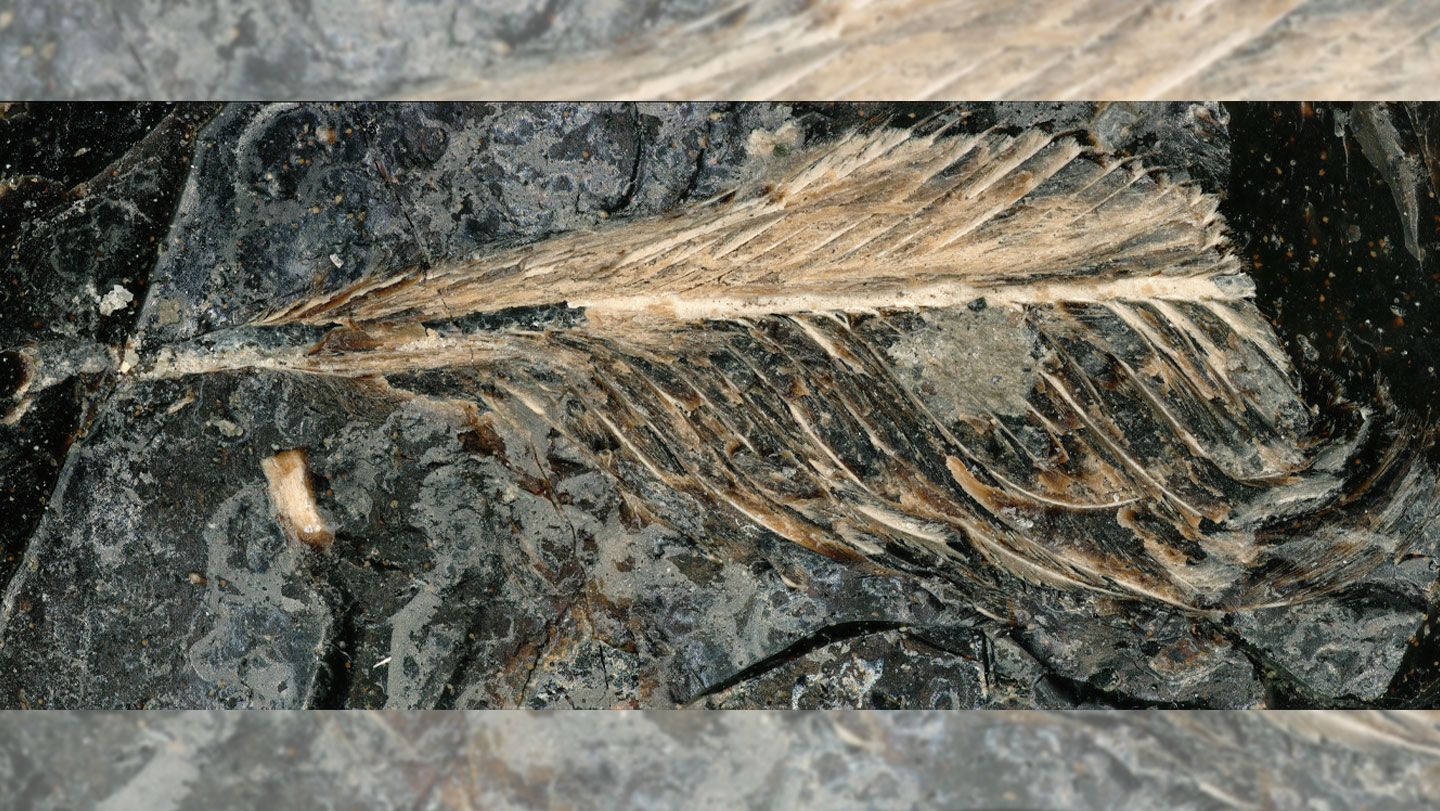
Think of all the ways an ancient animal can vanish without a trace. Bones weather away, skin decays, and even the most beautiful feathers eventually turn to dust. But every once in a while, nature finds an odd way to preserve a moment from deep time. In a chunk of fossilized dung found in Montana’s Hell Creek Formation, scientists have discovered the first feathers ever recovered from ancient animal feces—an extraordinary stroke of luck that is offering a rare glimpse into the lives of birds that lived alongside dinosaurs. The exquisitely preserved plumage, reported September 10 in Current Biology, includes dense, bristle-like feathers that may have repelled water as effectively as those of a modern pelican. It also contains feathers with air-filled central shafts, a feature that helps living birds keep their plumage light enough for flight but stiff enough to hold their shape. According to vertebrate paleontologist Jingmai O’Connor of the Field Museum of Natural History in Chicago, that combination has never been seen before in fossils from the Age of the Dinosaurs. The find is not just a curiosity; it may help explain why some ancient birds survived the mass extinction 66 million years ago while others, including the bird that left this dung behind, disappeared forever. Feathers are among the most fragile of animal tissues, and their preservation in any fossil is rare. To find them inside a coprolite, where digestive acids and bacteria would once have been at work, seems almost impossible. Yet there they were, so well preserved that researchers could study their microscopic structure. The discovery is a reminder that fossilization is not always a neat process of bones turning to stone; sometimes it is messy, strange, and wonderfully surprising.
The feathers themselves are a study in contradictions. Some are highly evolved, with tightly packed bristles that would have made them excellent at shedding water—imagine a cormorant or pelican emerging from a lake with dry, buoyant plumage. Others are more primitive and stringy, closer to the downy, disorganized feathers of early birds than to the sleek, aerodynamic feathers we see today. The presence of air pockets inside the central shafts is particularly striking. In modern birds, those hollow spaces are what allow a feather to be both sturdy and light, a crucial adaptation for powered flight. Finding that same structural sophistication in a bird from the Cretaceous is a reminder that ancient birds were not all clumsy, transitional creatures; some had already evolved remarkably modern features. O’Connor’s surprise at seeing this for the first time in the dinosaur era underscores how little we still know about the soft tissues of ancient animals. Feathers rarely fossilize, and when they do, they are usually flattened impressions in rock, not three-dimensional structures preserved inside a coprolite. This discovery offers a rare chance to examine ancient plumage in a way that feels almost as if the bird had molted yesterday. It also raises intriguing questions about how these feathers functioned in life. Were the water-repellent feathers used for diving, like those of modern aquatic birds? Did the air-filled shafts help the bird stay buoyant? And what did the more primitive feathers mean for the animal’s ability to regulate its body temperature? Each question points to a larger truth: there is still so much to learn about the soft parts of ancient animals, and every new fossil has the potential to rewrite the story.
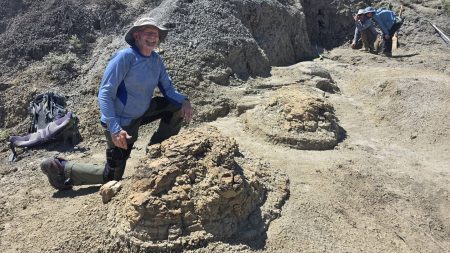
How did the feathers end up inside a piece of fossilized dung? The story begins in 2016, when one of O’Connor’s colleagues was prospecting in Montana’s Hell Creek Formation, a fossil-rich rock layer that records the final chapter of the dinosaur age. At first glance, the coprolite looked unremarkable. But a lucky break on its surface exposed a single fossilized feather, and that small crack was enough to reveal that the lump was hiding something remarkable. Using micro-CT scans, the team was able to map the interior of the coprolite in three dimensions without destroying it. What they found was a jumble of bones, scales, and feathers—a snapshot of a bird’s final moments. The leg bones and fish scales suggest the animal was aquatic, a member of a group known as hesperonithiforms, which were specialized, toothed diving birds that lived in oceans and inland waterways. The fish scales in particular hint that the bird had eaten shortly before it died, and that its last meal was still being digested when something brought its life to an end. It is a strangely intimate portrait: a bird, a meal, and then a sudden stop. The fact that all of it was preserved in feces is almost absurd, but it is also a reminder that fossilization can happen in unexpected ways. Hell Creek is best known for producing some of the last dinosaurs, including Tyrannosaurus rex and Triceratops, but it also preserves a rich record of birds, mammals, and other small creatures that lived alongside them. This coprolite adds a new layer to that record, showing that even the most humble fossil can contain extraordinary information. The coprolite is not just a piece of ancient waste; it is a record of behavior, diet, and even the moment of death. For paleontologists, such details are priceless.
Those ancient feathers may also carry a clue to one of the great mysteries of life on Earth: why did some birds survive the asteroid impact that ended the Cretaceous period while others did not? The hesperonithiforms were highly specialized for life in the water, with dense bones and strong legs for diving. But their feathers tell a different story. Some of the plumage found in the coprolite was primitive and stringy, lacking the complex structure needed for efficient insulation. That would have made it harder for these birds to stay warm, especially in the cold, dark years that followed the asteroid strike. When the impact threw dust and sulfur into the atmosphere, global temperatures plummeted. Animals that could not keep their bodies warm, or that depended on a narrow range of food sources, were especially vulnerable. O’Connor and her colleagues suggest that poor insulation may have been a death sentence for hesperonithiforms and their close relatives, while the ancestors of modern birds—which had already evolved better insulation and more flexible diets—managed to cling to survival. It is a compelling hypothesis, but it is not yet proven. To test it, researchers would need feathers from many different bird species from the same time period, and fossilized feathers are extraordinarily rare. The new study makes a strong case that coprolites might be one of the best places to look. If other researchers begin scanning ancient dung for feathers, they may find evidence that either supports or overturns this idea. Either way, the search will deepen our understanding of one of the most dramatic extinction events in Earth’s history. It also reminds us that survival is not just about size or strength; sometimes it comes down to something as simple as whether a creature could keep itself warm when the world turned cold.
The discovery is also a lesson in looking where no one thought to look. For decades, paleontologists have studied fossilized bones and teeth to reconstruct the lives of ancient animals. Soft tissues like feathers, skin, and internal organs were thought to be almost impossible to find. But coprolites, which are essentially fossilized feces, can act as tiny time capsules, preserving materials that would otherwise be destroyed. The fact that feathers can survive inside dung for tens of millions of years is astonishing. It suggests that other fossilized droppings, from dinosaurs and ancient birds alike, might contain hidden treasures that have been overlooked. O’Connor’s advice to other researchers is simple: “people should start looking.” That may mean re-examining museum collections, cracking open coprolites that were previously dismissed as uninteresting, or using CT scanners to peer inside specimens without damaging them. The more we look, the more likely we are to find feathers, fur, scales, and other fragile remnants that can fill in the gaps left by bones. Each such discovery helps scientists understand not just what ancient animals looked like, but how they lived, what they ate, and why they ultimately succeeded or failed in a changing world. It also changes the way we think about fossilization itself. Preservation is not always about big, dramatic events like volcanic ash falls or tar pits. Sometimes it happens in the most ordinary and unglamorous ways—inside a pile of dung that happened to be buried in just the right conditions. The study is a reminder that scientific breakthroughs often come from the least expected places, and that a willingness to examine the overlooked can lead to discoveries that reshape our understanding of life’s history.
In the end, this study is a reminder that science often advances through a combination of luck, curiosity, and a willingness to embrace the unexpected. A cracked piece of fossilized dung, found by chance in Montana, has opened a window into the lives of birds that vanished long ago. It tells us about their feathers, their last meals, and their struggle to survive in a world that was about to change forever. It also raises new questions: Were hesperonithiforms already in decline before the asteroid hit? Did their feathers make them more vulnerable to cold? Could other coprolites hold similar secrets? The answers will not come easily, but the search is now underway. And there is something deeply human about that search—the desire to understand where we came from, and why some forms of life endure while others fade away. The feathers in this ancient dung are more than just fossils; they are a message from the past, preserved by chance, waiting for someone to notice. Now that we know where to look, the next discovery may be just a lucky break away. The study also highlights the importance of patience and careful observation in science. A researcher had to notice that crack, decide to scan the specimen, and then interpret the jumble of bones and feathers. None of that would have happened if someone had simply dismissed the coprolite as a worthless lump. It is a good reminder that scientific discoveries often come to those who are willing to look closely at the things others overlook. The next time a museum drawer is opened, or a new fossil is split open, there is no telling what might be found. For now, the feathers in this ancient dung stand as a testament to the resilience of life—and to the strange, wonderful ways that life can be remembered.