





On a quiet ridge in the Bolivian cloud forest, life moves in soft, striped light. Here, in the damp green twilight between the Andes and the Amazon, two small cats once made their home. They were not lions or jaguars or anything that would make a headline in a zoology textbook. They were, to all appearances, just another pair of skinny tiger cats—the kind of secretive, pocket-sized felines that locals might call “tigrillo” and scientists might shrug off as an unremarkable side note in the great cat family. But when geneticists finally studied them, something astonishing happened. The DNA from these two little cats did not match the DNA of any known tiger cat. It was a separate, ancient lineage, a hidden branch that had been growing in silence for thousands—perhaps millions—of years. The result of that laboratory test, announced in a scientific journal, was a revelation: a new species was alive on Earth, and no one had noticed. There is something deeply moving about that. It tells us that even in an age of satellites and genome maps, wildness still keeps secrets. We can walk past a miracle and mistake it for a stray. The discovery also feels personal. These were not massive, awe-inspiring predators. They were two small creatures, little larger than housecats, with beautiful speckled coats and watchful eyes. Their lives were spent hunting in the undergrowth, sleeping in hollow logs, and moving silently through the mist. Yet their blood carried a story that scientists had never read. When that story was finally deciphered, it added a whole new twig to the feline family tree—and reminded us that the world is far more diverse than our textbooks suggest.
To understand why this discovery was such a surprise, you have to appreciate how confusing the “tiger cat” group has always been. Tiger cats belong to a genus called Leopardus, a group of small, elegant wild felines found across Latin America. Their spots and rosettes give them an uncanny resemblance to leopards in miniature, but they are not little leopards. They are a separate evolutionary experiment, a family of cats that fill the role of forest foxes and lynx. For a long time, taxonomists treated the tiger cats of South and Central America as one widespread species, Leopardus tigrinus. That single name was used for cats living in dry savannas, wet Atlantic forests, and high mountain cloud forests—regions that differ as much as the plains of Texas differ from the rainforests of Borneo. It was an easy mistake. These cats look alike to the untrained eye; even to trained eyes, the differences are subtle. A slightly shorter face, a different pattern of rosettes, a thicker tail, a variable set of bones. No one could say for sure where one kind ended and another began. The trouble was that small wild cats do not announce themselves. They are solitary, nocturnal, and extraordinarily good at hiding. By the time scientists could examine them, many were specimens in museum drawers—stuffed, flattened, or preserved through decades of biological afterthought. Siberia has the tiger. Africa has the lion. But the Americas have dozens of small cats, each with its own personality, habitat, and evolutionary destiny. The tiger cat group was perhaps the most frustrating of all: widespread, common in some areas, but as complicated as a family reunion with no photographs. Only a revolution in genetics could sort them out. DNA does not lie. It does not rely on fur color or skull measurement. It carries the careful records of every ancestor, every migration, every split in the family line. When scientists began to read those records, the old classification dissolved like mist in the morning sun.
At the heart of this new discovery were two particular tiger cats from Bolivia. Exactly how these animals ended up being studied is a story in itself. In the past, a researcher might have looked at their skins and skulls, taken a few measurements, and assigned them to the familiar species. But this time, tiny pieces of tissue were collected from the specimens and subjected to genetic sequencing. The laboratory work was not glamorous. There was no great chase through the jungle, no dramatic camera trap showing a spotted phantom in the night. There were just machines, chemical reactions, and rows of As, Ts, Cs, and Gs. But those unimpressive data points rearranged the map of cat evolution. When the Bolivian cats’ DNA was compared against tiger cats from Brazil, Colombia, Peru, and Central America, they did not nest within any known group. They stood apart, on their own branch, with a degree of divergence comparable to other recognized species in the genus. It was a moment that taxonomists live for: the sudden, quiet sense that the world has just become larger. In the scientific paper that followed, researchers proposed recognizing this distinct lineage as a separate species. The name they suggested was Leopardus pardinoides—sometimes referred to as the cloud forest tiger cat. The word “pardinoides” is a scholarly nod to the old idea of a panther-like animal; it means something along the lines of “panther-like in form.” It is not a big, bold name; it does not shout. But that is fitting for a creature that has spent its entire existence avoiding attention. This is a cat of the Andes, a high-country specialist. It lives not in the hot lowlands but in cloud-wrapped forests where the trees drip with moisture and the terrain tilts steeply. The two Bolivian cats became ambassadors for a whole invisible population. Their genes told a story of ancient separation: perhaps a mountain range rose, perhaps a river changed course, perhaps a forest shrank, and one group of ancestral cats was cut off from the rest. Time did the rest. Over millennia, they became their own kind—perfectly adapted to their misty realm, unknown to human science until now.
Discovering a new species is not simply a bookkeeping matter. It has real consequences for how we care for the living world. If the cloud forest tiger cat is truly a distinct species, it deserves species-level attention. Conservationists, governments, and wildlife reserves simply do not have enough money or energy to protect every indistinct population. But they can rally behind a unique, named species. A name gives an animal visibility; a name makes people care. Without a name, the two cats from Bolivia were just stray tiger cats in the sprawling, complex family of wild felines. With a name, they become a symbol—a reason to scrutinize the fate of the high mountain forests they and their kin depend on. Those forests are in trouble. Cloud forests are among the most fragile habitats on Earth, often narrow strips of green along Andes slopes. They are cleared for coffee, cattle, and coca; they are crisscrossed by dirt roads and highways; they are increasingly invaded by fires, logging, and climate stress. The tiny tiger cat does not need much: perhaps a few thousand square meters of unbroken forest, a network of prey, and a measure of peace. But that is exactly what is being lost. Every new highway through the Andes fragments the remaining habitat, leaving populations isolated and vulnerable. Roadkill is one of the greatest dangers. A cat that lives in a treetop and can leap from branch to branch still has to cross a clearing or a road eventually. The two Bolivian specimens may well have died that way—not under a predator’s claws, but under the wheels of human progress. Naming their species cannot undo that. But it can change the story. It can lead to stronger protections, better corridor planning, and a little more compassion for the small lives hidden in the shadow of the Andes. In ecology, the smallest animals often hold the web together. The cloud forest tiger cat may be a minor predator, but it is a living part of the forest’s intricate machinery. If it vanishes, the forest will be a little quieter, a little more empty, even if nobody can say exactly why.
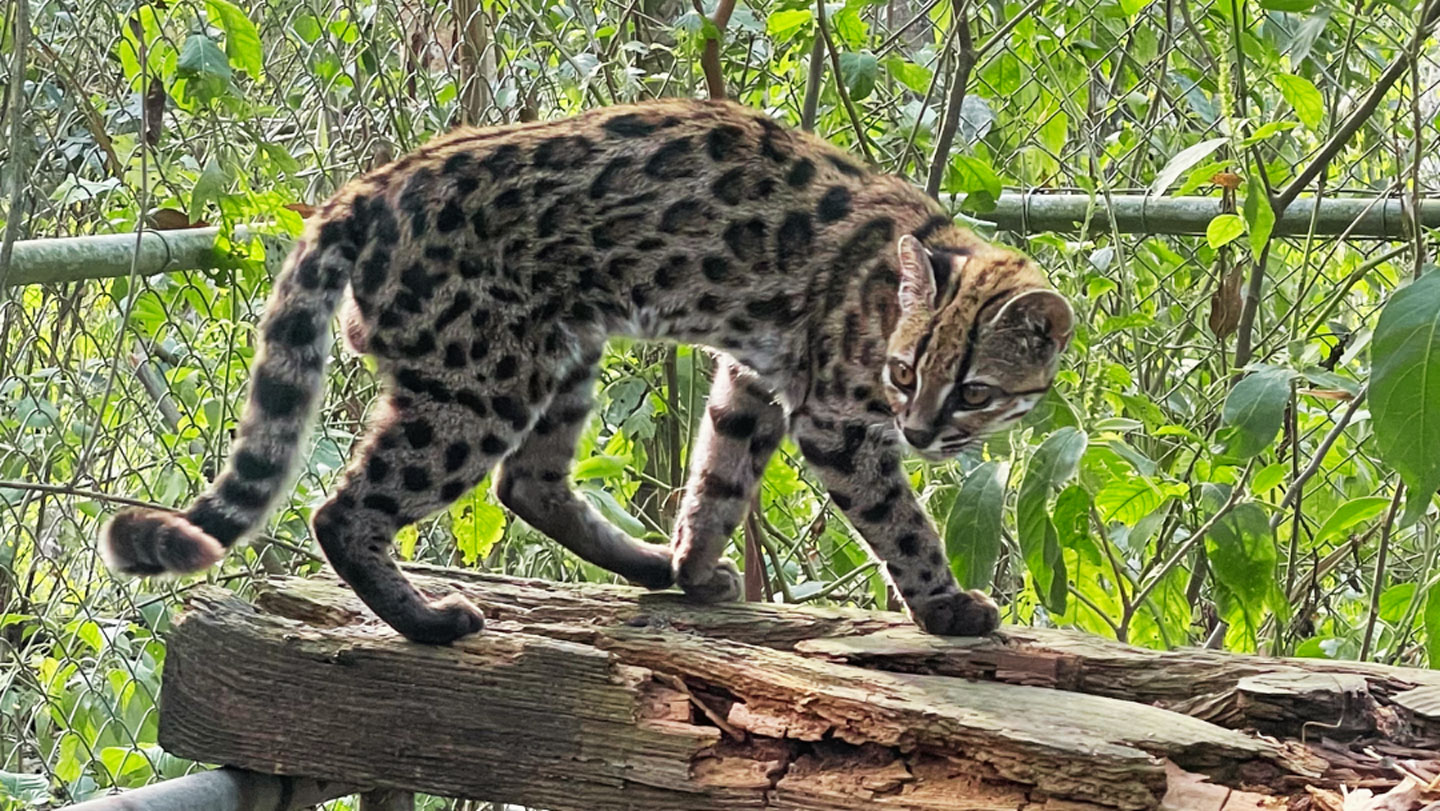
Imagine meeting one of these cats. Picture a creature about the size of a domestic tabby, with a rounded head, large amber eyes, and a tail so thick and plush it seems almost out of proportion. Its coat is thick and soft, colored in warm ochres, rusts, and coffee browns, marked with irregular rosettes that sometimes merge into solid streaks. In the dim, dripping understory, those markings break the outline of its body, making it melt into the dappled light. It moves with a compact, efficient grace—shoulders rolling, paws placed carefully, each step a calculation. It can climb a vertical trunk with the ease of a squirrel and squeeze through gaps that seem too small for any cat. It hunts while the world is half asleep: at dusk, during the blue hours of morning, on rainy nights when the leaves turn to silver. Its prey are small things—mice, spiny rats, birds, insects, the occasional tree frog. It is probably a solitary hunter, like most of its relatives. It marks a territory with urine and scratches, announces its presence with a scent that says: I am here, this is my tree, my stream, my patch of forest. It does not know it belongs to a new species. It does not need a name. But humans, with our odd gift for language, love to name things. It makes us feel connected. When we say “cloud forest tiger cat,” we are not just labeling an animal; we are telling a story about a place. The cloud forest itself is a kind of heaven: cold mornings, thick fog, orchids growing in the crotches of trees, moss draping every branch, birds with iridescent feathers. The little cat is part of that world. It has probably been there longer than any human settlement on the mountain. Its ancestors watched the ice ages come and go, adjusted as the forest climbed and fell with the climate, and persisted. Even now, some campesino may have seen its eyes catch a flashlight beam at night, mistaking it for a spirit. Perhaps that is the proper response: awe, not indifference.
At the end of the paper, when the scientists added their new branch to the feline family tree, they were doing something older than science. They were performing an act of attention—saying to the world: look, here is a being that existed all along, and we almost missed it. This is the quiet power of genetics: it gives a voice to the voiceless. It can take a piece of skin from a Bolivian tiger cat, buried in a museum drawer, and turn it into a chapter in the story of life. But the discovery also asks something of us. It challenges the assumption that we already know the map of nature. Every year, new species are found in places people said were thoroughly explored. Some are found not on expeditions, but in the back of freezers, in jars of ethanol, in scraps of tissue that a previous scientist had the foresight to preserve. The two tiger cats from Bolivia were probably collected long before anyone understood their significance. That is worth thinking about. What else sits in a drawer somewhere, waiting for a curious intern, a new technique, a chance moment of insight? We live in an age of extinctions, and yet we are also still in an age of discoveries. The same forests being cut down may hold creatures that have never blinked at a human face. The cloud forest tiger cat is a reminder that biodiversity is not just a count of known species. It is a fabric of histories, memories, adaptations, and possibilities. When we lose a piece of that fabric, we do not always know what we have lost. But when we find a new species, we gain a second chance—a chance to learn the animal’s ways, to preserve its home, and to tell the story to our children. The two tiny tiger cats from Bolivia were small, silent, and easy to overlook. Yet they changed our understanding of the entire feline family. That is the kind of magic that science can still make. It should fill us not only with pride, but with humility, and with the determination to let the world’s quietest creatures remain.