




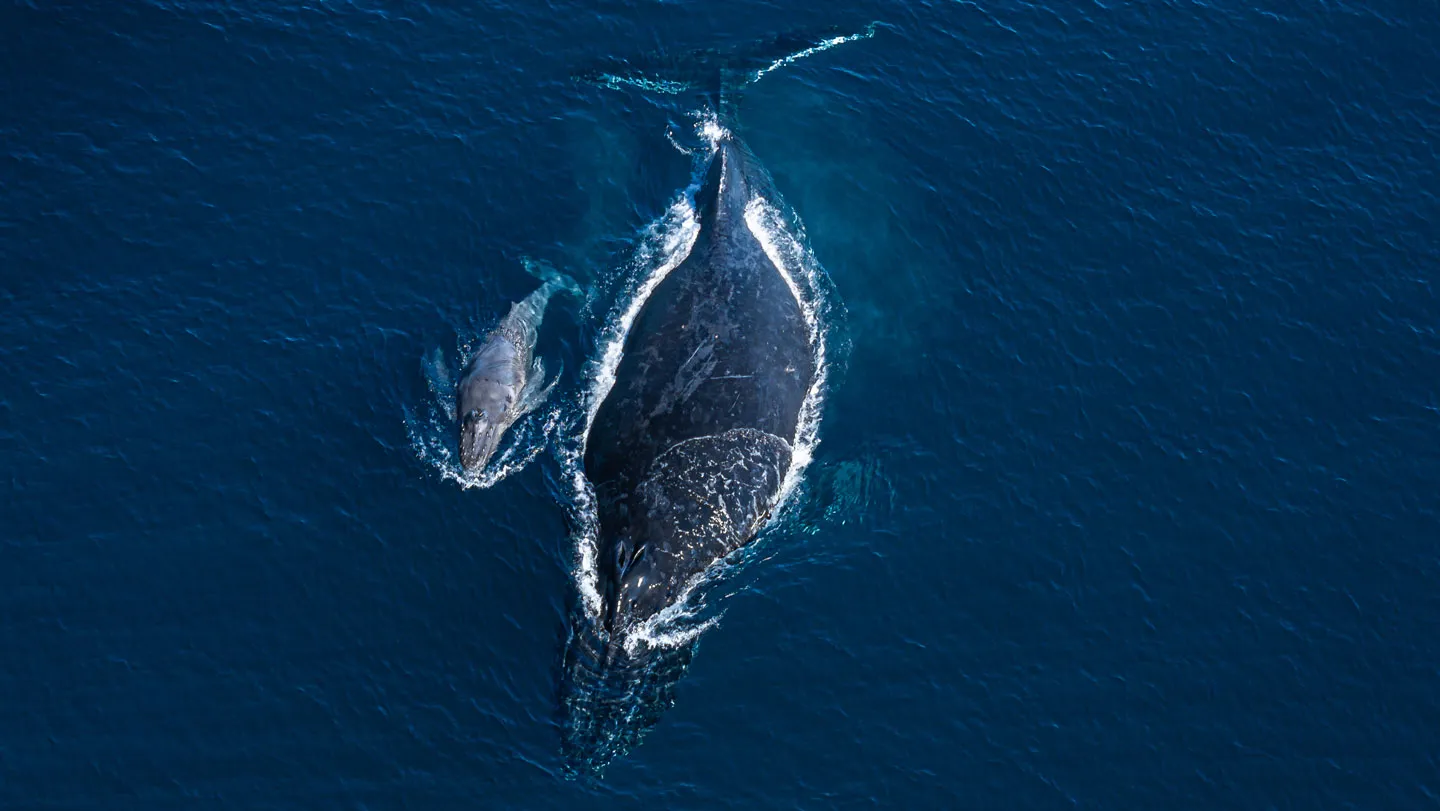
Every so often, science offers a glimpse of something that feels less like data and more like a story. In July 2025, off the coast of Palm Beach in Queensland, Australia, a small team of researchers and rescue workers found themselves watching a scene that seemed both heartbreaking and profound: a female humpback whale lingering beside her dead calf, diving down again and again to look at it, touch it, and rest near it. The observation, reported by marine biologist Olaf Meynecke of Griffith University and Andrew Mulville of the Sea World Foundation, was published in the journal Discover Animals. It is believed to be the first detailed documentation of a humpback whale attending to a calf after its death. For scientists, the sighting offers rare evidence that baleen whales—the group that includes humpbacks, blue whales, and gray whales—may experience something like grief. Until now, most observations of apparent mourning among whales have come from toothed whales, especially orcas, which have been seen carrying dead calves for days. But baleen whales have remained a mystery, partly because their newborns are less buoyant and tend to sink when they die, making any underwater vigil almost impossible for humans to witness. This time, the conditions aligned in a way that allowed a rare and intimate view of a mother’s response to loss. The scene was quiet, underwater, hidden from the world above—but it carried a weight that anyone watching could feel.
The encounter began when Mulville, a rescue boat captain, spotted two adult humpback whales in the water and went to check on them. As he approached, he noticed tissue floating on the surface that looked like amniotic membrane—the placental lining that whales shed into the water at birth. Looking down, he could see a small newborn calf, less than four meters long, resting on the seafloor. The female whale, believed to be the calf’s mother, did not swim away. Instead, she kept diving down to the bottom, making eye contact with the stillborn calf, and at one point placed her pectoral fin—her arm, as Meynecke described it—over the body. She rested beside it, as if keeping watch. The behavior continued for hours, and possibly days. The footage captured whale calls, sounds that may have been attempts to communicate with a calf that would never respond. Meynecke later said it was “pretty emotional to observe.” The image of an enormous animal gently placing a fin over her dead offspring is hard to shake. It is a gesture that, in human terms, looks like tenderness, protection, or mourning. But the researchers are careful not to jump to conclusions. They know that what looks like grief to us may mean something entirely different to a whale. Still, the moment felt undeniably intimate—a mother and her child, alone on the ocean floor, in a silence broken only by the whale’s own calls.
To understand why this sighting matters, it helps to know what scientists have seen before. Among toothed whales, grieflike behavior has been documented repeatedly. Orcas, for example, have been observed carrying dead calves on their rostrums or pushing them through the water for days, sometimes traveling long distances with the body. Dolphins have shown similar behavior. These displays are often interpreted as signs of mourning, though scientists debate whether the animals truly understand death or are simply responding to a disrupted bond. In baleen whales, however, such observations are extremely rare. The reason may be partly physical. Newborn baleen whales are born without the thick layer of fat, or blubber, that would eventually help a corpse float. When a calf dies, it tends to sink to the seafloor, where it is hidden from human eyes. If a mother remains with her dead calf underwater, scientists would likely never know. That is why this particular observation is so significant. It offers a rare window into a behavior that may have been happening all along, unnoticed, beneath the surface. The authors believe this is the first detailed documentation of a humpback whale attending to a calf after its death, and it suggests that the capacity for something like grief may be more widespread among whales than previously thought. It also reminds us that the ocean keeps many secrets, and that some of the most profound moments in animal life occur far beyond our view.
The sighting also revealed something else: the mother was not alone. Two adult whales were seen in the same area for two more days. The researchers believe they were the calf’s mother and a male escort—a common presence during the breeding season. “We can’t prove it, but I’m very certain they were the same whales,” Meynecke said, “which also suggests that this is a prolonged change of behavior … something that we might call mourning or a form of grieving.” The fact that the whales remained in the area for days, rather than swimming away, points to a sustained emotional response, not just a brief moment of confusion. It suggests that the loss of a calf can alter a whale’s behavior in ways that resemble grief in other social animals, including humans. The presence of the male escort adds another layer of mystery. Was he accompanying the mother, perhaps offering some form of social support? Or was he simply staying nearby for reasons unrelated to the dead calf? The researchers cannot say. But the prolonged attendance of both whales makes the scene feel even more like a vigil, a quiet gathering around a loss that the animals seem to recognize, even if they understand it differently than we do. There is something deeply human in the image of a community staying close to someone in mourning, even without knowing exactly what to say or do.
For all the emotional weight of the footage, Meynecke is careful to caution against anthropomorphizing. “Remember that the whale is experiencing their world in a completely different form and shape,” he said. “They have different ways of understanding their environment.” This is an important reminder. Humans are prone to seeing ourselves in other animals, projecting our own feelings and narratives onto their behavior. A humpback whale’s brain is wired differently from ours; its senses, its social life, and its relationship to the ocean are shaped by millions of years of evolution in a world we can barely imagine. The mother’s behavior may not mean the same thing to her as it would to a human parent. She may not experience “grief” in the way we define it. But that does not make the moment less meaningful. It may simply mean that grief, or something like it, exists in more forms than we can recognize. The researchers’ caution is not a denial of the whale’s suffering; it is a form of humility in the face of another creature’s inner life. It acknowledges that we can observe, describe, and even feel moved by an animal’s behavior, but we cannot fully know what it is thinking or feeling. That uncertainty is not a weakness. It is a reminder that the natural world is full of mysteries, and that our own emotions are not the only measure of what matters.
Ultimately, this observation is a reminder of how much we still have to learn about the emotional lives of animals, especially the largest ones on Earth. Humpback whales are known for their haunting songs, their spectacular breaches, and their long migrations. Now, perhaps, we can add another layer to that picture: they may also mourn. The discovery comes at a time when whales face increasing threats from human activity—ship strikes, entanglement in fishing gear, ocean noise, and the effects of climate change on their feeding grounds. If whales are capable of something like grief, then the loss of a calf is not just a biological event; it is an emotional one, with consequences that ripple through the lives of the animals left behind. The researchers hope that future studies, using drones, underwater microphones, and long-term monitoring, will reveal more about how whales respond to death and loss. For now, the image of a mother humpback resting beside her stillborn calf on the seafloor, her fin draped over the body, stands as a powerful and humbling reminder that love and loss are not exclusively human experiences. We may never know exactly what that mother felt. But the fact that she stayed, and returned, and touched, and called, is enough to make us pause—and to wonder.