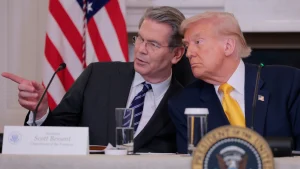






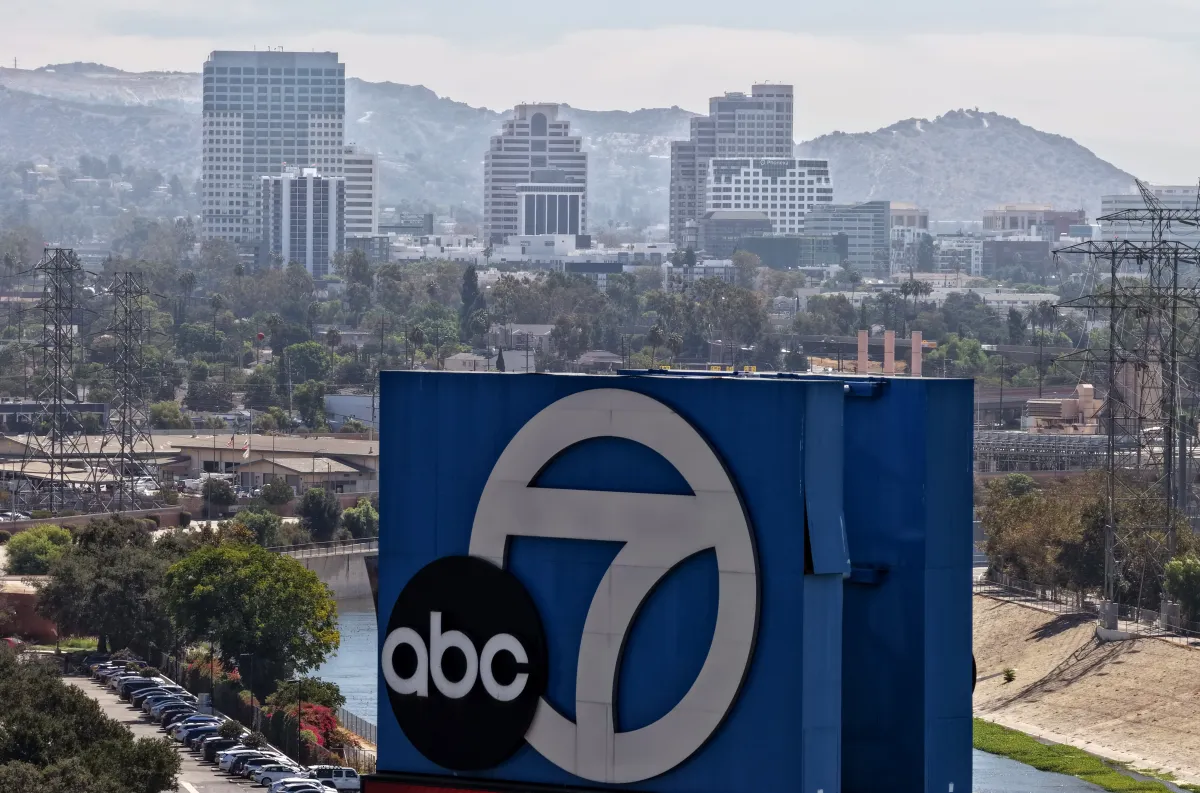
Let’s be honest about what’s happening here: there is nothing new about this administration trying to punish journalists for how they cover it. We’ve seen the pattern before, and we’re seeing it again right now. Most recently, the White House pulled the press credentials of reporters from three major news organizations—MS NOW, CNN, and Politico—a move that was so legally dubious that a federal judge had to step in and say, essentially, that these outlets were likely to succeed in showing their due process rights had been violated. That’s not how a healthy democracy treats its press. And while that fight was still fresh, the Federal Communications Commission launched what can only be described as a retaliatory investigation into Disney, the parent company of ABC, over its news coverage. The FCC chairman at the center of this, Brendan Carr, has tried to dress it up with bureaucratic language about broadcast licenses and employment practices, but anyone paying attention knows what this is really about. It’s about the fact that the Trump administration dislikes the views expressed by ABC personalities and the way ABC News covers the White House. It’s about using the power of the federal government to intimidate a media company into submission. And it’s unprecedented. The FCC has raised the possibility that Disney-owned television stations, including WABC in New York and KABC in Los Angeles, could actually lose their broadcast licenses. Let me be clear: I have spent years as a media executive criticizing Disney’s business strategy and performance. I have no interest in being a corporate apologist for the Magic Kingdom. But on this one, there is no ambiguity in my mind. I fully support Disney in its fight against the FCC and against this politically weaponized investigation. Full disclosure, I am a senior advisor to Versant Media, the parent company of MS NOW, so I know firsthand what it feels like to be in the crosshairs of this administration. But you don’t need a personal stake to see that what the FCC is doing to Disney is wrong, dangerous, and designed to send a chilling message to every newsroom in America.
What makes this moment so alarming is not just the aggressive rhetoric, but the carefully manufactured legal pretext. The FCC knows it cannot simply revoke a station’s license because it doesn’t like a particular newscast or a satirical monologue. Established First Amendment law is clear on that point, and even the Trump administration’s first FCC chairman, Ajit Pai, admitted as much years ago when George W. Bush-era presidents complained about “fake news.” Pai said plainly that the FCC does not have the authority to revoke a license based on the content of a newscast. That should have settled the issue. But Brendan Carr is not interested in settled law. He is interested in leverage. So the FCC has ordered early renewal reviews of Disney’s eight broadcast station licenses, even though they aren’t due for renewal until October 2028. The stated justification is that Disney has engaged in discriminatory employment practices in violation of the FCC’s Equal Employment Opportunity regulations. This is a pretext, and it needs to be exposed as exactly that. Attacking Disney through EEO rules is more insidious than directly banning reporters from the White House, because it gives the government a veneer of legitimacy. It’s easier for a federal judge to immediately see through a blatant retaliation against a reporter’s press pass. But an employment discrimination claim is murkier, harder to dismiss out of hand, and more expensive to fight. The FCC is counting on that. And the economic stakes are far higher. When reporters are banned from a building, their organizations can still broadcast and publish; the ban might even rally their audiences to watch more. But revoking a station’s license is the death penalty. It would destroy the business outright, silence local voices, and take away a vital service from millions of viewers. This is not a technical regulatory disagreement. It is an attempt to use state power to bankrupt a news organization and terrify every other one into compliance.
I have a deeply personal connection to the rules at the center of this fight. In the 1980s, I served as senior counsel to the U.S. House of Representatives Subcommittee on Telecommunications, and I worked on the very EEO requirements broadcasters are now being attacked over. After the broadcast industry was deregulated, the EEO rules were one of the few remaining guardrails, and they were designed with a simple, noble goal: to ensure that license holders made meaningful efforts to recruit broadly, so that women and minorities could actually be considered for jobs and have a fair shot at promotion. These rules were never about quotas. In fact, when we passed the Cable Act of 1984, we fought hard to include language making crystal clear that these requirements could not be interpreted as sanctioning racial quotas. It was a last-minute compromise, and it helped secure passage of the law that fueled the growth of cable television across America. The point was never to force stations to hire unqualified people or to give preference to any particular race. The point was to open the door, to break the old-boy network, and to make sure that people of all backgrounds were at least in the room. And the hope was that a more diverse workforce would lead to programming and news coverage that better reflected the communities broadcasters were licensed to serve. Those rules, in their current form, have been in place for nearly twenty-five years. The FCC has never once tried to change them. Not in all that time. And broadcasters have operated under them in good faith. Now, suddenly, the same rules that were designed to encourage inclusion are being twisted into evidence of discrimination. It makes no sense, unless you understand that the real target is not employment practices at all. The real target is the First Amendment.
So what changed? The rules didn’t change. The law didn’t change. What changed is that the Trump administration, in its second term, has declared war on Diversity, Equity, and Inclusion in every corner of American life. From the Department of Education to the Pentagon, programs that encourage the fair treatment of women and minorities are being dismantled and demonized. And the FCC chairman appears to believe that the very EEO rules that have been on the books for decades are themselves discriminatory. But here’s the problem: the FCC has not formally changed those rules. It has not gone through the proper rulemaking process. It has offered no new guidance to broadcasters. If Brendan Carr truly believes the EEO rules are wrong, he has every right to propose new regulations and make his case through the established process. That’s how government is supposed to work. Instead, he is trying to manufacture a violation of existing rules against a company that has been following them, and he is doing so only because that company’s news division has incurred the President’s displeasure. The FCC’s reach doesn’t even extend to most of Disney’s business. It has no authority over Disney’s theme parks, its cruise line, its film studios, or its streaming services. It can only reach the broadcast stations. But that, of course, is the point. The stations are the public-facing arm of Disney, and they are the part of the company that visibly exercises First Amendment rights. The rest of Disney is just collateral damage. President Trump made the true motivation impossible to deny when he said that ABC’s decision not to broadcast his primetime speech about election fraud “should mean a revocation of their licenses.” That is not a statement about employment law. That is a President demanding that the government punish a broadcaster for an editorial decision. It is a threat to the very concept of a free press, and it comes straight from the White House.
This is not the first time Disney has faced pressure from this administration, and it’s important to acknowledge that the company has not always handled it well. Disney has, to its discredit, caved on more than one occasion. It settled a lawsuit by paying fifteen million dollars to a Trump-related foundation after comments made by ABC anchor George Stephanopoulos. It took Jimmy Kimmel off the air for a short time after his sharply criticized remarks about the death of Charlie Kirk. Those were not good moments. They looked like capitulation, and they probably emboldened the people who are now coming after Disney with a much bigger weapon. But there is a line, and license revocation is where this administration has, perhaps unintentionally, drawn it. When the stakes are eight television licenses—the very ability to exist as a broadcast station group—there is nowhere left to run. This is existential. It is not about settling a lawsuit or cooling off a late-night host for a week. It is about whether a major American media company can survive while speaking truth to power. And so, to Disney’s credit, it appears to have found its courage. It is fighting. That matters, not just to Disney, but to every broadcast station in America. If the FCC can revoke Disney’s licenses over a politically unpopular news decision, it can do the same to any station, anywhere, for any reason. The broadcaster that angers the President one day could be the next target. The chilling effect is the point. It is designed to make every editor, every anchor, and every network executive think twice before running a story that the White House might not like. This is not the behavior of a healthy democracy. It is the behavior of an authoritarian regime trying to control the media by fear.
As disturbing as the FCC’s actions are, perhaps even more disturbing is the silence that has come from the rest of the media industry. When the White House pulled press credentials from MS NOW, CNN, and Politico, much of the electronic news media rallied around them. Networks and news organizations issued statements, wrote editorials, and spoke out publicly. They understood that an attack on one journalist’s access is an attack on all journalists. But where is that same solidarity for Disney? Where are the broadcast companies standing up and saying, “This could be me next”? Where are the major news organizations filing legal briefs in support of Disney’s fight? Aside from public interest groups and the National Association of Broadcasters, the industry has been largely silent. That silence is deafening. It is exactly what this administration wants. Donald Trump does not need to issue direct orders to every newsroom to get what he wants. He just needs them to be afraid. He needs them to look at what is happening to Disney and decide that it’s not worth the fight. He needs them to quietly soften their coverage, second-guess their reporting, and avoid drawing the White House’s ire. Silence is complicity. Silent obedience is the goal. And if the media industry refuses to stand up for one of its own at a moment like this, it cannot expect anyone else to stand up for it when its turn comes. This is too crucial a fight to sit out. The industry must speak up, loudly and without hesitation, not only for Disney but for the principle that a free press cannot exist if broadcasters are subject to government reprisal for their content. Tom Rogers is executive chairman of the AI film studio Fountain 0, executive chairman of agentic AI company Claigrid, Inc., the founder of CNBC, an on-air CNBC contributor, and a member of the Task Force for American Democracy. The views expressed in this article are the writer’s own.