




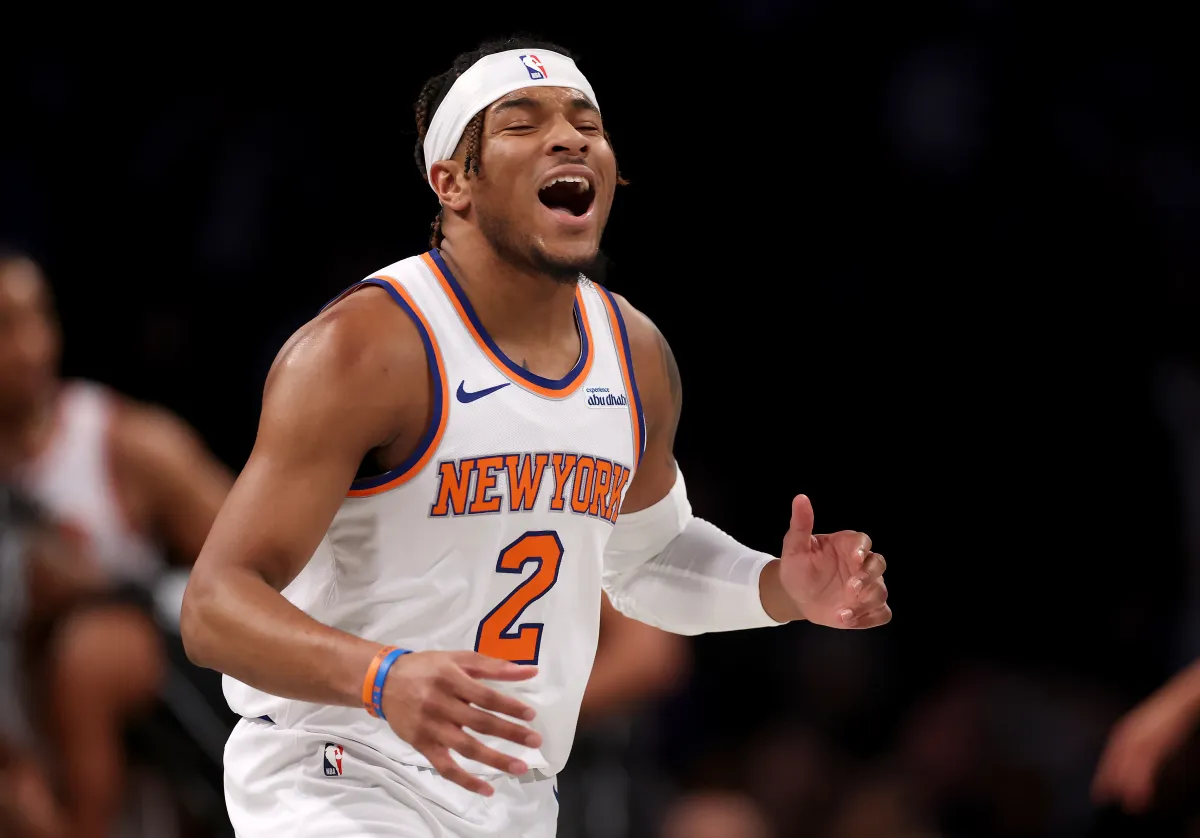
For the first time in more than half a century, the New York Knicks can finally say it out loud: they are champions. When the final buzzer sounded in June and the Knicks closed out the San Antonio Spurs in five games, a 53-year wait came to an end. This wasn’t just another title; it was a release of decades of frustration, a moment that belonged to every fan who had watched the team stumble through rebuilds, bad luck, and near misses. The city was electric, the players were exhausted and ecstatic, and for a few weeks, it felt like the Knicks were the center of the basketball universe. But the NBA does not allow you to sit in the moment for long. The trophy gets polished, the parades end, and the front office goes back to the quiet, unglamorous work of trying to keep the window open. The good news for Knicks fans is that nearly the entire title team is back to defend its crown. The unsettling news is that not every key piece of that championship puzzle is locked in. One of those names is Miles McBride, better known to teammates and fans as Deuce, a player who does not always show up in the biggest headlines but who has become absolutely essential to what New York does on both ends of the floor. He is now the longest-tenured Knicks player on the roster, and he is entering the final year of his contract while earning just under $4 million. That number, more than any highlight reel, is about to become the center of a very important conversation.
Here is where things get tricky. When the regular season ended and the celebration arrived, most of the roster went into the offseason knowing exactly where they stood. McBride did not. He watched the Knicks bring back nearly everyone, and then he watched his own extension deadline pass on Aug. 11 with nothing signed. That silence is rare in the NBA, especially for a player who just helped win a championship. In a league where teams often rush to keep good soldiers happy, the fact that Deuce is still waiting on his next deal means the organization is either being cautious, working on something bigger, or quietly thinking about moving him. The trade rumors did not take long to surface. Because his salary is small and his value is high, McBride has become the obvious trade chip in a lot of imagined deals. Most of those ideas have one common theme: shipping him out for a backup center. The logic is understandable on the surface. The Knicks need frontcourt depth, centers are hard to find, and Deuce is a guard whose contract is tiny enough to fit into a variety of trades. But trading him would be the real mistake, and anyone who watches this team closely knows it. The trades that make the most sense on a calculator do not always make the most sense on the court. There is no computer model that can measure what Deuce means to the Knicks’ defensive identity, their locker room, and their ability to close out playoff quarters without letting the other team breathe.
SB Nation’s Posting and Toasting recently made exactly that case in a column that pushed back on the trade rumors with a simple, powerful argument: Deuce’s small salary is the reason to keep him, not the reason to move him. The site wrote that you cannot find that level of two-way reliability for under $4 million, and that statement should be engraved in the Knicks’ front office. Two-way reliability is rare in the modern NBA. There are players who can guard, and there are players who can shoot, but there are very few who do both on every single possession, in every quarter, without ever taking a play off. Deuce does both. He is the kind of player who makes winning plays that never show up in the box score, the one who picks up guards full court, hounds ballhandlers, rotates over to a center for a possession, and still runs off screens ready to shoot. If the Knicks trade him for a backup center, the math does not work. A $4 million contract is not going to return some star-level big man. It will likely bring back another $4 million center, which in today’s NBA means a third-stringer, a situational body who gets targeted in ball screens, gets played off the floor in certain matchups, and spends the month of May sitting on the bench in street clothes. New York would essentially be giving up a closer, a player who lives for the last five minutes of a game, for a towel-waver who will be lucky to see meaningful minutes when the playoffs turn serious. That is not a trade. That is a downgrade disguised as a roster-balancing move.
The Knicks have been down this road before, and they have the evidence to show why patience matters. Last season, when the roster was still taking shape, the organization knew it probably could not afford to re-sign Mitchell Robinson. The financials were tight, the cap was a maze, and the standard move would have been to trade him away for whatever value they could get before losing him for nothing. It would have been easy to make the cold, practical decision and move on. But Leon Rose and the front office chose a different path. They kept Robinson. They trusted that a player who had invested in the team and given everything he had was worth more to them in a Knicks uniform than whatever second-round pick or bench piece he could have brought back in a trade. That decision, along with Robinson’s health and productivity, helped carry the team to a title. He was a major part of the run that broke the 53-year curse. Now Deuce deserves the same treatment. He has earned the right to be kept, not because he is flashy, but because he is exactly the kind of player who helps teams win in June. The Knicks knew they could have gotten something for Robinson and they did not. They knew they might lose him for nothing and they accepted that risk because the payoff of keeping him was a championship. Deuce is in the same position, and the organization should show him the same loyalty.
The people closest to the situation clearly understand what is at stake. In a video of his availability shared by SNY, head coach Mike Brown was asked about the Deuce situation, and he did not sound like a coach who wanted to discuss a trade. He sounded like a coach who wanted to make sure everyone knew where he stood. Brown pushed the decision toward the front office, saying that at the end of the day, Deuce wants to be here, the team wants him here, and that is something Brown has faith in Leon Rose and even Deuce’s representatives to figure out. That is the kind of statement that tells you everything. Brown is not preparing the locker room for a farewell. He is not walking the tightrope of coach-speak. He is publicly expressing trust in a process and making it clear that the coaching staff’s preference is simple: keep the man who helped win the title. When a coach uses language like that, it is usually a strong signal that the player is valued far beyond his cap hit. It also suggests that the delay in signing an extension is not necessarily about lack of desire on either side, but about the complexity of the overall roster and the numbers. Contract talks in the NBA are rarely about whether a player is good enough. They are about how every dollar fits into a structure that also has to fund centers, wings, draft picks, and stars. Deuce’s situation feels less like a player being pushed out and more like a messy but solvable puzzle.
Whatever happens in the negotiation, the basketball arguments for keeping Deuce are overwhelming. He averaged a career-high 12 points this past season, shot 41.3 percent from three, and still picks up guards full court. That last part matters more than any stat line. He is a guard who does not just stay in front of his man; he hunts his man. He presses up the floor, fights through screens, and makes life miserable for opposing ballhandlers. That kind of defensive pressure creates offense. It forces turnovers, accelerates the clock, and turns a tight game into a comfortable one. He is exactly the player every contender claims it wants and then rarely develops. Losing him for nothing next summer would sting, absolutely, because a player of that value should never just walk out the door. But losing him now, for a big man who barely plays, could cost the Knicks a repeat. The front office has to ask itself a simple question: what is the threshold of talent that makes a backup center more valuable than a proven winner? The answer should be almost nothing. There are centers in every draft, in every free-agent class, on every practice squad. There are not many Deuce McBrides. The Knicks have already learned that lesson once with Mitchell Robinson. They should not have to learn it again. Sometimes the strongest move is the one you do not make, and keeping Deuce, even at the risk of getting nothing back next year, is the kind of decision that makes the difference between a team that is good on paper and a team that celebrates in June.