




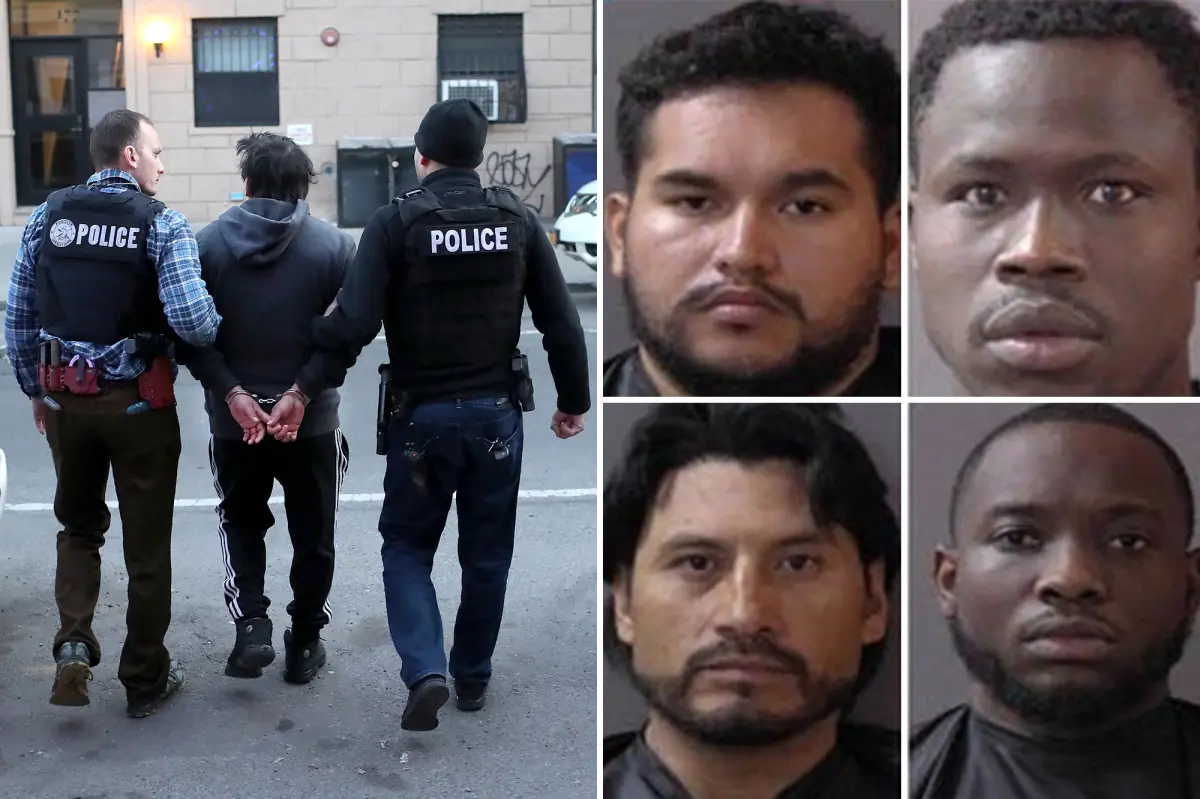
On an ordinary day in Indiana, a predator’s online fantasy collided with the hard hand of the law. Men from different walks of life, different countries, and different circumstances had spent hours or days talking to people they believed were underage girls. They crafted messages full of affection, manipulation, and explicit desire, convincing themselves that they were special to a child who barely existed. Then they got into their cars, drove to meet the girls, and imagined the encounter that would follow. Instead, they were met by undercover detectives who had been listening, waiting, and documenting every word. When the arrests were announced, the community learned that eleven alleged sex offenders had been taken into custody during a coordinated sting operation. But the revelation that stunned many came from the Department of Homeland Security: four of the eleven were illegal immigrants, citizens of four different countries, each with a separate story of how they came to be in the United States. For the families in that Indiana community, the news was both terrifying and reassuring: terrifying because online predators are so close, so hidden, and so ordinary; reassuring because the system had caught them before any child was harmed. This is the human reality behind the police headlines, a story of vigilance, narrow misses, and the ever-present danger of those who seek to exploit the innocent.
The four suspects identified by authorities bring with them a complicated map of immigration and failure. El Hadji Babacar Ndiaye, a citizen of Senegal, had been caught and released at the southern border in September 2023 in Lukeville, Arizona, under the Biden administration. Lucky Philip Udoudo, a Nigerian citizen, entered the United States as a “got-away,” a term used by border patrol agents to describe people who evaded capture entirely, slipping across the border at an unknown time and place. Filomeno Ricardo Flores Marin, a Mexican citizen, had been living illegally in the United States since 2002, crossing into Arizona illegally more than two decades ago. David Josue Gomez-Posada, a Salvadoran citizen, entered the country illegally as a juvenile in 2017. These four men were not part of a single migrant caravan or a sudden wave; they came at different times, through different routes, and under different circumstances. Yet they all ended up in the same place: an Indiana jail, facing serious charges related to child exploitation. U.S. Immigration and Customs Enforcement has lodged detainer requests against them. A detainer is a request from ICE to a local jail or police department to hold an individual after their criminal case is resolved so that immigration authorities can take custody and begin removal proceedings. It is not a punishment; it is a legal mechanism designed to ensure that people who are in the country illegally and who have allegedly committed crimes do not simply walk free into the shadows. But behind each name and each immigration status is a human being with a history, a family, and choices that led them to this moment. Some came seeking opportunity; some came fleeing hardship; but their presence in this story is now defined by the crimes they are accused of committing, and by the children they allegedly tried to meet.
The charges against the four men are deeply disturbing, and they reflect the dark reality of online child exploitation. Filomeno Ricardo Flores Marin faces two counts of sex offenses, one count of molestation of a minor, and one count of enticement of a minor for indecent purposes. His criminal history, according to authorities, also includes a prior arrest for stolen property, and he was previously arrested by ICE on January 18, 2019, while assisting the Drug Enforcement Administration on an operation in Indianapolis. He was released on bond on March 7, 2019. That release, which allowed a man with known illegal status and a criminal record to return to the streets, raises difficult questions about the gaps in the system. Lucky Philip Udoudo is charged with child solicitation and sexual misconduct with a minor. David Josue Gomez-Posada is charged with child solicitation. El Hadji Babacar Ndiaye is charged with child solicitation. For the accused, these are just charges, and under American law they are presumed innocent until proven guilty. But for the families of the children these men intended to meet, the stakes are not abstract. A child who is groomed online carries invisible scars long after the conversation is over. Parents who discover that their child was being manipulated by an adult predator feel a betrayal that is almost impossible to describe. The detectives who run these operations have to read the disturbing messages, pretend to be children, and lure predators out of the safety of their screens. They see the worst of human behavior and have to remain calm, professional, and focused. Every arrest is not just a statistic; it is a story of a potential victim saved and a tragedy prevented.
The Department of Homeland Security responded to the arrests with a forceful statement that sought to connect the dots between illegal immigration and public safety. “We are calling on Indiana to honor our detainers,” a DHS spokesperson told Fox News. “All of their claims will be heard by an immigration judge, and they will receive due process. This administration will not ignore the rule of law.” The spokesperson continued: “Under President Trump and Secretary Mullin, if you break the law, you will face the consequences. Criminal illegal aliens are not welcome in the US.” These words reflect a policy and a philosophy that have become central to the national conversation about immigration. To the victims and their families, such statements offer reassurance that the government is paying attention, that the names and faces of predators will not be forgotten, and that communities are being protected. To immigrants who are living peaceably and lawfully in the United States, the statements can be the source of anxiety, a reminder that they are often viewed with suspicion because of the actions of a few. But the DHS spokesperson was careful to mention due process, an essential American guarantee that ensures even those accused of horrific crimes have the right to be heard by an impartial judge. In human terms, this means that the four accused men will not simply vanish into an immigration facility without a hearing. They will have lawyers, they will face evidence, and they will receive a decision based on the law. That is how justice works in a country that believes in both accountability and mercy.
The Indiana sting is also part of a larger effort by federal authorities to work with local police departments in the fight against crime. DHS noted that seven of the top ten safest cities in the United States cooperate with ICE, and that partnerships between law enforcement agencies are critical to combating crime and arresting illegal immigrants. The agency cited 40,000 arrests made in Florida and a two-week operation in West Virginia that resulted in the arrests of 650 illegal immigrants. These numbers are staggering, but behind every arrest is a human story. Some of those arrested are people who crossed the border to find work, support families, or escape violence. Others are people who allegedly committed serious crimes and used their illegal status to remain hidden. The challenge for law enforcement is to distinguish between those two groups without harming the innocent or leaving the guilty free. When local police and federal agents share information, they create a web of accountability that makes it easier to identify dangerous individuals. Detectives in Indiana did not know in advance that four of the eleven suspects were illegal immigrants; they only knew that the suspects had allegedly tried to sexually exploit children. It was ICE that connected the dots. This collaboration, which happens every day in police stations and federal offices across the country, is often invisible to the public. But it is one of the most important tools in protecting families from predators who would otherwise slip through the cracks.
In the end, the story of these eleven arrests is a story about children, community, and consequences. It would be easy to turn the men into monsters and the immigration debate into a shouting match, but the human reality is more complicated. The children these men allegedly targeted are not statistics; they are real people with birthdays, favorite toys, school friends, and futures. Their parents are real people who trust that the world is mostly safe, and who struggle to explain evil to someone too young to understand it. The detectives are real people who choose to spend their careers facing the darkest corners of the internet so that others do not have to. The accused are real people, too, with mothers and fathers in distant countries, with dreams that once seemed possible, and with choices that have now turned their lives toward prison and deportation. For the four illegal immigrants, the criminal charges are now intertwined with their immigration status, and their futures will be decided in two systems: criminal court and immigration court. They will receive due process. Their claims will be heard. But the broader message from law enforcement is clear: those who break the law, especially those who seek to harm children, will face the consequences. For the community in Indiana, the sting operation was a reminder that predators hide behind screens, cross borders, and adapt their methods, but the commitment of local police and federal agents is just as determined. The safest cities are not safe by accident. They are safe because someone was paying attention, because someone followed the trail, and because someone was willing to stand between a child and a predator. That is the human heart of this story, and it is worth remembering.