




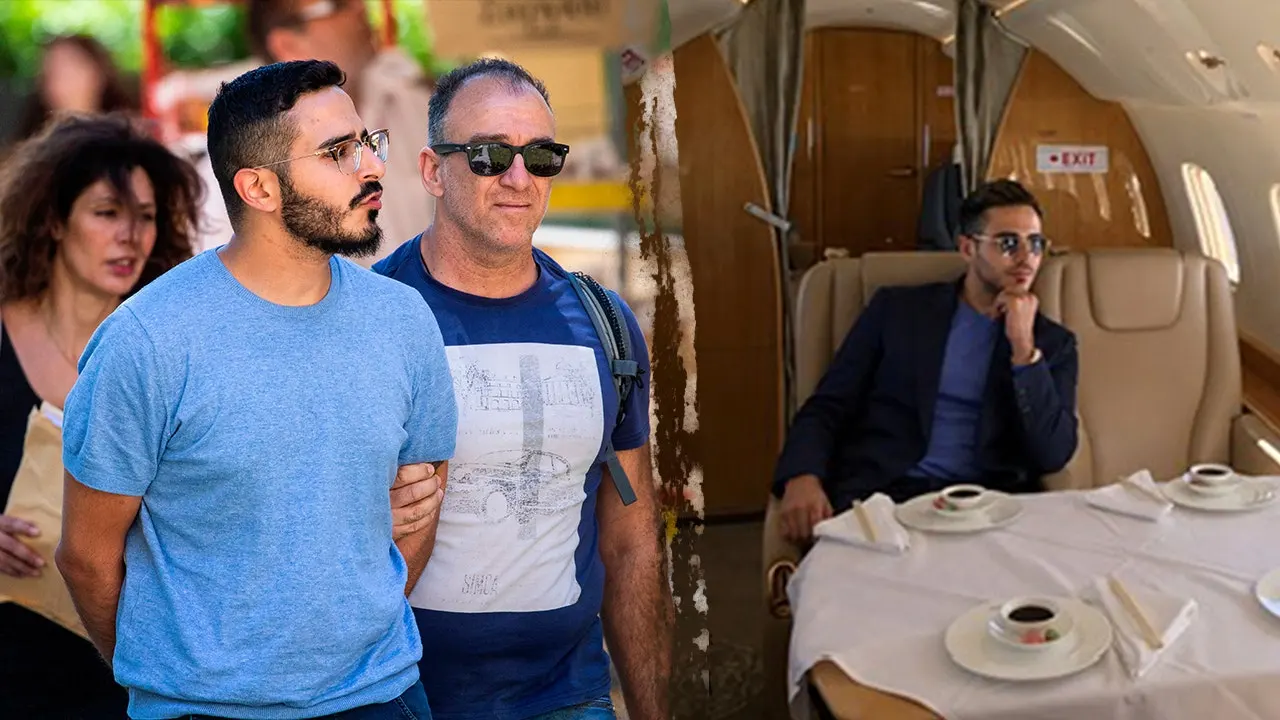
Shimon Hayut knows exactly how a romance scam works because he spent years writing the playbook. Now the man the world calls the “Tinder Swindler” says he wants to use that dark expertise to build a dating app so secure that no one like him can ever slip through again. The 36-year-old, who went by the alias Simon Leviev while conning women out of money and hearts across the globe, is preparing to release a platform called Safe Love, a dating app he claims will stop the exact kinds of deception, fraud, and false identity that made him a global byword for romance scams. It’s a twist that feels almost too cinematic: a convicted con artist, someone who used fake passports, fake names, and fake billionaire personas to fund a lavish lifestyle, now positioning himself as the ultimate guardian of online romantic safety. He even compares his trajectory to that of Frank Abagnale Jr., the real-life forger and impostor immortalized by Leonardo DiCaprio in Catch Me If You Can, who eventually reinvented himself as a respected fraud-prevention specialist. “The idea came from me being the Tinder Swindler,” Hayut said in a videoconference interview, his Israeli accent heavy with determination. “They say I made the dating environment unsafe. So I thought: all right. Let’s make it safe.” It’s an audacious pitch, and one that has already drawn sharp criticism from the online dating industry, but Hayut seems to welcome the controversy. He knows people don’t want to hear from him. But he also knows exactly how to prove them wrong.
Hayut’s criminal history is long and well-documented. He was arrested in Israel in 2011 on fraud charges, and again in 2017 in connection with the same cases. In 2015, a Finnish court sentenced him to two years in prison after authorities concluded he had defrauded three women there; he served time in Finland from September 2015 until March 2017. In 2019, he was convicted on four counts of fraud in Israel and sentenced to fifteen months, though he was released after only five. His journey to that jail cell included an extradition from Greece to Israel in June 2019, where he remained behind bars until May 2020. Hayut does not try to hide these facts; he acknowledges them plainly and says he has paid his debts to society. He used false passports and false identities, he says, and he has been convicted for it. But rather than disappear into shame, he has turned his criminal past into a credential. “I know how fake passports look,” he said, adding that he likely knows far more about them than most airport security officers, because he passed hundreds or even thousands of fake documents without ever being questioned once. He wants people to understand that this knowledge is exactly what qualifies him to challenge the system. If you want to catch a fraudster, he argues, who better than the person who once fooled everyone? He compares himself to Abagnale, who became one of the FBI’s most famous fugitives before spending decades helping banks, governments, and corporations prevent the very crimes he once committed. It is a comparison that raises eyebrows, but Hayut embraces it. His past, he insists, is precisely why he can see the gaps in online dating safety that everyone else has missed.
Safe Love is intended to close those gaps through uncompromising identity verification. Unlike mainstream dating apps that often rely on self-reported information and optional verification badges, Safe Love will require every user to upload a government-issued identification card and take a live selfie to match it. That selfie will be compared against the ID, and all profile photos must align within a strict fifteen percent tolerance of that verified selfie. In other words, you cannot post heavily filtered images, misleading angles, or old photos that make you look dramatically different from your official identity. Hayut wants to ensure that the person people meet in person is exactly the person they saw online—same face, same name, same identity. The idea, in part, was born from his own match-gone-wrong: a date in which the person who showed up was transgender, a situation he says made him realize how easy it is for a dating app to fail its users. This detail is complicated, and some may find it uncomfortable, but Hayut presents it as the moment he understood that even he, a person skilled at deception, could be deceived by the flaws in the system. In addition to verification, Safe Love will include an SOS button. If a user feels unsafe during a date, a single press will immediately begin recording audio and video from the phone, activate location sharing, and transmit that information directly to law enforcement authorities. Hayut insists that this feature could be a lifeline for people in dangerous situations. Safe Love is currently in the late stages of regulatory approval, and he says release could come in days or weeks. He is careful not to promise a date, but his ambition is clear: to rewrite the expectations of what online dating safety looks like.
Not everyone is convinced. The Online Dating and Discovery Association (ODDA), a group dedicated to promoting safety within the dating industry, has openly opposed Hayut’s plans. In a letter sent to Apple and Google, the ODDA urged both tech giants to ban Safe Love from their app stores, arguing that the platform would be an unacceptable return of a convicted romance fraudster to the environment in which he committed his crimes. The letter stated that allowing a known romance fraud offender to operate a dating platform—an environment built entirely on trust, and on the very emotional and financial vulnerabilities he has already proven he can exploit—would undermine all the work the industry has done to protect users. It called the app a “very real risk” to consumers. The word “risk” is powerful here, because Hayut’s promise of safety is difficult to separate from his history of manipulation. His victims were not naive; they were professional women who believed they were falling in love with a real person. The ODDA clearly believes that giving such a person access to a deeper pool of potential victims is dangerous, regardless of his stated intentions. Apple and Google have not publicly commented on the matter, but their decision will likely determine whether Safe Love ever reaches the market. Hayut, however, seems unconcerned. When asked about the ODDA’s opposition, he dismissed it confidently. “They won’t be able to do that, and they won’t succeed,” he said. He claims the industry is simply threatened by his product, and that their resistance is proof of how much fear he inspires. “I mean, they’re threatened by me,” he said, with the kind of certainty that either comes from brilliance or delusion.
Whatever else can be said about him, Hayut is acutely aware of the spotlight. He knows that he cannot afford a single mistake. In a normal startup, a minor technical flaw would be fixed quietly and forgotten. But for him, any failure would be framed as a return to form. “If something will go wrong, I cannot be saying, ‘Ah, we have a fault in our system.’ Automatically, I will be [considered] guilty as charged,” he admitted. His notoriety means that every feature, every user complaint, every bug will be scrutinized under the unforgiving lens of his past. There is no room for error. This pressure is why he says the app must be working perfectly before it launches. He cannot show up to the world with a half-finished product, because the world is already expecting him to fail. The same notoriety that made him infamous also gives him a kind of discipline that ordinary founders may never experience. He knows that if anything goes wrong, he will not receive the benefit of the doubt. Every time he faces a problem, he is effectively on trial again. And yet, he seems to have chosen this path deliberately. Rather than hiding from his reputation, he is leaning into it, making it the foundation of his redemption story. Whether that story is sincere or simply another con—another carefully constructed identity designed to win trust and financial backing—is the question no algorithm can answer.
At the end of the day, Hayut wants people to see him as a changed man. He acknowledges that on paper he remains a convicted criminal, but he asks the world to look beyond that label. “I’m not the same kid that I was at 19 years old,” he says. He is now a father—an unmarried one—of an eleven-year-old daughter and a three-year-old son, and he says that fatherhood has shifted his perspective in ways he never expected. People do change, he insists. And maybe he is right. The story of Frank Abagnale Jr. shows that a person with a dark past can become something new, that the skills used to defraud can be redirected toward protection. But Abagnale’s transformation was under the close supervision of the state, with decades of work in cooperation with law enforcement. Hayut’s transformation is happening in real time, on public networks, with his own marketing machine behind it. The question is whether we can trust a man who once built his life on convincing people to trust him. It is a strange, uncomfortable paradox: the same charm and cunning that made him a successful swindler might now be used to build a genuinely safe space. Or it might simply be the newest mask. Hayut wants us to believe in him, not just as an entrepreneur but as a human being. “We do change,” he says. And perhaps that is exactly what a former con artist would want us to think.