





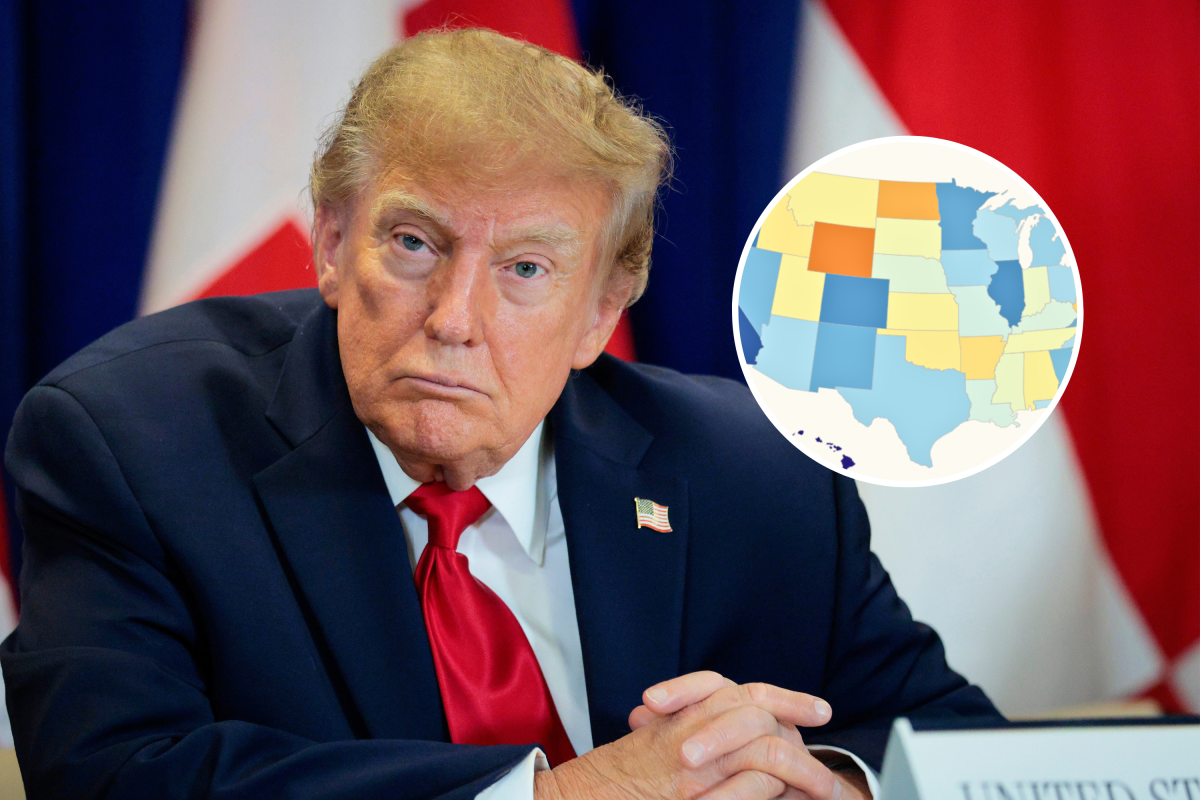
One month before the midterms, the political ground has shifted under President Donald Trump in ways that are hard to overstate. According to new polling from Civiqs, a rolling online tracker that collected more than 133,000 responses from registered voters between January 20, 2025, and October 2, 2026, Trump is now underwater in 39 states and in every major battleground state. The national numbers are stark: 34 percent approve of the job he is doing, while 60 percent disapprove, leaving him with a net approval rating of negative 26. Newsweek’s analysis compared these state-level numbers to where they stood when Trump began his second term, and the trend lines are not kind. Presidential approval is not an election forecast, of course. But it creates the weather every candidate is running in. When a president is deeply unpopular in states he won, his party has to make hard decisions about how closely to embrace him. With control of Congress at stake on November 3, that question is not theoretical. It affects recruiting, fundraising, messaging, and, most importantly, who actually shows up to vote. And right now, the map suggests that Republican candidates in competitive races are facing headwinds that have nothing to do with their own records and everything to do with the political environment their president has created.
It is not all bad news for Trump. He remains positive in a small cluster of reliably Republican states, though even there, the enthusiasm has cooled dramatically. Wyoming is his strongest state with a net approval of plus 18, down from plus 47 in January 2025. North Dakota follows at plus 15, West Virginia plus 12, Arkansas plus 9, Idaho plus 8, Alabama plus 6, South Dakota plus 5, Oklahoma plus 4, Kansas plus 3, and Utah plus 2. Montana is the only state in the entire country that is exactly tied, with 46 percent approving and 46 percent disapproving. These are not states where Republicans are likely to lose Senate or House races, but the margins matter in ways that go beyond the final result. A state like Wyoming, which should feel like political fireproof material, has seen Trump’s standing collapse by nearly 30 points. North Dakota and West Virginia have also seen double-digit declines. That matters because midterm elections are often decided by enthusiasm. If the president’s most loyal supporters are less excited than they were in 2024, they may stay home, and in a midterm, that is enough to make otherwise safe Republican seats competitive. The list of positive states is also striking for what it does not include: no Florida, no Ohio, no Texas, no Georgia, no North Carolina. Those are states where Republican presidential candidates used to expect double-digit victories. Now they are all underwater, and that changes the entire national playing field.
The demographic picture makes the challenge even clearer. Among voters aged 18 to 34, only 20 percent approve of Trump’s performance while 73 percent disapprove, a massive 53-point gap. Voters aged 35 to 49 are similarly negative, with 66 percent disapproving and only 26 percent approving. Older voters are less hostile, but Trump is still underwater with them. Among those aged 50 to 64, 51 percent disapprove and 44 percent approve; among those 65 and older, the numbers are 52 percent disapprove and 44 percent approve. Perhaps most important for any national election, independents are overwhelmingly negative: 65 percent disapprove, while just 27 percent approve. That is a devastating number in a political system where independent voters often decide control of Congress. Women also oppose Trump by a wide margin, 65 percent to 29 percent, while men are closer but still negative, with 54 percent disapproving and 39 percent approving. Education tells a similar story. Trump’s approval among postgraduates is just 24 percent, and it is only 32 percent among college graduates. Even among non-college graduates, the group that has formed the core of his political coalition, his approval sits at just 37 percent, with disapproval still exceeding approval. And the racial breakdowns are just as stark: Black voters disapprove by 90 percent to 7 percent, Hispanic voters by 70 percent to 26 percent, and white voters by 52 percent to 41 percent. These numbers are not just snapshots; they are warnings. In a midterm election, where turnout drops off among less engaged voters, the groups that are most energized against the president are often the ones who show up.
Nowhere is the problem more visible than in the battleground states, the very places that will decide control of Congress. Trump’s net approval in Arizona is negative 18, Florida negative 16, Georgia negative 25, Michigan negative 24, Nevada negative 24, North Carolina negative 15, Ohio negative 17, Pennsylvania negative 22, and Wisconsin negative 18. Every single one of those states is underwater, and several have moved dramatically against him since the start of his term. Florida began his second term at plus 9; it is now minus 16. Ohio was plus 8 and has fallen to minus 17. Nevada was exactly even at 0 and now sits at minus 24. North Carolina has moved from 0 to minus 15. These are not deep-blue states where a Republican president might expect to struggle. These are states that Trump won or competed in, states that Republicans need to hold or flip in order to keep or take control of Congress. The fact that they have all turned so negative is a sign that the political realignment many Republicans hoped for is not happening. Instead, the president is becoming a drag on the Republican brand in exactly the places where his party needs to run strongest. A Senate candidate in Georgia cannot run as an extension of a president who is 25 points underwater there. A House candidate in Pennsylvania cannot assume that Trump will bring out the voters they need to win. The battleground map has become the battleground problem.
Perhaps the most striking finding is that Trump’s approval has fallen in every single state since he took office. There is no place in the country where he has gained ground. The biggest declines have not necessarily been in the most Democratic states, but in states where Trump once had plenty of room to fall. Kentucky has dropped 33 points, from plus 23 to minus 10. Wyoming has dropped 29 points. Oklahoma, Tennessee, and Texas have all dropped 27 points. Idaho is down 26, while Alaska, Ohio, Florida, and Montana are each down 25. Even Nevada, which was already at zero, has dropped 24 points. These are enormous shifts in a relatively short period of time. They suggest that the president’s second term has worn through the goodwill he had in conservative areas without expanding his appeal anywhere else. Meanwhile, the most negative states remain deeply hostile territory. Hawaii has the lowest net approval at minus 58, followed by Maryland at minus 52 and Vermont at minus 51. California and Massachusetts are both at minus 47, Connecticut at minus 46, Washington at minus 42, New York at minus 39, and Oregon and Rhode Island at minus 38. The movement in these states is less dramatic because Trump started near his floor there. But the combination is the worst of both worlds: he has lost support in the places that should be his foundation without gaining anything in the places where he needs help.
The White House, for its part, is dismissing the polls. Spokesperson Davis Ingle has pointed repeatedly to Trump’s 2024 victory and the nearly 80 million voters who supported him as the clearest expression of public support. “The ultimate poll was November 5th, 2024,” Ingle said, adding that Americans elected Trump to deliver a popular and commonsense agenda. The White House says Trump remains focused on creating jobs, reducing inflation, and improving housing affordability, and that the administration has already made historic progress. Newsweek emailed the White House for further comment but did not receive an immediate response. There is some truth to the argument that approval ratings are not the same as election outcomes. Presidents have recovered before, and a month is a long time in politics. But the scale of the challenge here is hard to dismiss. When a president is underwater in nearly every state, when his support has fallen in every state without exception, and when the groups that usually decide elections are moving against him, the burden of proof falls on those who say it will not matter. Control of Congress is on the line, and the numbers are telling Republicans something they may not want to hear: the enthusiasm that defined 2024 is gone, and without it, the political landscape one month before Election Day looks like a very difficult place to run.