





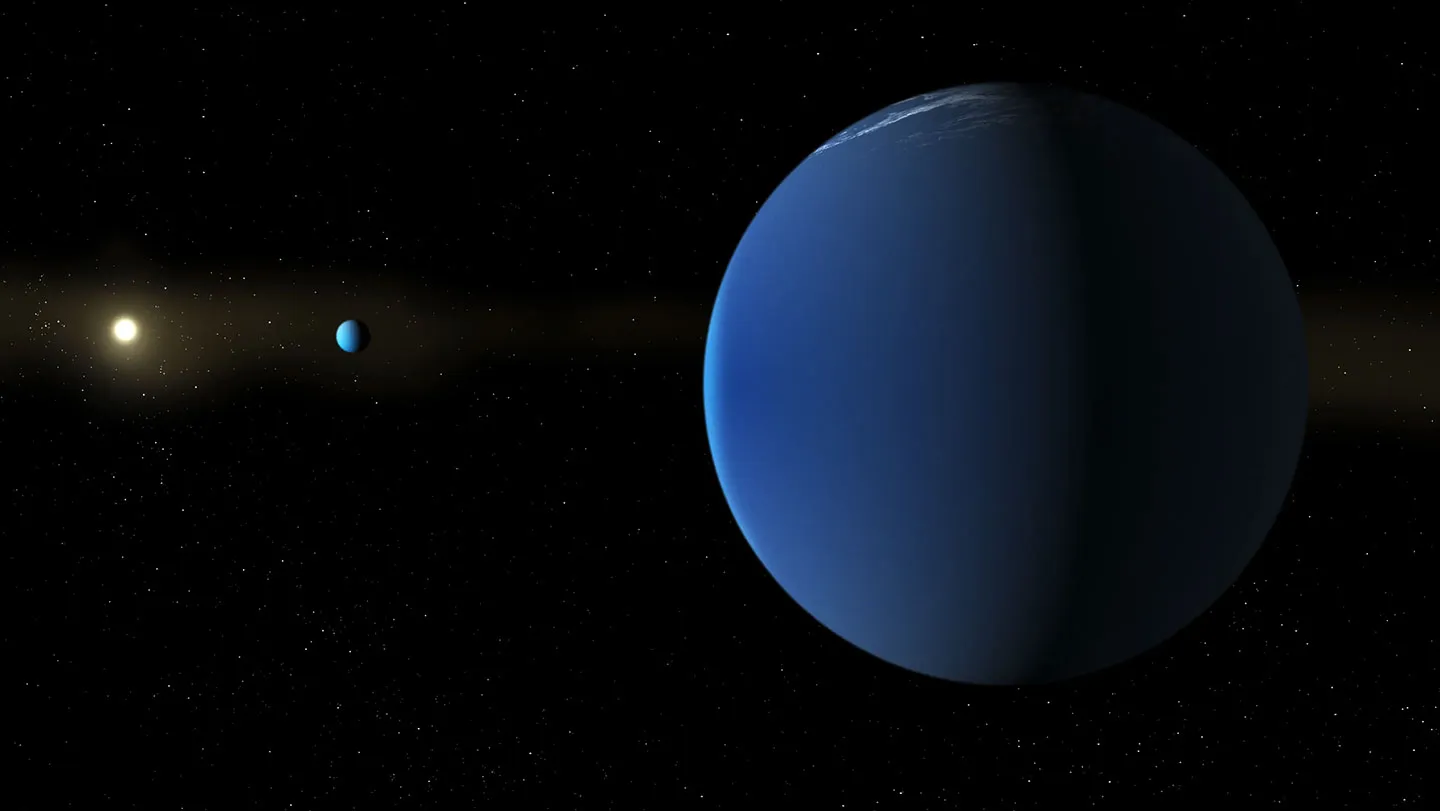
In a universe full of cosmic wonders, astronomers have stumbled upon a pair of planets that challenge our very understanding of what a world can be. These newly discovered celestial bodies, orbiting a sunlike star named TOI 791 located roughly 1,113 light-years from Earth, have earned the distinction of being the fluffiest planets ever observed. While they are roughly the size of the gas giant Jupiter, they possess less than six percent of its mass. This extreme discrepancy between scale and weight places them in a rare class of exoplanets known as “superpuffs.” To put their incredible structure into perspective, scientists estimate their densities to be between 0.038 and 0.047 grams per cubic centimeter—making them lighter and less dense than a fresh batch of cotton candy or a dollop of shaving foam.
The discovery of these airy giants was made possible through a combination of cutting-edge space technology and extreme ground-based observation. The planet-hunting TESS space telescope first spotted the worlds as they transited in front of their host star, momentarily blocking a fraction of its light. This dimmed starlight allowed researchers, led by astrophysicist George Dransfield of the University of Oxford, to calculate the physical size of the planets, finding their radii to be 0.993 and 1.155 times that of Jupiter. However, discovering a planet’s size is only half the battle; determining its density requires knowing its mass, a measurement that cannot be extracted from a simple shadow.
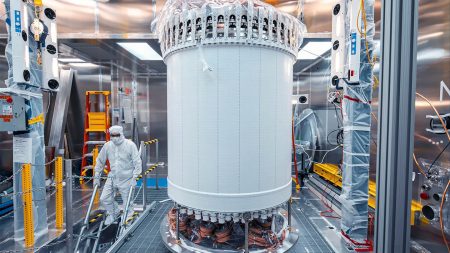
To solve the mystery of their weight, scientists relied on a delicate gravitational relationship between the two neighboring worlds. The planets are locked in a closely aligned orbital path where they periodically pass near one another, exerting a subtle gravitational tug on each other’s trajectories. Dransfield describes this cosmic interaction as a “fun little dance,” where the slight orbital variations caused by their mutual pull allowed the team to calculate their true masses. Cultivating these precise measurements required years of patient monitoring, which was uniquely facilitated by the Antarctic Search for Transiting ExoPlanets (ASTEP) telescope. Operating in the continuous, three-month winter darkness of Antarctica, ASTEP was the only instrument on Earth capable of tracking the planets’ entire twelve-hour transits—a feat Dransfield credits as absolutely essential to the discovery.
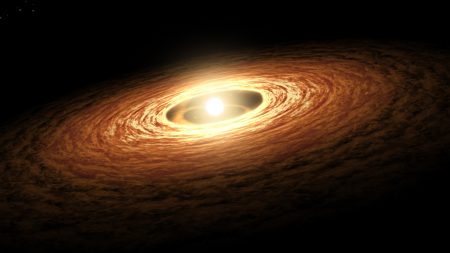
Ultimately, the data revealed that these massive structures weigh only 9.5 and 18.6 times the mass of Earth, a stark contrast to Jupiter’s hefty mass of 317 Earths. These astonishingly low numbers have reignited discussions within the scientific community regarding how such delicate, puffed-up worlds can exist without their atmospheres escaping into the vacuum of space. One leading theory suggests that these planets originally formed in the freezing, outer regions of their solar system before migrating inward toward their host star. As they drew closer to the stellar heat, their thick atmospheres gaseous envelope expanded and “puffed up,” bloating their physical profiles while keeping their overall mass remarkably low.
Alternative explanations for superpuffs have historically focused on optical illusions, such as the presence of vast, undetected planetary ring systems that trick telescopes into reading a planet as much larger than its core would suggest. However, astrophysicists like Anthony Piro of the Carnegie Observatories suggest that this is unlikely to be the case for TOI 791’s planets. Having two ring-induced illusions orbiting the very same star would be an extraordinary coincidence. Instead, Piro points to the rapid rotation of the host star as a potential indicator of youth, suggesting that we might simply be catching these planets during a temporary, intermediate stage of life. Over billions of years, as these young worlds gradually cool, their bloated atmospheres may slowly contract, turning them into more traditional gas giants.
As astronomers look to the future, the next logical step is to point the powerful James Webb Space Telescope toward TOI 791 to dissect the chemical makeup of these planetary atmospheres. Unlocking the molecular secrets of these cotton-candy worlds will offer invaluable clues about how planets form, migrate, and mature under different cosmic conditions. Beyond the sheer novelty of finding such bizarre environments, identifying and studying rare anomalies like these superpuffs helps astronomers understand the full spectrum of planetary possibilities. Ultimately, mapping these extreme alien worlds provides critical context for our own solar system, helping us better comprehend Earth’s unique place within the grand tapestry of the cosmos.