





For generations, humanity has looked back at the age of the dinosaurs with a profound sense of wonder, trying to comprehend the abrupt end of these magnificent creatures that ruled our planet for over a hundred and fifty million years. The quest to solve this prehistoric cold case has sparked intense debate within the scientific community, dividing researchers into passionate camps. For decades, one dominant theory suggested that a series of massive, long-term volcanic eruptions in what is now India destabilized the global climate, slowly choking the dinosaurs out of existence long before the final blow was dealt. Another widely accepted school of thought painted a tragic picture of a slow, freezing twilight, proposing that after a colossal asteroid struck the Earth 66 million years ago, a massive shroud of dust and soot blanketed the atmosphere, blocking the sun, halting photosynthesis, and causing the dinosaurs to slowly starve to death in a dark, barren wasteland. However, this long-standing narrative of a slow, agonizing decline is now being challenged by a far more immediate and terrifying reality. Recent scientific revelations suggest that for the dinosaurs walking the land, there was simply no time to starve, as their world was transformed into a literal furnace in a matter of mere hours.
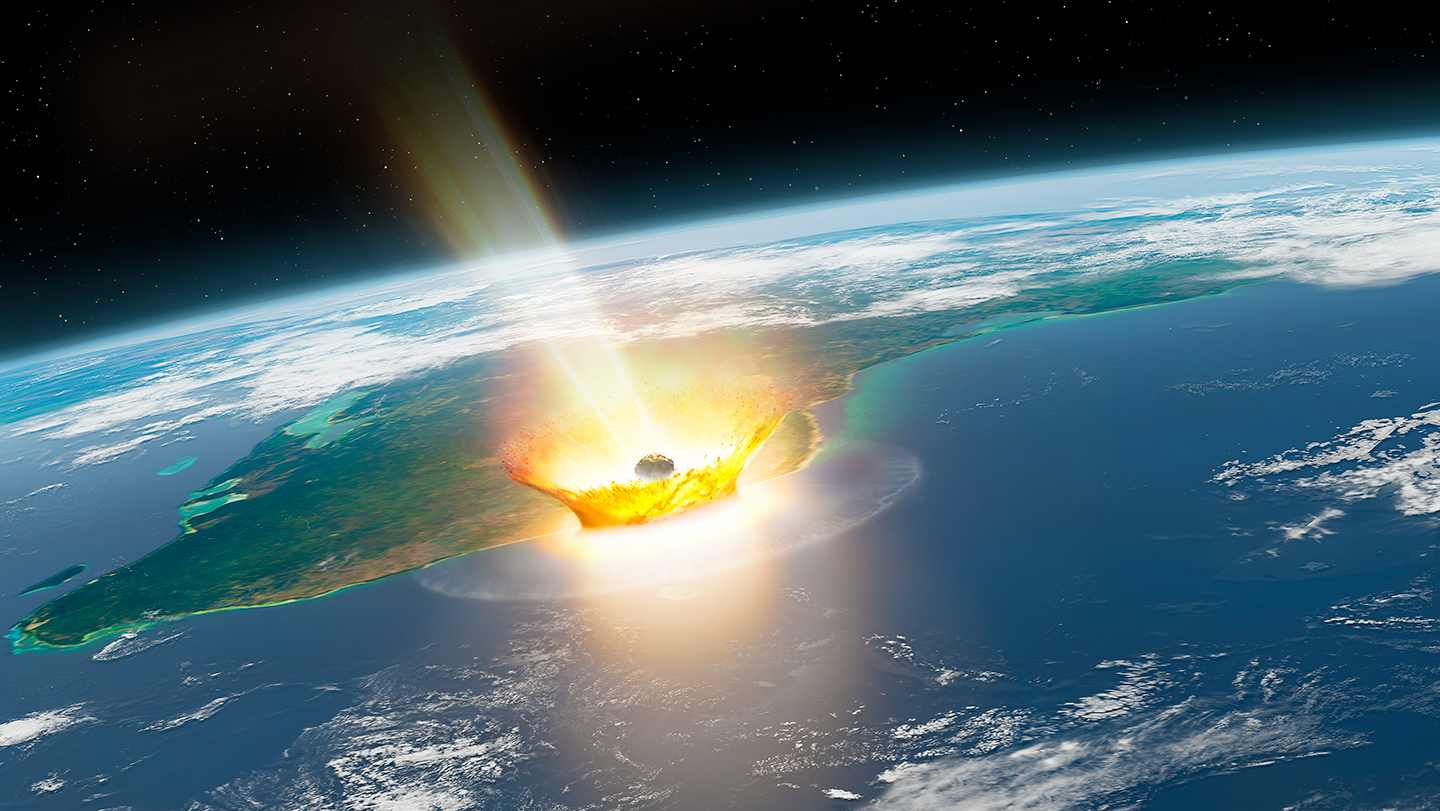
A groundbreaking study published in the Journal of Geophysical Research: Biogeosciences has forced us to dramatically rewrite our understanding of that fateful day, revealing that many land-dwelling dinosaurs were incinerated by a sudden wave of intense thermal radiation almost immediately after the impact. When the mountain-sized asteroid collided with the shallow waters of what is now the Gulf of Mexico, it did not merely kick up a cloud of dirt; the sheer kinetic energy of the impact vaporized the surrounding crust, carving out the massive, 200-kilometer-wide Chicxulub crater. This vaporized rock exploded upward into the upper reaches of the atmosphere, where some of it cooled and condensed into tiny, glass-like droplets of molten rock, while the rest dispersed as an ultra-fine global dust cloud. In the minds of scientists and the public alike, this dust has long been viewed as a slow-acting poison that dimmed the sun, but this new research indicates that the immediate journey of this displaced material back down to Earth was far more cataclysmic than the cold dark that followed it.
To understand the terrifying mechanics of this atmospheric backfire, planetary scientist Brandon Johnson of Purdue University and his team turned to physical evidence preserved in ancient asteroid deposits located in North Dakota. By analyzing these geological fingerprints, Johnson’s team simulated the global progression of the debris cloud as it was thrown across the globe, revealing a nightmarish chain reaction. As the trillions of molten rock droplets fell back through the atmosphere under the pull of gravity, they did so with the relentless speed and force of falling bullets, generating an unimaginable amount of friction and kinetic heat. Instead of escaping harmlessly back into the vacuum of space, this immense thermal energy was trapped beneath the rising blanket of fine dust, radiating back down toward the Earth’s surface like a global heat lamp turned to its maximum setting. Within minutes, the ambient air temperature across the globe soared, turning the daytime sky an ominous, glowing red and subjecting any living creature caught without shelter to a thermal blast roughly 17 times more intense than what would be lethal to a human being.
This intense, suffocating heat wave lasted for about an hour, transforming the lush Cretaceous forests into a global oven where exposed animals had absolutely nowhere to run. The sheer intensity of the thermal radiation was so extreme that it caused dry vegetation, leaves, and forests across entire continents to spontaneously ignite, sparking rampant, unstoppable wildfires that consumed vast swaths of the planet’s surface. By the time the primary thermal wave finally dissipated, the sky did not clear; instead, the sun was utterly blotted out by a dense mixture of asteroid dust, soot, and smoke from the raging global conflagrations. The only light remaining on Earth during those first terrifying hours came from the flickering, apocalyptic glow of burning forests, a stark and lonely contrast to the vibrant, green world that had existed just hours prior. Under this new hypothesis, the vast majority of terrestrial life did not fade away over weeks or months of starvation, but was instead wiped out in a single, devastating afternoon.
Yet, as compelling and terrifying as this firestorm theory is, it also highlights the incredibly complex and selective nature of mass extinctions, particularly when it comes to life beneath the waves. As planetary scientist Cem Berk Senel of the Royal Observatory of Belgium points out, even the most intense terrestrial fires and thermal pulses are incapable of penetrating deep into the oceans, which would have insulated marine life from the immediate heat. This explains why the extinction event required a secondary, longer-lasting mechanism to wipe out the diverse marine ecosystems of the late Cretaceous period, such as the monstrous mosasaurs and coiled ammonites. For the oceans, the traditional theory of an “impact winter” remains the most likely culprit, as the prolonged absence of sunlight shattered the marine food web from the bottom up, starving the microscopic plankton that supported all ocean life. The tragedy of the dinosaurs was therefore a dual catastrophe: an instant firestorm that cleansed the land, followed by a cold, dark, and silent winter that slowly drained the life from the seas.
For the rare and fortunate survivors on land, the passing of the initial thermal blast was merely the beginning of a grim struggle for survival in a ruined world. Small, unassuming creatures—such as early mammals, burrowing reptiles, and ancestors of modern birds—only survived because they were able to retreat deep underground, into caves, or beneath the water’s surface, shielding themselves from the lethal sky. When they finally emerged, they did not find their familiar habitats, but a dark, freezing landscape choked with toxic ash, soot, and the ruins of a collapsed ecosystem. Enduring the years of darkness and food scarcity that followed required an extraordinary level of evolutionary resilience and sheer luck. It is a humbling and profound realization that our own existence hangs by this thin, fragile thread of survival; if those tiny, terrified creatures had not clung to life in their subterranean shelters while the world burned above them, the human story would never have even begun.