




The Girl They Feared Would Rise: Uncovering Zosia’s Haunting 17th-Century Burial
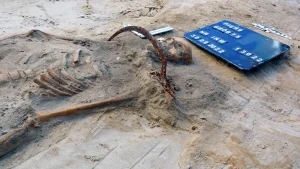
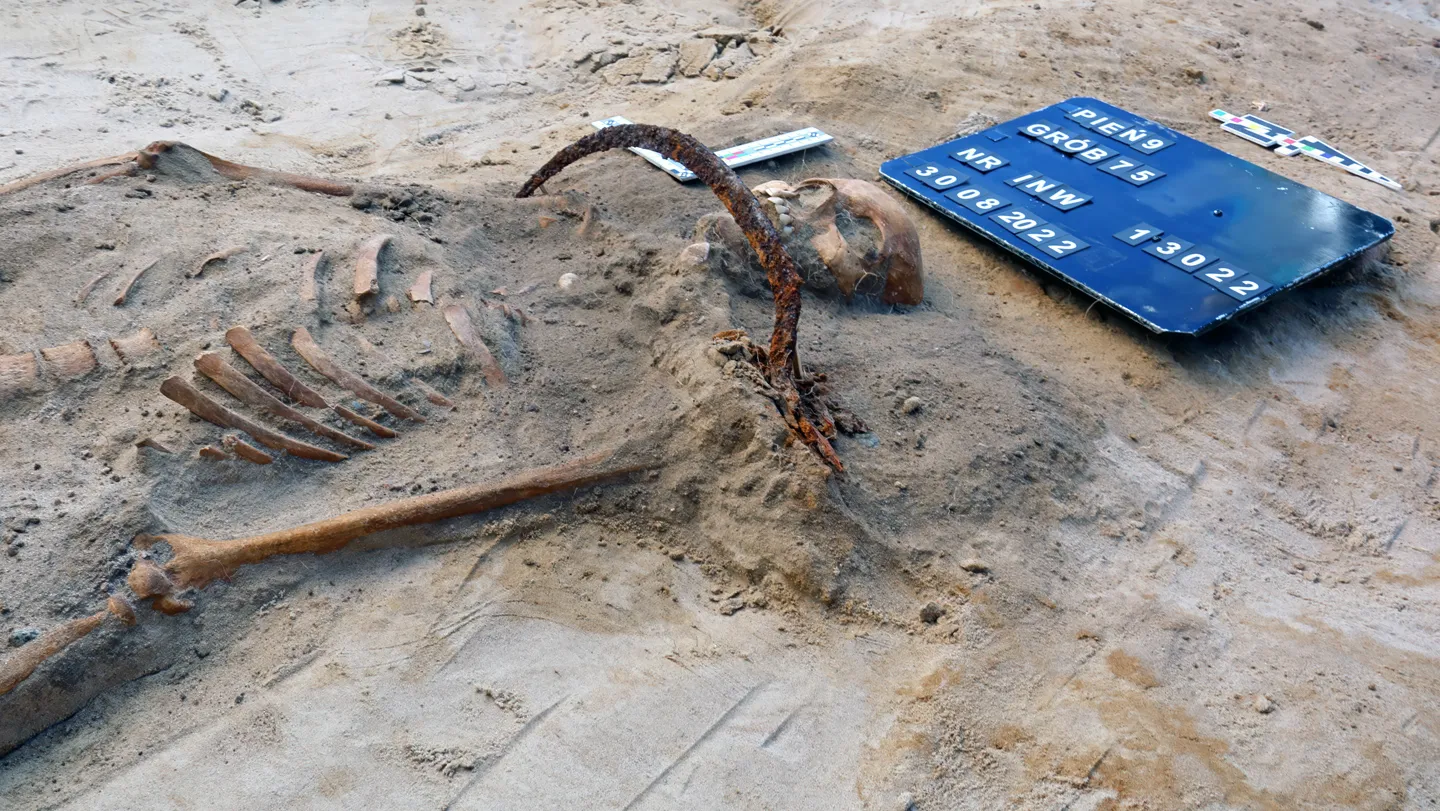
In the quiet countryside of north-central Poland, beneath the soil of a small cemetery in Pień, archaeologists made a discovery in 2022 that reads like something straight out of a horror story. Buried deep in the earth lay the remains of a young woman, her final resting place arranged with such care and yet such terror that it speaks volumes about the fears of those who laid her to rest. The woman, whom researchers have affectionately named Zosia, was discovered with a sickle—its serrated blade carefully positioned to hook over her throat, as if to sever any attempt she might make to rise from her grave. Adding to this macabre scene, a triangular padlock had been secured around the big toe of her left foot, a deliberate restraint meant to keep her anchored firmly in the earth. The sheer intentionality of these precautions reveals a community so terrified of this young woman that they took extraordinary measures to ensure she could never return to the world of the living.
The archaeological team, led by Dariusz Poliński of Nicolaus Copernicus University in Toruń, has spent considerable time piecing together the story behind this extraordinary burial. The placement of the sickle and padlock leaves little room for interpretation—these were protective measures designed to shield the living from Zosia after her death, with the explicit purpose of preventing her from rising from her grave. What makes this discovery particularly significant is that while similar artifacts have been found in other post-medieval European tombs, Zosia’s grave represents the first known instance where both anti-revenant measures were combined. The researchers published their findings in the Journal of Archaeological Science: Reports, documenting how these items were historically believed to protect the living from the dead. The fear that drove people to such extremes was not unique to Poland—similar practices appeared across Europe—but the combination of these particular precautions in a single burial makes Zosia’s case exceptional in the archaeological record.
The physical evidence tells a fascinating story about both Zosia’s life and the circumstances of her burial. Her skeleton reveals she was between seventeen and nineteen years old at the time of her death—barely more than a teenager by modern standards. The positioning of her leg bones suggests the padlock was attached when she was first interred, indicating that whoever buried her immediately recognized her as someone who might attempt to escape her grave. However, the disturbed soil and the unusual angle of her left arm tell a different story—one of a grave that was later reopened, likely to add the sickle as an extra layer of protection. This suggests that perhaps Zosia’s initial burial wasn’t enough to ease the community’s fears, and they returned to reinforce their precautions. Even more unsettling, examination of her skull revealed greenish stains, evidence that copper objects had been shoved into her mouth or nose. This additional measure aligns with Polish folklore, which held that copper could ward off vampiric demons known as strzygi—creatures believed to rise from their graves to terrorize the living.
The scientific analysis of Zosia’s remains paints a picture of someone who might seem an unlikely candidate for such treatment. Chemical analysis of the isotopes in her teeth suggests she grew up near Pień, making her a local rather than an outsider. Yet her DNA tells a more complex story—her mother’s lineage may have traced back to Scandinavia, hinting at connections beyond the immediate region. Most surprisingly, remnants of a silk cap adorned with threads of pure silver and gold were found on her head, suggesting she was a woman of considerable wealth and high social status. This combination of local origins and apparent privilege complicates the traditional narrative of who might receive such unusual burial treatment. Typically, historical records suggest that those singled out for strange burials were often outsiders or individuals who lived difficult lives on the margins of society. But Zosia doesn’t neatly fit either category, leaving researchers to puzzle over what made her so feared by her community.
The question of why Zosia received this treatment remains open, though researchers have begun to rule out some possibilities. There are no obvious signs of injury or illness on her skeleton that might explain sudden or violent death, and her apparent wealth and local origins seem to contradict explanations based on social marginalization. The research team continues to examine her DNA for clues about how she died, hoping that genetic evidence might unlock the mystery of her final days. It’s possible that particularly violent or unusual circumstances surrounding her death sparked the community’s fear, or perhaps something about her appearance or behavior during life marked her as different or dangerous. The fact that her grave was reopened after initial burial suggests that the fear didn’t diminish with time—if anything, it may have grown stronger, prompting the community to take additional precautions even after Zosia had been in the ground for some time.
The cemetery at Pień itself adds another layer of mystery to this already strange story. Zosia’s grave is just one of several unusual burials found there, including a boy who was buried face down with a padlock on his right foot. Perhaps most tellingly, that boy’s grave was also reopened, with most of his remains removed, leaving only his lower legs and feet behind. The cemetery’s very existence is puzzling—there are no written references to it, it appears on no maps, and it was located away from the village, possibly on unconsecrated ground. This suggests the cemetery was specifically designated for people whom society had rejected or feared, making it a repository for the dead that the living wanted to keep at a distance. For researchers like Sandra Garvie-Lok of the University of Alberta, the site represents an extraordinary opportunity to understand the fears and beliefs of 17th-century communities—a window into a world where the boundary between the living and the dead was more porous, and where fear of the deceased could drive communities to extraordinary lengths to protect themselves. The discovery of Zosia and her fellow outcasts reminds us that history is filled with stories of people who were different, feared, or misunderstood—and that sometimes, the dead have as much to tell us about the living as they do about their own lives.