





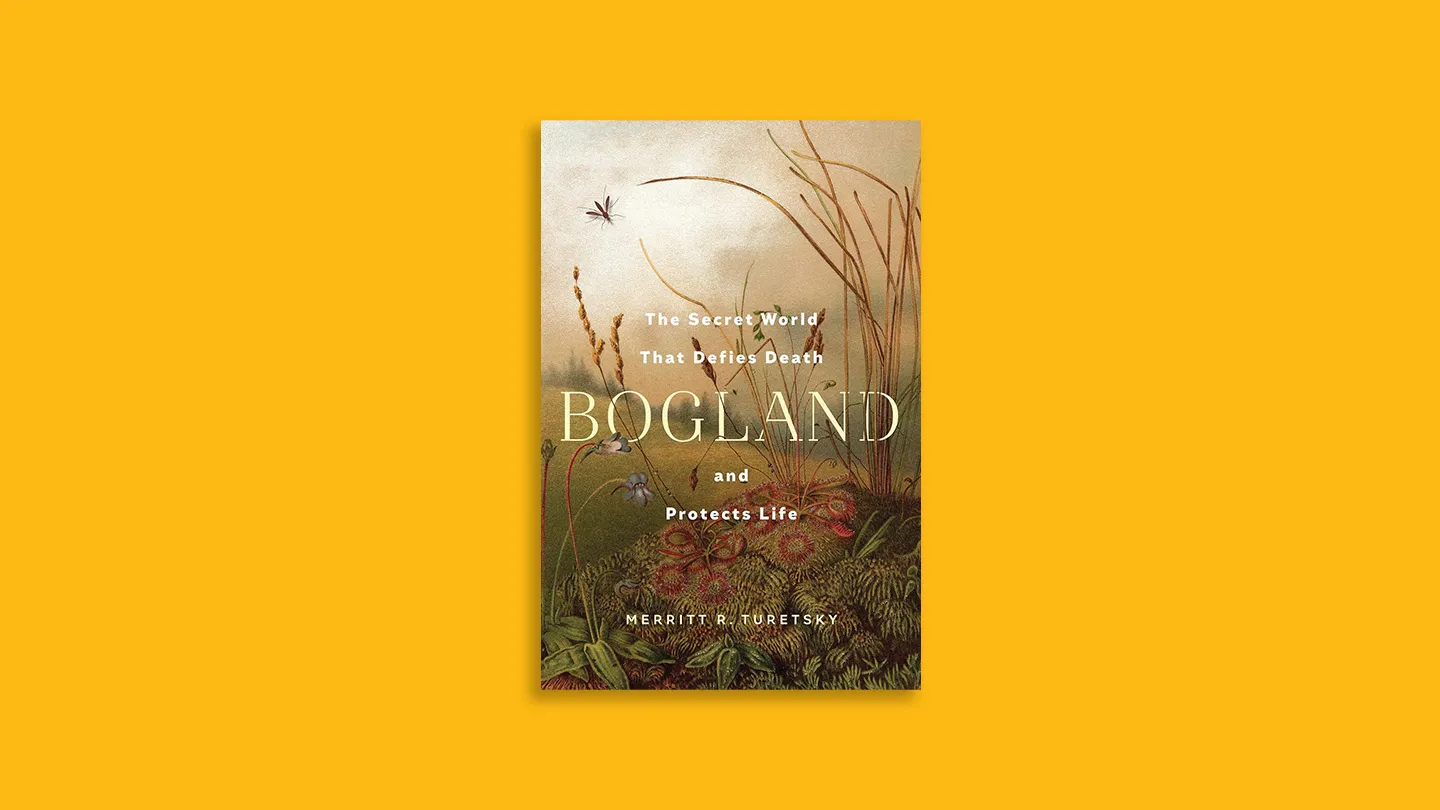
Thank goodness Merritt Turetsky became captivated by boglands. The ecosystem ecologist at the University of Colorado Boulder has written a book, Bogland (W.W. Norton, $29.99), that is equal parts memoir, natural history, and plea for respect. I came to it with a vague, dismissive mental image: bogs as cold, smelly, mucky places where nothing exciting happens. Turetsky changed my mind within a few pages. In her telling, bogs are not wastelands or obstacles; they are “buffering the space between forest and river,” refusing to be defined as either land or water. They are soggy and oxygen-starved, which means the microbes that normally rot dead plants can barely do their job. Instead of decomposing, organic matter builds up, layer after layer, into carbon-rich peat. That peat is the defining feature of bogs. No other ecosystem makes a substance quite like it, and no other ecosystem depends on it the way bogs do. Reading this, I began to understand why Turetsky calls them vital, even beautiful. A bog is a slow, wet alchemy, turning soggy moss into a substance that can preserve ancient bodies, store enormous amounts of carbon, and support bizarre carnivorous plants. It is not simply a swamp. It is a living archive, a waterlogged treasure chest of ecological memory. Turetsky’s enthusiasm is contagious; by the end of the opening chapters, I was ready to lace up my boots and find the nearest peatland.
Boglands, Turetsky explains, are not all the same. They are broadly split into bogs and fens, with occasional appearances by marshes and swamps. Bogs are fed primarily by rain, which makes them low in nutrients and acidic; they are the realm of sphagnum moss and carnivorous plants like sundews and pitcher plants, which have to catch insects because the soil gives them so little. Fens, by contrast, draw water from streams, groundwater, and rain alike, so they are richer in nutrients and can support a far wider range of plant life. Turetsky’s own adventures illuminate these facts with vivid human moments. Her “bug baptism” happened on a college trip to a bog in Nova Scotia. She stood in her netted headgear as hundreds of mosquitoes, black flies, and other insects swarmed around her. The noise, she writes, is “seared deep into my memory”; after half an hour she realized she had to conquer the whine or lose her mind. That moment of surrender is so specific and so relatable. It is exactly the kind of experience that separates armchair naturalists from field scientists. Turetsky reaches out with both hands, literally, into the murk, and she takes us with her. In her descriptions, I felt the swarm and the damp heat, the squelch of muck, and the strange peace of standing in a bog, surrounded by life that has evolved to survive in an impossible place. She makes field research feel both heroic and gloriously messy.
The book really soars when Turetsky dives into her own bogland adventures, especially in the tropics. I was transfixed by the chapter set in Brunei, where she meets a peatland restoration research team. They wade into waist-deep water, pass through a rehabilitated area, and eventually arrive at a healthy peat swamp. It is, she writes, “pure pitcher plant heaven,” unlike anything in her northern bogs. Pitcher plants grow not only on the ground but dangle from trees in layers, their colors and shapes almost too fantastical to be real. Reading it, I thought of the imaginary landscapes Dr. Seuss might have drawn. This secret garden is both magical and scientifically fascinating, a reminder that peatlands are not only the soggy, Northern European bogs of popular imagination; they also exist in tropical rainforests, teeming with biodiversity. Turetsky’s descriptions made me want to see them, and her awe was so genuine that I found myself grinning. It’s in these moments—the insect swarms, the deep-arm reaches into dark water, the wading through muck with devoted co-workers—that the book stops being a lecture and becomes an invitation. She isn’t just telling us about ecosystems; she’s letting us feel what it is like to be in love with a landscape that many people find repellent. That is no small gift. The secret garden becomes a metaphor for the entire book: a hidden world that reveals itself only if you are willing to get your feet wet.
But Turetsky is careful not to romanticize boglands into harmless fairylands. Along with beauty and wonder, they harbor real danger. She tells a chilling story of getting lost when she left her team to check something at a study plot alone. Even on familiar ground, the bog was deceiving. The same features that make bogs fascinating—their flatness, their mossy sameness, their strange acoustics—can disorient even an experienced scientist. She writes, “I was disoriented even as I felt surrounded by what seemed well-known.” That line hit me hard, because it captures something true not just about bogs but about any place we think we know. Luckily, she found her team before anyone had to start a search-and-rescue. But the episode lingers, and it deepens the book. Turetsky celebrates the contradictions of boglands. They are filled with decay yet teeming with life; they are places of refuge and risk; they are allies in a warming world and potential enemies if we damage them. This refusal to simplify is what makes the book so trustworthy. She doesn’t ask us to love bogs despite their dangers. She asks us to love them because of their complexity. A bog is neither land nor water, neither savior nor threat; it is both at once. In a time of climate anxiety, that kind of nuanced, grounded affection feels genuinely refreshing.
The stakes, as Turetsky lays out, could hardly be higher. Peatlands occupy only about 3 percent of the world’s land area, yet they store around 30 percent of Earth’s soil carbon. That is more carbon than all the world’s forests hold in their biomass, even though forests cover far more ground. Huge carbon stores, sitting in wet, acidic ground, have remained locked away for millennia. But this is exactly what makes bogs so vulnerable and so important. When they are drained for agriculture, damaged by wildfires, or stressed by drought and climate change, those ancient carbon stores can be released, adding enormous amounts of greenhouse gases to the atmosphere. Turetsky’s warning is clear: we are unraveling one of the planet’s best natural climate solutions. I confess that the climate sections lost me a little. She mentions specific warming periods and ice ages, and at times I felt the way she must have felt in that bog: turned around and uncertain of my bearings. I would have appreciated more basic context about those geological timeframes. But the bigger story came through. Boglands are not timeless, static places. They have been forming, growing, and shifting for thousands of years, always changing, always accumulating peat. To disturb them is to break a boundary between the past and the present. Turetsky is not just an advocate for moss; she is a translator of geological time, and her message is urgent. The bogs we ignore today might be the very landscapes that determine our future.
By the end of Bogland, I had not only learned a great deal; I had been converted. I emerged firmly on team boglands. Turetsky’s passion, woven through every chapter, ignited a reverence in me for ecosystems I had never thought twice about. Her book is a reminder that wonder is available in the most overlooked places—if you’re willing to get muddy. The final gift arrives in the closing pages: a list of bogs, many with boardwalks, that people can actually visit. I found myself reaching for my bug spray. What else can a book do? It can change the way you see the ground beneath your feet. It can make you want to stand in a mosquito-thick bog and listen. It can convince you that a place built on rot and water is one of the most alive, precious landscapes on Earth. Bogland is available from W.W. Norton at $29.99, and if you buy it through Bookshop.org, the publisher’s affiliate program supports the bookshop ecosystem. But more importantly, read it. Read it before you walk past a bog without seeing it. Turetsky has written a love letter to the in-between places, and after spending time in her prose, I suspect you’ll be hooked too. After all, what could be more human than finding beauty in the murky, messy, life-giving ground we usually try to avoid?