




In the crushing darkness of the deep Australian Abyss, where sunlight never reaches and the pressure could crumple a submarine like paper, the most unnerving sights are often the ones that glow. There, in the cold and silent vastness, giant sea spiders creep across the muddy seafloor on legs that can stretch a remarkable 25 centimeters—nearly the length of a human forearm. These aren’t the tiny, harmless garden-variety spiders people sweep out of their homes; these are otherworldly creatures with finger-sized bodies and impossibly long, spindly limbs. What makes them truly haunting, however, is the fact that they shine. They emit a soft, eerie light from their undersides, drifting through the darkness like disembodied apparitions. For researchers, these glowing giants are not a nightmare but a marvel. Their discovery, published in the October issue of Deep Sea Research Part I: Oceanographic Research Papers, confirms that these unusual arachnids are bioluminescent—a trait that makes them both fascinating and, in the words of one delighted marine biologist, “quite impressive for people scared of spiders.”
That scientist is Jérôme Mallefet, a marine biologist at the Catholic University of Louvain in Belgium, and his encounter with these glowing giants began on a 2017 expedition to survey a deep-sea trench off the southeastern coast of Australia. For weeks, the research vessel Investigator cruised over some of the most alien terrain on Earth, hauling up treasures from depths of nearly 5,000 meters. But Mallefet wasn’t interested in the rocks or the sediment—he was hunting for light. Working out of a makeshift darkroom aboard the ship, he examined each of the roughly 25,000 specimens that came up in the nets, gently testing any creature suspected of harboring the ability to glow. It was a laborious, almost monastic task. He spent most of his time in a small, windowless room kept at a bone-chilling 6 degrees Celsius, surrounded by jars of deep-sea life, his breath visible in the air as he worked under dim red light. “I spent most of my time in 6° Celsius, in a dark cold room,” he recalled with a mix of weariness and affection. “I believe I was a little bit crazy, but I like that.”
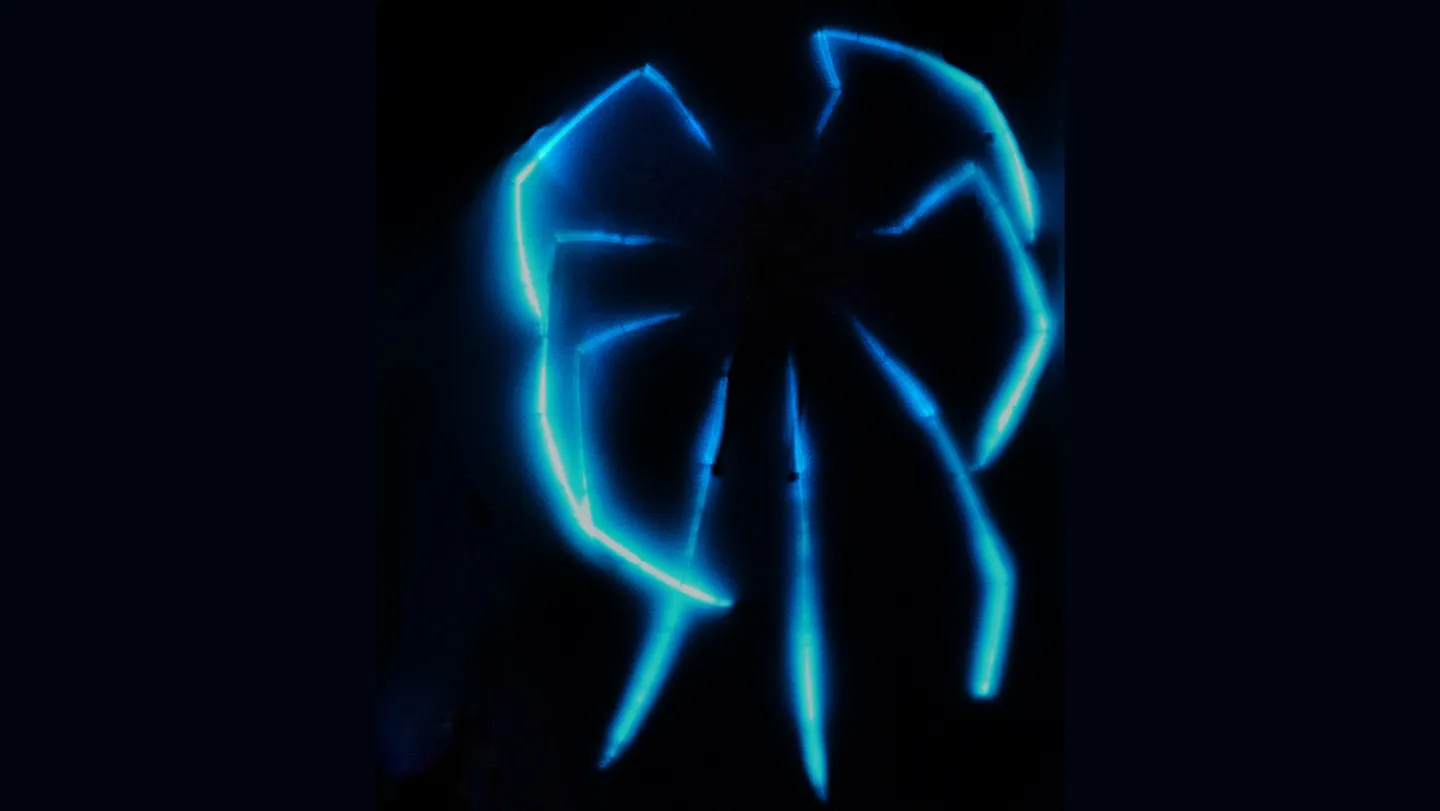
The madness paid off. When Mallefet and his team poked the largest of these sea spiders, a species called Colossendeis tasmanica, they were rewarded with a faint but unmistakable glimmer. The light was dim, barely visible to the naked eye, but it was there—a soft radiance emanating from the animal’s elongated legs. Intrigued, the team tried something more direct. They applied a solution of potassium chloride, a chemical known to excite bioluminescent cells, to the creatures. The results were spectacular: the spiders lit up brilliantly, their entire bodies glowing for up to ten minutes in the dark room, a slow, luminous pulse that transformed them into living lanterns. A second species, C. minor, also glowed when treated the same way. These observations provided the first unambiguous photographic confirmation of bioluminescence in sea spiders, validating tales that had floated around the edges of marine biology for over a century. Indeed, one particularly poetic account from more than a hundred years ago described a sea spider lying on its back, “shone like a star, all its legs being lit along their length.” Now, finally, that poetic vision had been captured on film, transformed from a sailor’s tale into a scientific fact.
What makes the glow even more intriguing is where it comes from. Mallefet and his colleagues noticed that most of the luminescence appears on the underside of the spiders’ legs, in the region where their digestive tracts are located. This anatomical detail offers a tantalizing clue about the origin of the light. The researchers speculate that the sea spiders might not produce their own bioluminescence at all. Instead, they may acquire it from their diet—specifically, from creatures like sea anemones, which are well-known bioluminescent organisms. If the spiders eat glowing prey, it’s possible that the luminous properties are retained in their digestive tissues, effectively turning the spiders into glowing vessels powered by their last meals. It’s a clever and somewhat ironic survival strategy: a predator that steals light from its prey, carrying the glow with it as it hunts through the abyss.
The story becomes even stranger when fluorescence enters the picture. Bioluminescence involves the chemical production of light, but fluorescence is something different—it’s the absorption of light at one wavelength and the re-emission of it at another, typically a brilliant green. Mallefet and his team found that three sea spider species—C. tasmanica, C. minor, and a third species that showed no bioluminescence—all fluoresced brightly when exposed to ultraviolet and blue light. This is a phenomenon shared by some unexpected animals; several species of amphibians and even platypuses are known to fluoresce under certain wavelengths, turning a drab brown coat into a shimmering spectacle of green and blue. But why would a deep-sea spider fluoresce? Mallefet admits he isn’t sure. The function remains a mystery, wrapped in the larger enigma of why deep-sea creatures go to such lengths to produce or manipulate light in the first place. What is clear is that these animals are not just passive dwellers of the deep; they are active players in a hidden world of light and color that humans are only beginning to comprehend.
Bioluminescence is, in fact, one of the most widespread forms of communication in the deep sea. Roughly 76 percent of deep-sea creatures produce their own light, a trait that first evolved an astonishing 540 million years ago. In the perpetual darkness of the abyss, light serves as a language—a way to attract mates, lure prey, warn off predators, or simply illuminate the surrounding gloom. For the giant sea spiders, the glow may serve several purposes. Mallefet speculates that the bioluminescence could be used to attract a mate in the vast, empty darkness, a luminous beacon saying, “I am here.” Alternatively, since the light is most visible along their appendages, the spiders might use it to see their prey on the seafloor. Once they zero in on an unsuspecting victim, they collapse upon it, using a needle-like appendage inside their proboscis to pierce the flesh, inject digestive fluids, and then liquefy and suck up the tissues. It is, by any measure, a gruesome feeding strategy, rendered all the more alien by the creature’s glowing limbs. But Mallefet is quick to note that observing this behavior in action will require the next leap in deep-sea technology—advanced underwater video systems capable of capturing these shy predators in their natural environment, moving slowly through the abyssal dark, their legs shining like faint stars in an endless night. For now, the images they’ve captured offer a rare and awe-inspiring glimpse into a world where even the spiders carry their own light, a world that remains, in so many ways, far more wondrous than the darkest nightmare.