





For decades, science fiction has painted a vivid picture of artificial intelligence as the ultimate co-pilot for deep-space exploration. From the soft-spoken HAL 9000 to the witty TARS in Interstellar, these fictional entities effortlessly calculate complex orbital trajectories, monitor life support systems, and make split-second decisions in the face of cosmic anomalies. They are portrayed as the ultimate safety net, capable of safeguarding fragile human biological pods across the vast, hostile vacuum of the universe. In these narratives, AI is the bridge between human curiosity and the terrifying unknowns of the cosmos. However, as we stand on the precipice of a new era of real-world space exploration, we are forced to confront a sobering reality: our current AI technology is nowhere near intelligent or adaptable enough to fulfill these grand sci-fi promises.
To understand why our current AI falls short, we must look at the fundamental difference between the “narrow” intelligence we possess today and the “general” intelligence required for space survival. The machine learning models driving modern breakthroughs—like large language models and autonomous driving algorithms—are incredibly powerful, but they are essentially hyper-advanced pattern recognition engines. They rely on vast, curated datasets of past human experiences to make predictions about the future. Deep space, by its very definition, is an environment of absolute novelty. When a spacecraft ventures beyond the protective bubble of Earth’s magnetosphere, it enters a realm of unpredictable radiation storms, uncharted gravitational anomalies, and unprecedented hardware failures. A narrow AI cannot look up a solution in its training data if the problem it is facing has never been encountered before in human history.
This limitation becomes a critical vulnerability when we consider the agonizing physical realities of space travel, particularly the issue of communication latency. When astronauts eventually journey to Mars, radio signals will take up to twenty minutes to travel one way between the spacecraft and Earth. In a critical emergency—such as a sudden hull breach, a solar particle event, or a catastrophic life support failure—waiting forty minutes for a response from mission control is a death sentence. The spacecraft’s onboard systems must be able to diagnose the problem, weigh the risks, and implement a creative, real-time solution entirely on their own. Today’s AI lacks the common-sense reasoning, causal understanding, and existential awareness required to make these kinds of high-stakes, gray-area executive decisions under extreme pressure.
Furthermore, the harsh physical environment of space itself poses a significant threat to the complex computing hardware that modern AI requires. The advanced neural networks we use on Earth run on massive, energy-hungry data centers cooled by endless supplies of water and air. Translating this computational power to a compact, highly constrained spacecraft is an engineering nightmare. Cosmic radiation constantly bombards silicon chips with high-energy particles, which can flip bits of data, fry delicate microprocessors, and corrupt active memory. Safekeeping a highly sensitive, power-thirsty AI brain on a multi-year journey through a radioactive void requires heavy shielding and redundant architectures that add prohibitive weight to the payload. Until we can develop highly resilient, low-power neuromorphic hardware that mimics the biological efficiency and plasticity of the human brain, running a truly intelligent AI in deep space remains a pipe dream.
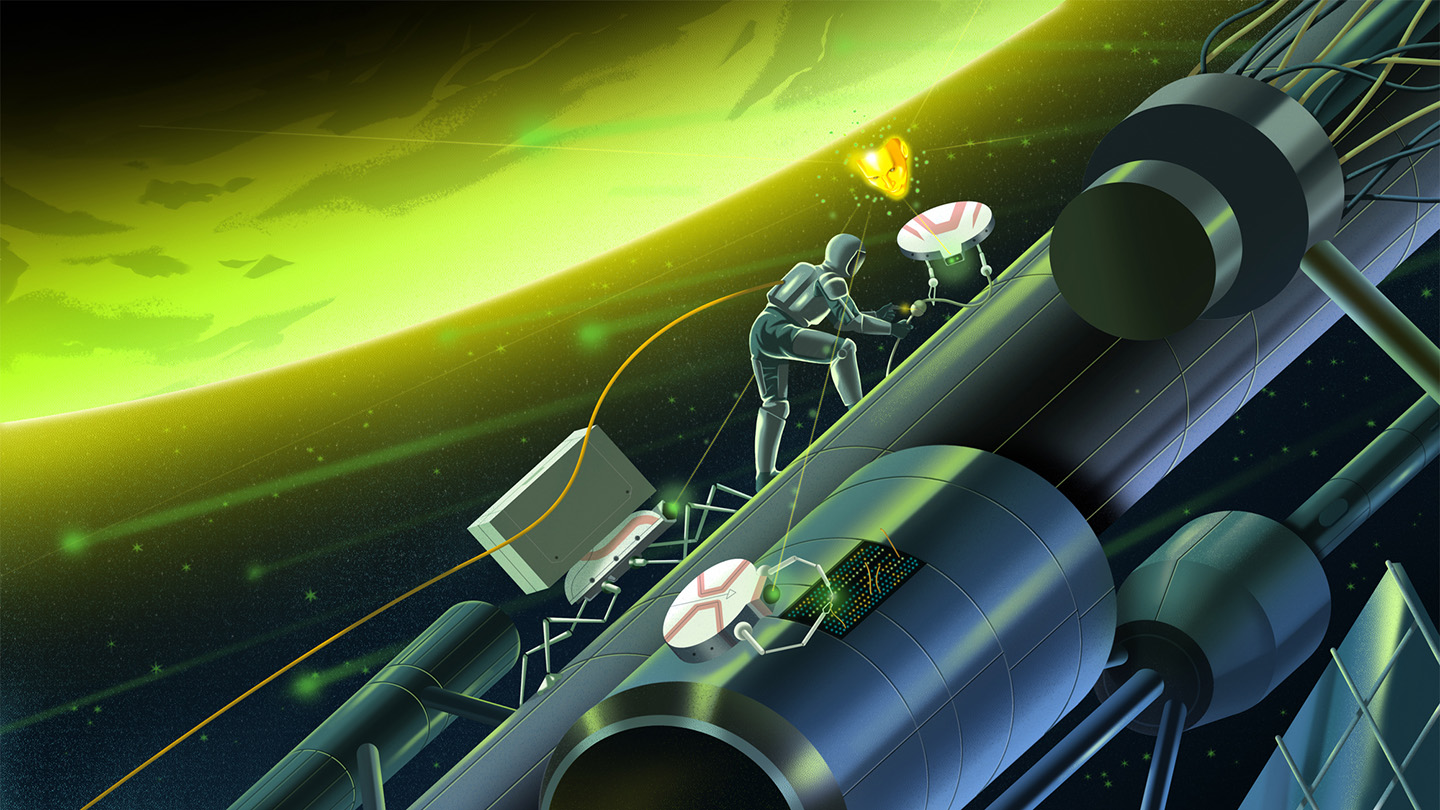
This technological gap forces us to recalibrate our relationship with technology, shifting our focus from replacing human pilots to augmenting them. The immediate future of space AI is not a sentient digital captain, but rather a suite of highly reliable, specialized assistant tools. We are seeing early iterations of this today with robotic assistants on the International Space Station, which can automate routine inventory tasks, monitor air quality, and perform basic diagnostics. By taking over the tedious, repetitive cognitive load of running a space habitat, these systems free up the human crew to do what they do best: apply intuitive problem-solving, emotional resilience, and creative adaptability to the unexpected. The ideal crew for a deep-space mission is a symbiotic partnership, where machines handle the dizzying deluge of data, and humans provide the vital spark of context, judgment, and improvisational genius.
Ultimately, the journey to bridging the gap between sci-fi fantasy and scientific reality serves as a humbling reminder of the sheer complexity of human consciousness. Our ability to navigate the unknown is not merely a product of calculating probabilities, but of our capacity for curiosity, empathy, and courage in the face of fear—qualities that cannot be coded into silicon. As we continue to push the boundaries of machine learning and robotic engineering, we must accept that the path to the stars will not be paved by autonomous machines alone. For the foreseeable future, the most sophisticated, adaptable, and resilient survival tool on any spacecraft will not be the onboard computer, but the fragile, flesh-and-blood humans sitting in the cockpit, looking out into the dark.