






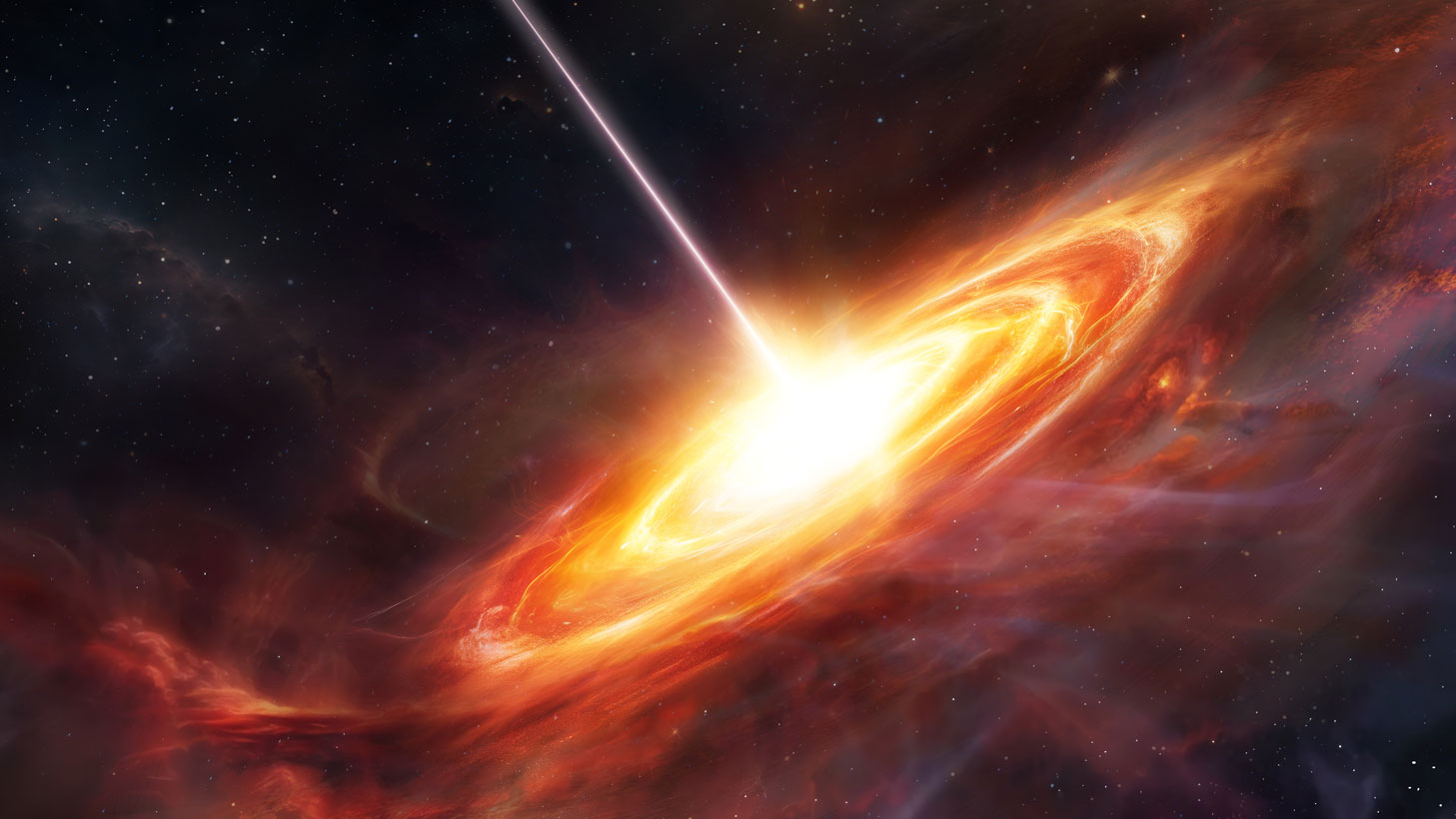
Astronomers have identified a new record holder for the most distant supermassive black hole ever observed. On July 6, in the journal Astronomy & Astrophysics, researchers announced the discovery of an ancient quasar—a ravenous black hole devouring surrounding matter so rapidly that it glows white-hot. This cosmic beacon emitted its light just 662 million years after the Big Bang, meaning its light traveled through space for over 13 billion years to reach us. This finding edges out the previous record holder, discovered in 2021, which dated to about 15 million years later in cosmic history.
The discovery intensifies a long-standing space mystery: how did these ancient black holes grow so massive, so quickly, in the early days of the universe? Cosmologists have struggled to explain how objects containing millions or even billions of times the mass of our sun could form in such a relatively short cosmic timeframe. Astronomer Daming Yang of Leiden University in the Netherlands notes that each new discovery pushing further back in time makes this fundamental question even more difficult to answer, challenging our current theories of cosmic evolution.
This breakthrough was achieved using the European Space Agency’s Euclid space telescope, which launched in 2024 on a six-year mission to map roughly a third of the sky. Euclid operates in infrared wavelengths of light, which is essential for studying the deep universe. Because the universe is constantly expanding, light traveling across vast distances stretches out, a phenomenon known as redshifting. Visible light emitted by young, distant galaxies billions of years ago is stretched into infrared light by the time it reaches Earth, making Euclid the perfect tool to detect it.
Prior to Euclid’s deployment, astronomers were severely limited in what they could see from the dawn of time. Telescopes could only pick up the absolute brightest, most radiant quasars dating back to about 770 million years after the Big Bang. Before this recent survey, only nine quasars older than that threshold had ever been identified. Unbelievably, in just its first 18 months of operation, Euclid managed to locate 12 more of these ancient objects, drastically expanding our window into the early universe.
This sudden influx of data marks a major turning point for astrophysics. As Daming Yang explains, Euclid’s discoveries allow scientists to transition from analyzing a handful of unusual outliers to studying the very first generation of massive black holes as an interconnected population. Along with the record-breaking quasar, officially designated as EUCL J1729, the telescope also discovered the second and third most distant quasars known to science. These newly found objects are much fainter than previous discoveries, offering a more realistic representation of ordinary black holes from that ancient era.
Looking ahead, astronomers plan to use the James Webb Space Telescope and other cutting-edge observatories to take closer looks at these targets, aiming to calculate their exact masses and examine the environments surrounding them. Meanwhile, the hunt for even older black holes continues. Euclid is capable of spotting quasars dating back to just 645 million years after the Big Bang. Scientists are optimistic that the telescope might break its own newly minted record before the year is out, bringing us closer than ever to understanding the origin of our universe.