





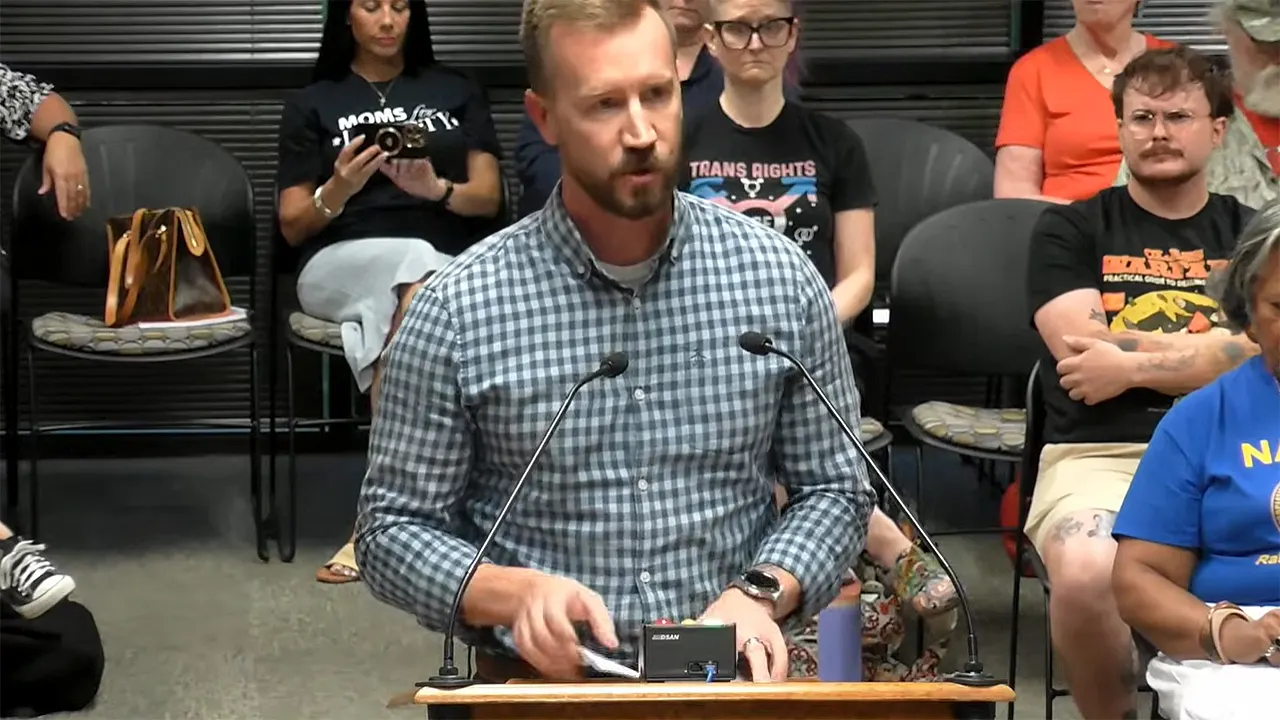
The quiet friction simmering within the hallways of Middle Creek Elementary School in Wake County, North Carolina, has erupted into a full-blown, raw, and deeply personal confrontation. At its heart lies a simple yet profound demand from a group of parents: the right to keep their children enrolled in the public school system while simultaneously opting them out of a specific music class. The reason for this request is the teacher assigned to that class, who is transgender. For these families, the issue is not about the teacher’s competence but about a fundamental conflict with their religious and personal values, a conflict they believe should be accommodated without forcing them to abandon the entire public school experience. One father, Aaron Driver, a parent of three at the school and a member of the group termed Middle Creek Parental Rights, articulated this predicament to the local school board with a sense of exasperation. Driver claimed that the response to their concerns from critics has been blunt and dismissive: if you don’t like this teacher, you can leave. “Here’s what our detractors are telling us,” Driver said, relaying the message his group has received. “You don’t support school hiring a trans teacher. Maybe public school isn’t for you or your family. Maybe homeschool. Maybe private school.” He underscored the financial and ideological dilemma this creates, pointing out that parents are already taxed to support public schools, and demanding they essentially pay twice for a private alternative to avoid a situation they find ethically untenable.
This wasn’t a simple scheduling request. The desire for an opt-out sprung from what parents described as a lack of advance notice. They say they were not informed the children’s music class would be taught by a transgender individual. This lack of transparency left them no opportunity to prepare their children for a situation they believe will challenge the moral and religious framework they are teaching at home. When these families did raise concerns, they claim to have been ignored, or referred to as bigots, their valid questions about accommodation brushed aside. The narrative from these parents is one of helplessness, feeling like they are fighting against a bureaucratic monolith that has already decided the answer before they could question the questions. They are not, as they state, asking for the teacher to be removed, but rather for the district to acknowledge their dissent by providing, a seemingly simple alternative: perhaps a different music teacher or an extracurricular activity for those students whose parents object. The frustration is palpable, causing the sense of a rupture in the community.
The conflict reached a fever pitch during a tense meeting of the Wake County Board of Education. The room was a microcosm of the wider societal divide, with public commenters fundamentally disputing what the parents’ request really means. For some, the demand for a religious or conscientious exemption was a blatant attempt to discriminate against the teacher based on her gender identity. They argued that allowing students to avoid a teacher because they dislike a personal characteristic is not acceptable, and it sets a dangerous precedent for other minority groups and protected classes. They wrestled with the idea that these parents viewed a transgender teacher as something to be avoided altogether, rather than a teachable moment about diversity and the world. This side of the argument posits that public schools should be a melting pot of perspectives, and that letting parents pick and choose which lessons their children will be exposed to based on personal tolerance shreds the fabric of the institution. They see the parents’ request not as a mere preference, but as a demand that the public school system endorse and validate their biases, which they believe are harmful.
This deeply felt divide was encapsulated by two guests at the board meeting. One, Aaron Driver, who brought the frustration of the parents forward, concluded his remarks by pointing out the financial quagmire. “That’s right,” Driver said, “maybe pay for taxes into the school system and then pay again to escape from it.” He’d was highlighting the inherent unfairness of being asked to sacrifice her children into a system that doesn’t align with their values, or to pay to escape it. On the other side of the microphone, however, a parent named Katrina Day offered a striking response, but it was one that many found equally concerning, just for different reasons. Day’s reaction wasn’t just a disagreement; it validated the parents’ concerns in a provocative manner. In her comments, she proposed a solution that turned the conversation toward immunity the other way, suggesting that the district should keep “the bigots away from my grandchildren.” She even went further, suggesting that the district “relocate the children of bigots” or, with a remarkable lack of hesitation, “expel the children of bigots.” This response brought the underlying animosity out into open, framing the disagreement not as a policy question, but as a fundamental clash between two groups who view each other as morally deficient outsiders, willing to use the school as a mechanism to vanquish. The suggestion of expelling or isolating children based on their families’ beliefs historic reveals a concerning about the level of tolerance in the “tolerant” camp.
The controversy surrounding Middle Creek Elementary has been building for weeks, since before the board meeting even convened into the summer. State Representative Erin Paré, a Republican from Wake, had already raised public concerns in late July after hearing from a group of parents about the possibility of a transgender teacher being assigned to a southern Wake County elementary school. In her public statements, she went past just raising awareness, floating the idea of legislation that would require sex-based attire for all public-school employees. Rep. Paré was capitalizing on the situation, pinning a problem in a broader policy push regarding transgender issues in public schools. Her response signals that this local dispute is quickly becoming a national political flashpoint, with one side. While Rep. Paré’s proposal was perhaps the most direct legislative instinct, it effectively becomes a cry that can be used in a larger political war. A school board can no longer treat this as a isolated dispute; it is being painted as a battleground in the ongoing culture wars over how the educational system treats gender identity. The question is now not just about one music class, but about the rights of parents versus the rights of transgender individuals and the role of the state in enforcing.
But for the parents at the heart of this, like Driver, the political firestorm misses the point. They see their request as utterly simple: they want their children to receive their education without having their religious beliefs constantly in a fight. They insist that their requests for an alternative or having a reasonable admission from the school only met with hostility and accusations of bigotry. They feel they are being silenced by a Backlash from people who claim to be the advocates of tolerance but are demonstrating little of it. According to them, the school system’s adoption of a transgender teacher is not just a hiring choice but a sign of systemic change, a change they don’t want their elementary school children to be arbitrarily exposed to. At an age where students are still developing mentally. They are still learning about the core tenets of their faith. These parents are not asking to get rid of her, but to have someone else teach their children to use the basic optional. They do not want to uproot their entire lives and other children’s school relationships because of one teacher, nor should they have to. The choice presented to them, to either accept what they see as an inappropriate in classroom without being consulted, or to pull out their kids, is one that leaves them feeling like they’re being penalized for their faith. Their insistence on an opt-out instead of an uproot is a plea to be acknowledged as part of the community, even when in dissent.
In the end, the situation at Middle Creek Elementary is a symptom of a larger, unfolding drama in American education. The traditional idea of the community school as a place that unites diverse households is colliding with a new reality where a single teacher can fundamentally change the environment for those with different beliefs. Respect is a thick line, and the demands of one family can be seen as a threat to another’s child’s right to see a teaching staff that reflects the full spectrum of humanity. The board is being put in an impossible position: they must navigate between treating an employee with dignity and respecting those padres who object. But the most telling part of the entire debate is the level of animosity, in this case where the word “bigot” is thrown around and where the idea of “expelling the children” is proposed with zero regard for education. They are speaking of children as if they are tokens were pawns in an adult fight. The families have crossed from being a group with a concern to a group that has to be managed, contained, or expelled. In the meantime, the children—both the ones who will listen in this music class, and the ones who won’t, and the ones who will be taught to view the other as the unprecedented—are caught in the middle of a fight that they do not understand. The peaceful schoolhouse is now a battlefield for identity, and the casualties are the small, kind, curious kids who just want to learn. The answer is complicated, but one thing is certain, the decision about how to resolve this at Wake County will send a powerful message about whose right are considered worthy of protection and who gets to call a public school a home. The parents are asking if it’s okay to have a different moral compass, or if that only is okay if it points in the same direction as the state’s.