





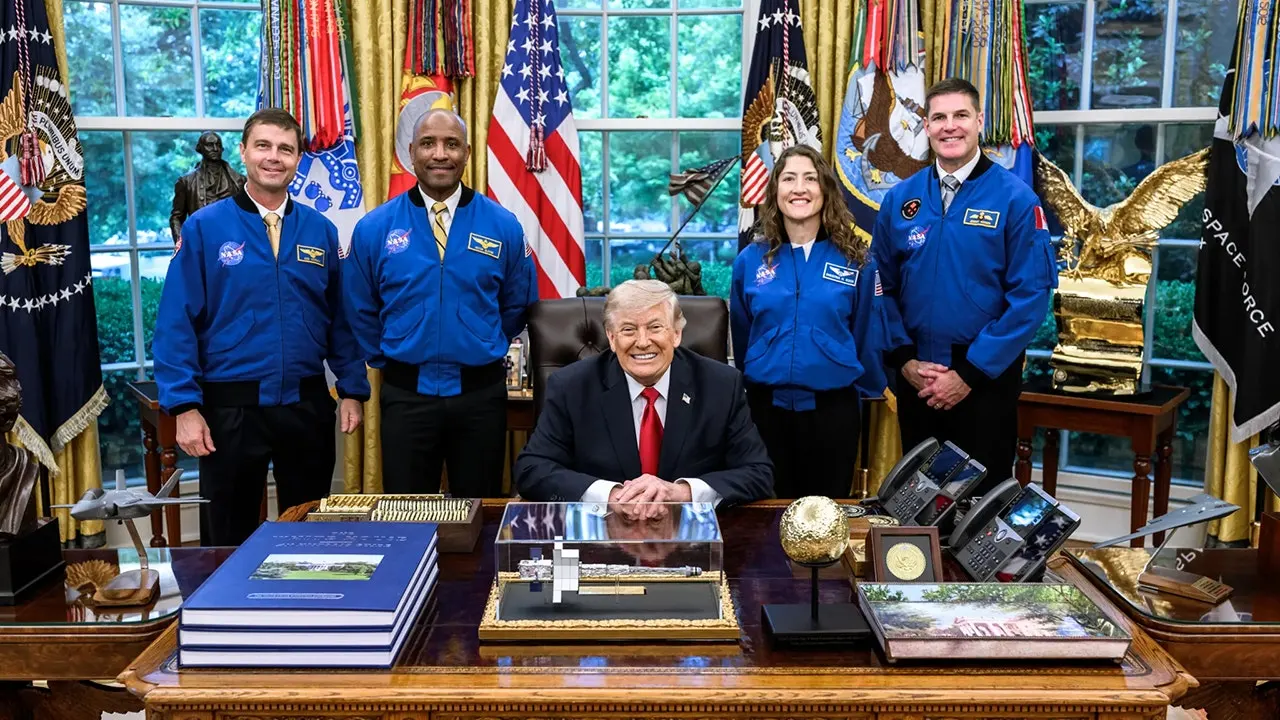
Inside a cavernous hall at NASA’s Johnson Space Center in Houston, a quiet kind of history will be made later this month. Four astronauts — three from NASA and one from the Canadian Space Agency — will gather under the gaze of the nation’s leaders and a roomful of their peers to receive one of the most exclusive honors in all of human exploration: the Congressional Space Medal of Honor. President Donald Trump will present the medal on August 28 to Reid Wiseman, Victor Glover, Christina Koch, and Jeremy Hansen, the crew of Artemis II. In April, these four individuals climbed aboard a spacecraft and rode a pillar of fire into the sky, ultimately traveling farther from Earth than any human beings in history. The voyage was not merely a technical triumph; it was a rare, collective gasp of wonder for a world often too distracted to look up. Their mission was the first crewed flight of NASA’s Orion spacecraft, the first time astronauts had been sent around the Moon in over fifty years, and a reminder that the great age of exploration is not a chapter in a history book but a living, breathing endeavor.
The story of that voyage reads like something out of a science fiction epic, except every detail is true. The crew lifted off from the Kennedy Space Center in Florida on April 1, strapped atop NASA’s Space Launch System rocket, a towering machine that generated 8.8 million pounds of thrust and shook the Florida coastline with a roar you could feel in your bones. Once in space, they tested Orion’s systems, checking every switch, display, and life-support loop that would one day carry astronauts deeper into the cosmos. Then they turned toward the Moon. On April 6, they swept past the lunar surface at a distance of just over 4,000 miles, close enough to see the stark craters and ancient lava flows in breathtaking detail. At their farthest point from Earth, the crew reached a distance of 252,756 miles — surpassing the previous human spaceflight record set by the desperate, heroic crew of Apollo 13 in 1970. Over the course of nearly ten days, they covered 695,081 miles of lonely, silent space, all the while capturing more than 7,000 images: Earth rising and setting, the gray face of the lunar world, a solar eclipse seen from a perspective no human eyes had ever enjoyed. They even observed tiny flashes on the Moon’s night side, caused by meteoroid impacts, a reminder that the universe around them was neither empty nor still.
Their return to Earth was just as dramatic. On April 10, Orion slammed into the atmosphere at roughly 25,000 miles per hour, protected by a heat shield that endured temperatures far hotter than the surface of the Sun. After the parachutes deployed and the capsule splashed down in the Pacific Ocean off the coast of California, the astronauts were welcomed by a Navy medical team that opened the hatch to a new chapter in American spaceflight. NASA Administrator Jared Isaacman has spoken movingly about what the crew accomplished, noting that they accepted significant risk while testing the spacecraft and systems meant to carry future crews even deeper into space. This is worth pausing over. Spaceflight is not a theme park ride; it is an unforgiving, hostile environment. The astronauts who flew Artemis II didn’t just ride a rocket. They volunteered to put their lives on the line, to push the boundaries of what humanity has done before, and to do it in full view of the world. That kind of courage deserves more than a handshake and a plaque. It deserves a lasting place in the collective memory of the nation, and the Congressional Space Medal of Honor is exactly that kind of tribute.
This medal, it turns out, has roots that go all the way back to the Apollo era. Congress authorized it in 1969, a time when the country was gripped by the race to the Moon and captivated by the bravery of the men who flew into what the lawmakers called the “hostile environment of space.” The law declared that America’s space program depended on the intelligence, dedication, bravery, and self-sacrifice of its astronauts — and it gave the president the authority to honor them in the name of Congress for exceptionally meritorious efforts and contributions to the welfare of the nation and mankind. Since then, the medal has been awarded sparingly, to a very select group of extraordinary individuals. The official list includes just thirty names: legends like Neil Armstrong, John Glenn, Alan Shepard, and Jim Lovell, the commander of Apollo 13, whose crew never landed on the Moon but came back with a story of survival and composure that still inspires half a century later. Armstrong was among six astronauts who received the medal from President Jimmy Carter on October 1, 1978. When Wiseman, Glover, Koch, and Hansen accept the same honor this month, their names will join that small constellation of American heroes, bringing the total to thirty-four. In a world where medals are sometimes handed out as afterthoughts, this one still carries the full weight of its history.
But the ceremony in Houston is not only about looking back. Artemis II was, as NASA has made clear, a stepping stone toward something far bigger: returning astronauts to the lunar surface and, eventually, sending humans to Mars. The crew tested Orion’s life-support systems, manually piloted the spacecraft, and gathered data that will be used to design and calibrate future missions. NASA has laid out an ambitious roadmap that includes testing commercial lunar lander operations during Artemis III in low Earth orbit in 2027 and targeting Artemis IV for the program’s first lunar landing in 2028. The ultimate goal of the Artemis program is to establish a lasting human presence on the Moon — not just visit, but stay — and to use what is learned there as a foundation for the next giant leap to Mars. Isaacman put it beautifully in a recent statement, recalling how the NASA leadership team sat in Mission Control alongside the flight control team, watching as the Artemis II crew crossed the historic threshold and became the explorers who had ventured farthest from Earth. Under President Trump’s leadership, he said, Artemis II captivated the world, inspired a generation, and gave the nation the confidence to press on as America returns to the Moon to build a base and to stay. Artemis III is the next mission in that campaign, but it will be during Artemis IV, in 2028, that NASA astronauts will once again walk on the lunar surface.
More than anything else, the story of Artemis II is a story about human beings. It is about the wonder in the faces of the astronauts as they saw Earthrise from a quarter million miles away. It is about the years of grueling training, the sleepless nights before launch, the families waiting on the ground, and the thousands of engineers, scientists, and mission controllers who turned an impossible dream into a glowing dot of light in the sky. It is about Christina Koch, who has already spent nearly a year in space on the International Space Station and now stands as a symbol of what women can achieve in the most demanding arenas. It is about Victor Glover, a naval aviator and test pilot who helped pilot the spacecraft with steady hands and a calm mind. It is about Reid Wiseman, a naval aviator who led the crew with quiet authority. And it is about Jeremy Hansen, the first Canadian ever to fly around the Moon, representing not just his own country but the idea that space belongs to all of humanity. When President Trump places the Congressional Space Medal of Honor around their necks, it will not just be a reward for a job well done. It will be a promise that the spirit of exploration is still alive, that the future is still open, and that the most important voyages are still ahead of us. In a time when so many things divide people, the sight of four astronauts being honored for pushing the limits of human courage can remind everyone what it feels like to be united by awe.