





The Changing Face of Democratic Resistance
The political landscape of the Democratic Party is undergoing a seismic shift, one that is leaving some of its most recognizable figures from the Trump era scrambling for relevance. The old guard, those who built their careers on the moral high ground of opposing Donald Trump, are finding that their past heroics no longer guarantee a future in office. It’s a humbling reality check for a group of politicians who once basked in the national spotlight, cast as the party’s brave defenders against a president they considered an existential threat to American democracy. Their campaigns, built on the foundations of impeachment proceedings and fearless committee testimonies, are colliding with a party base that has fundamentally changing expectations. The base is not looking for a trip down memory lane; instead, they are hungry for a new vision of economic justice and are increasingly turning to fresh faces who represent the struggles come down and the anger of everyday people, not the well-worn paths of the establishment.
Among the most prominent casualties in this shifting political moment is Alexander Vindman. He was universally championed as a quintessential American patriot, a decorated Army lieutenant colonel who put his career and reputation on the line to testify against President Trump during his first impeachment. His tale was one of duty, sacrifice, and the courage to speak truth to power. For the left, he was a safe, credible, and heroic messenger of the resistance. Yet, when he translated that heroism into a bid for the Florida Senate, he found that the currency of his past bravery was vastly less valuable than the cost of a pizza. The voters, it seems, wonder what he would do for them, not what he stood for. He was soundly defeated by a little-known state representative, Angie Nixon, a member of the Democratic Socialists of America. Nixon’s campaign wasn’t about the past; it was about a pure future, and her win, despite being sharply underfunded, sent a clear message to the old guard: the era of pure anti-Trump sentiment is no longer a sustainable political strategy.
This trend is not confined to Vindman alone. Across the country, in congressional primaries, other one-time heroes of the resistance are meeting a similar fate. Established figures like Rep. Diana DeGette of Colorado and Rep. Dan Goldman of New York, who were both high-profile impeachment managers, have also been dealt primary losses. Their opponents, often younger far-left candidates, are tapping into an almost visceral voter base’s exhaustion with incrementalism and its sense of an establishment that is protecting the status quo. Similarly, Rep. Shri Thanedar in Michigan and Rep. Al Green in Texas, who led the charge on impeachment, fell to younger challengers, signaling that service under a past era has expiration days. Rep. Raja Krishnamoorthi’s bid for the Illinois Senate, which was anchored in his work on the second impeachment, also failed to gain traction. This is a clear pattern; the very thing that gave these politicians a national platform—their heightened resistance to Trump—is now being seen by the party’s most energetic base as insufficient, even irrelevant, to the crises of today.
But it’s not just one side of the party that’s failing. Other notable figures who symbolized the fight against Trump are also facing a rude awakening. George Conway, a Republican who founded the anti-Trump Lincoln Project, found his foray into the political arena failing to catch fire. Harry Dunn, the former U.S. Capitol Police officer who became a symbol of steadfast valor after the January 6th attacks, lost his second consecutive primary race in Maryland. Even billionaires who put their money where their mouth is, like Tom Steyer, who helped bankrolled the first-term resistance and attempted a presidential bid, couldn’t get traction in his run for California Governor. Rep. Eric Swalwell, who acted as a manager for the 2021 impeachment, dropped out of his gubernatorial bid and ended his career under the shadow of assault allegations. This atmosphere paints a stark picture: the party is not reminiscing on the glory days; it is looking towards a new horizon.
The reason for this change is becoming increasingly clear. Political experts and veteran strategists like Shannon Jackson, who worked on both Bernie Sanders’ presidential campaigns, argue that the Democratic base is simply no longer satisfied with opposition. The old playbook of “Trump is bad” is losing its pop power. The voters are demanding a fundamental reevaluation of why the party failed in 2016 and why it’s struggling to connect with the working class today. The success of the progressive wing, which has seen a wave of surprising victories in Michigan, Minnesota, and Florida, suggests a fundamental piedway going on, centered on economic populism and a sharp critique of the corporate elite. For these insurgent candidates, the fight is no longer about impeachment, but about the rising cost of living, the power of big money, and a government that seems to listen only to the very wealthy.
However, the base is fickle and not going left in complete lockstep. Moderates are still winning too. . In the same election that saw Vindman defeat, Rep. Jared Moskowitz, a moderate who backed President Biden, easily crushed his own DSA-backed challenger. Similarly, veteran and former DNC Chair Debbie Wasserman Schultz managed to secure renomination in what packed district against four candidates whose platforms were distinctly left. This demonstrates that identity isn’t the primary issue; a politician’s ability to seem like a “fighter” is what matters. Voters are not asking, “Are you attacking Jewish enough?”; they are asking, “Are you fighting for me?” And that distinction matters more than any label a candidate puts on themselves.
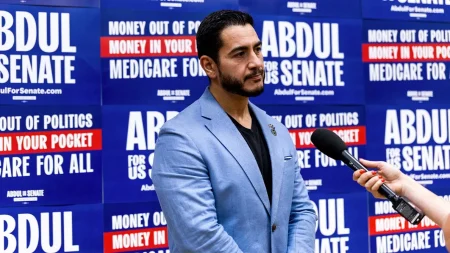
The strategists are torn on how to read all this turbulence. Maria Cardona, a DNC committeeman, advises that even though it looks like the heroes are falling, it’s not about the nomenclature or a label. It’s about who is going to show up, fight, and deliver something tangible. Whether you are a newcomer like Abdul El-Sayed, who won in Michigan, or a seasoned veteran like Debbie Wasserman Schultz, who has been around for decades, it’s all about delivering for your constituency and being perceived as a genuine fighter. The world isn’t looking for a politician who says “I voted against”; they are looking for one who says they will fix the leaky pipe, get the bills down, and stand up for jobs and dignity. The moment a candidate – whether progressive, moderate, socialist—speaks to those basic needs, they are able to win, no matter their resume or past victories. The digital age we live in is in a period of deep introspection, demanding a new vision of governance that serves the many, not the few, and we are only just seeing the start of this revolutionary and polarizing moment.