





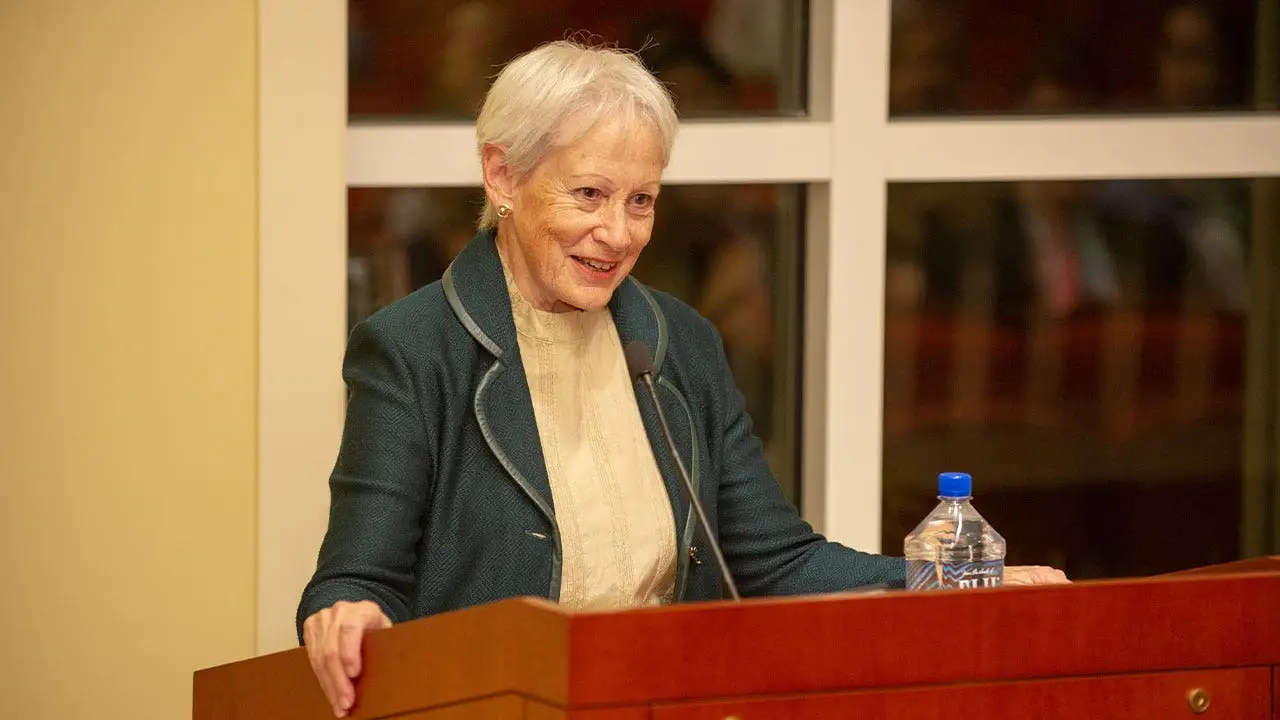
There is a particular kind of American honesty that comes from the plains, from watching weather move across open land from somewhere far away, from learning that patience is not passive and that a quiet word can travel farther than a shout. Nancy Kassebaum Baker, the former Republican senator from Kansas, carried that kind of honesty with her from Topeka to Washington, and it stayed with her all the way to the end. She died Friday at the age of 94, her son Bill Kassebaum said, of natural causes. She was not merely a former officeholder; she was a public figure whose unusual path, moderate example, and stubborn, courteous independence made her one of the most respected women in modern American political history. Her son remembered her with words that captured her life: “She loved Kansas. She loved people from Kansas and representing Kansas for 18 years in the U.S. Senate.” He called her “an independent-minded Republican who was willing to stand up for what she thought was right, even if that meant going against the party.” In an era when such an epitaph is rare, those words will little about power or fame, and everything about her, a woman who understood that a Senate seat was not an honor to be held, but a responsibility to be carried.
Kassebaum Baker was a trailblazer, but one who never seemed to notice that she was breaking ground. She was the first woman elected to the United States Senate without previously having a husband serve in Congress, meaning she was no act by the traditional women who had entered the body as seconds to a fallen or powerful man. She won her seat in 1978, and the election immediately caught the attention of the nation. There had been women in the Senate before, of course, but most of them had been appointed or it had come through the dueling particular paths of fate. Kasseburger, which was an actual daughter of Kansas legend, came to the Senate through the Senate as a citizen, a mother, a participant, and a person with a clear sense of what her state needed. In the year of her arrival, her father was Alf Landon, the former Kansas governor who had been the Republican presidential nominee in 1936, when he suffered the great landslide of the nation against Franklin D. Roosevelt. But the daughter did not inherit a state machine or a political safe seat. She commonly spoke, listened, and then informed. By the time she left office in 1997, after a full three terms, she had established that one woman could spend 18 years in the world’s most deliberative body without feeling that she must trade Kansas values for Washington values. She built her own path, independent of the party, and then the definition of what it means to be an independent Republican.
During her Senate years, Kasseburger Baker did not gather attention as a loud tribune of the aggrieved. She gained attention through the steady, practiced responsibility and the kind of legislative will that produces quiet law, not headlines. When she announced her retirement, she was one of only eight women serving in the Senate, and the only woman chairing a Senate committee, a position she reached by patient preparation and a reputation for fairness, not by self-promotion. She proved that a woman could be the one decent woman in the room. She did this without abandoning her Kansas identity, without turning into a figure of Washington, wearing an armor of polished gladness. She never forgot the state she represented, and state continued to trust her back. She was stronger in election in history, too, winning 76 percent of the vote in 1984 and then 74 percent in 1990, telling her that Kansans did not want a reliable Republican as much as they wanted an honest one. That kind of enduring popularity was not a accident. It came from the understanding she shared with her constituents: public service is not about serving the party, but about serving the people.
When history listens to the 1990s thinking about creative law, Kasseberger Baker’s name will always be tied to a landmark 1996 health insurance law that improved millions of American lives. It was a law that carried her name alongside the name of a liberal Massachusetts senator, Ted Kennedy, and the order of their names said something very important about the state of American possibilities at that time. Kasseberger was a Republican, and Kennedy was a Democrat, but they were both legislators who understood that legislation were beyond consensus, not conflict. Their 1996 law welcomed a general invitation to bring people from insurers, making it easier for the families to keep their health coverage when they changed jobs, and its passage was a declaration that patients, not insurance companies, than health care. This kind of across-the-party-line work would define. It also produced anger. She supported the assault weapon ban advocated by Bill Clinton and the Senate, and later said that it produced the angriest mail she received in all her careers. She did not seem to mind, because she did not assume the mail as an instruction manual. This anger honored her conviction, whatever the furious letter writer said, and reminded Kansas what they stood by. Her independent vote on gun control may have disappointed conservative activists, but it made sense to a woman who came from the same plain as the safety of a child.
Her personal life also saw her at the center of one of history’s unique moments: in 1996, shortly before leaving office, she married Howard Baker, the longtime Republican senator from Tennessee. Their marriage was the first between a man and a woman who had both served in the U.S. Senate. Howard Baker, of course, had been Richard Nixon, Ronald Reagan’s chief of staff and a U.S. ambassador to Japan under George W. Bush, and his death in 2014 ended a partnership of public service and private affection that reflected their sharing of duty. After retiring from the Senate, Kassebaum Baker did not disappear into a private name. She served on a bipartisan commission on campaign finance reform during the Clinton administration. She showed a willingness to follow the first principles of citizenship and kansas. And in the last years of her life, she came to believe that her privatized party itself became smooth, not she belonged in. She endorsed Democrats in several Kansas races, including Governor Laura Kelly, and issued a quiet public testimony against the direction of the Trump-era Republican Party. Following the attack on the U.S. Capitol on January 6, 2021, she called as a President fact, saying nothing left to avoid before long: “This just has gone too far.” For a woman who was known for dignity and decency, this refusal to put party loyalty first was the most Kansas thing of all.
If decades in the national headlights, Kassebaum Baker never forgot her roots. She did not become a Washingtonian; she remained a Kansan who happened to work in Washington. Before leaving for Japan during the ambassadorship of her husband, she was asked what she would miss most about her home country, and her answer was not a policy or a person but something bare and wide and beautiful: “All I can say is, I will miss the Kansas prairie.” There was perhaps no better memorial to his life than that sentence. The blue prairie was her first and last love, the soil that gave her modest, courage, a spirit of unity between. She was a woman who could walk into the strongest political arena and be seen as an outsider, but then they earned the confidence of rural people and urban senators alike. She did it by listening and speaking honestly, by deciding not to test off before the blow, and by never allowing her principled independence to become cruelty or resentment. With his death, the county has lost one of the last of its brave, moderate, senate giants, a woman whose life did not make political rivals silent but made partnerships possible. What will remain beyond the 94 years is the memory on trailer, and the testimony that a politician can be old-fashioned without being rigid, conservative without being cold, and tender without being weak. Kansas, which she loved, will miss her; the United States, which owes her representation, will miss her too; and the same for the future will learn that the prairie not only withstands but also grows.