





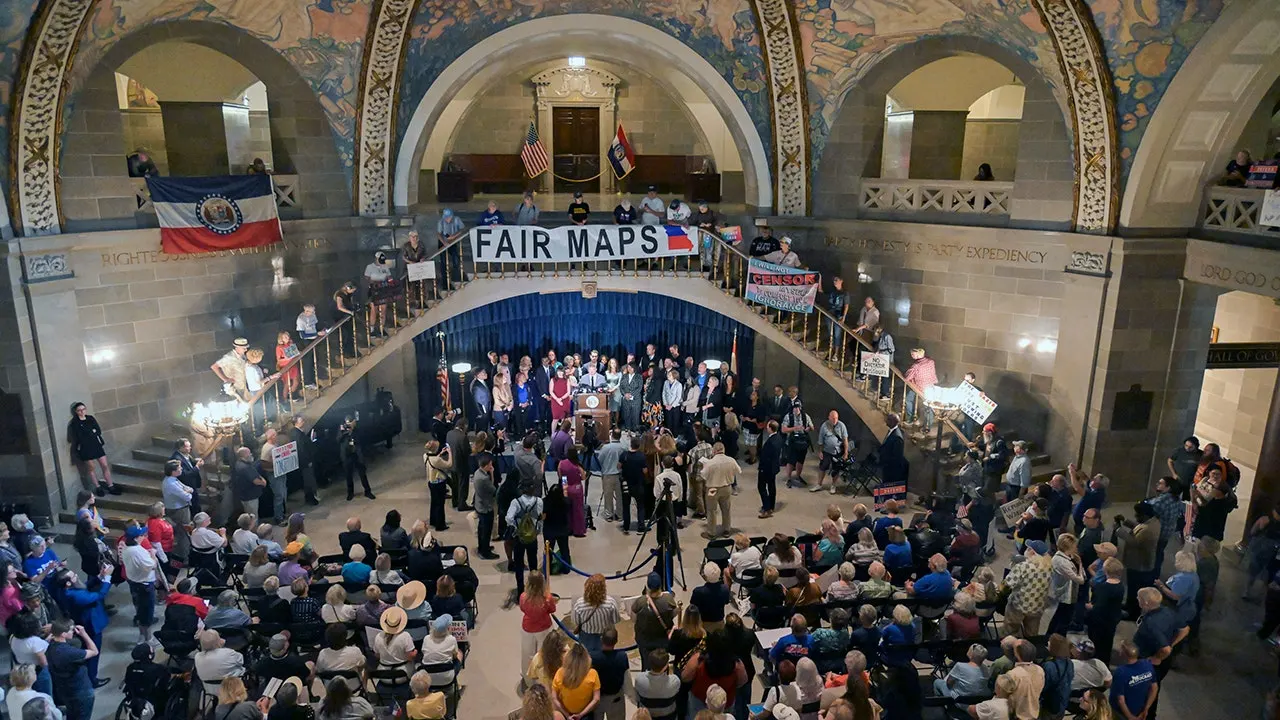
In a decisive legal victory for President Donald Trump and the Republican Party, a Missouri judge issued a ruling this week that keeps a newly drawn, GOP-friendly congressional map in place for the 2026 midterm elections. The decision, made by Cole County Circuit Judge Daniel Green, rejected a challenge that would have allowed Missouri voters to weigh in on the map through a statewide referendum. Instead, the judge ruled that the state’s referendum process simply does not apply to congressional redistricting enacted by the General Assembly. That might sound like a dry legal technicality, but the real-world consequences are enormous. The map, which was passed by Missouri’s Republican-led Legislature and backed by Trump, is designed to give Republicans another seat in the U.S. House. With the ruling, the map remains in full force and effect for the general election, meaning the GOP’s carefully drawn boundaries will guide the November vote. Secretary of State Denny Hoskins, who had refused to certify the referendum petition, was fully vindicated in the ruling. Judge Green not only affirmed that refusal as lawful but also ordered that the congressional map stay exactly where it is. This is exactly the result Republicans wanted, and it puts Democrats on the defensive as they try to counter what they see as an unfair political advantage. The fight, however, is not entirely over. The plaintiff, Richard von Glahn, filed an appeal on Wednesday evening, so the case will move to a higher court. But for now, the map stands, and the practical reality is that Missouri’s next election will unfold under these new lines.
At the core of this legal battle was a fundamental question about who gets to decide the shape of congressional districts. Opponents of the new map tried a people-powered approach: they gathered thousands of signatures to force a statewide referendum, hoping that Missourians themselves would reject the boundaries drawn by the Legislature. It was a bold strategy, and if it had worked, it could have changed the way redistricting battles are fought across the country. But Secretary of State Denny Hoskins threw up a roadblock, refusing to certify the petition on the grounds that Missouri’s Constitution does not permit congressional redistricting to be put to a public vote. Judge Green agreed with that interpretation, ruling in favor of Hoskins and the Republican committees that intervened in the case, including the Republican National Committee, the National Republican Congressional Committee, and the Missouri Republican State Committee. The involvement of those national groups shows just how much was riding on this case. If the referendum had been allowed to proceed, it might have created a blueprint for challenging maps in other states, using the ballot box instead of the courtroom. Instead, the judge shut that door, affirming that the Legislature’s authority over congressional districts is not subject to a popular veto. This is a significant procedural win for Republicans, because it prevents the map from being dragged through an unpredictable political campaign while the election season is already underway. The August primaries were conducted using the new boundaries, and voters are already adjusting to the reshaped districts. The judge’s ruling ensures there will be no last-minute scramble to change the rules of the game, at least not before the courts have a chance to weigh in on appeal.
To understand why this matters so much, it helps to look at how we got here. The new map didn’t just materialize out of a routine scheduling process. It was the direct result of a coordinated push by President Trump, who urged Republican-led states to redraw congressional boundaries ahead of the 2026 midterms. That call to action was answered quickly in Missouri. Republican Governor Mike Kehoe convened a special session last year, and the GOP-controlled Legislature got to work crafting a map that would maximize Republican advantages. Missouri became the second state, after Texas, to pursue new congressional lines as part of this broader national strategy. The most dramatic change is happening in Kansas City, where the map splits portions of the city between neighboring Republican-held districts. The remaining parts of Democratic Representative Emanuel Cleaver’s 5th Congressional District are stretched eastward into rural areas that lean heavily Republican. According to an estimate from the Associated Press, about 59% of the voters in the reshaped district are brand new to it. That kind of jaw-dropping change turns what was once a safely Democratic seat into an uphill climb for the incumbent. It is a textbook example of partisan mapmaking, and it is exactly what opponents were hoping to undo through the referendum process. But the judge’s ruling means the map will remain in place, giving Republicans a real chance to flip the district and expand their congressional majority from Missouri.
The human stakes of this ruling are visible in the candidates now running for office. In the redrawn 5th Congressional District, Republican state Senator Rick Brattin won the GOP primary earlier this month, while Cleaver ran unopposed for the Democratic nomination. That sets up a general election where the terrain heavily favors the Republican challenger. With nearly six in ten voters in the district being new to Cleaver, the congressman will have to build relationships and support from scratch in communities that have never had him on their ballot. Meanwhile, Brattin benefits from a map that was intentionally drawn to give Republicans a swing at this seat. If he wins, Missouri’s delegation would shift from six Republicans and two Democrats to seven Republicans and one Democrat, a meaningful change in the overall battle for control of the House. The ruling also has ripple effects beyond the candidates themselves. It validates the work of the GOP-controlled Legislature and protects the integrity of the primary results, which were already conducted under the new map. For Democrats, it’s a frustrating reminder that the courts are not always a reliable path for overturning politically motivated boundaries. They have argued that the map is unfair and that voters deserve a say, but those arguments have so far fallen flat in the courtroom. With the appeal now pending, there is still a small window for a different outcome, but the practical reality is that campaigns are already underway, television ads are being prepared, and voters are beginning to pay attention. Changing the map now would have thrown all of that into chaos.
This Missouri ruling is also part of a much larger national story, one that is unfolding in state capitols and courtrooms across the country. In the run-up to the 2026 midterms, Republicans in multiple states have been aggressively redrawing congressional maps, using their legislative majorities to lock in advantages wherever possible. Trump’s influence can be felt in every one of these efforts, from Texas to Missouri and potentially beyond. The push to be bold, as the former president phrased it, has encouraged Republican leaders to pursue maps that maximize their party’s chances rather than settle for something moderate or bipartisan. At the same time, a blockbuster Supreme Court voting rights ruling has ignited new redistricting fights across southern states, creating a volatile landscape where the rules of the game are constantly being tested. What makes this cycle so striking is the transparency of the strategy. In the past, redistricting was often done behind closed doors with a nod and a wink, but now it is a public, openly discussed part of political warfare. Lawmakers are not shy about saying that they want to draw lines that help their party, and legal challenges are treated as expected hurdles rather than scandals. The Missouri case is a prime example of that dynamic. The map was drawn to weaken a Democratic incumbent, the referendum challenge was designed to stop it, and the judge’s ruling was a decisive victory for the side that drew the lines first. The message to other Republican-led states is clear: if you move quickly and stick to the constitutional rules, you can protect your map from being overturned by the opposition. That is a powerful incentive for more aggressive redistricting efforts in the future.
Looking ahead, the immediate question is what the appellate court will do with the appeal, but for now, the Trump-backed map in Missouri is safe. The ruling leaves it in full force and effect, and the 2026 general election will almost certainly be conducted using these boundaries unless a higher court intervenes in an extraordinary way. For Republicans, this is a victory worth savoring. It locks in a strategic advantage at a critical time, when every seat in the House could be the difference between a majority and minority control. For Democrats, it is a setback that narrows their path to regaining power and raises doubts about the effectiveness of citizen-led referendum challenges. But beyond the immediate partisan calculus, this case illustrates a deeper truth about American democracy: the battle over maps is often more important than the battle over votes. The shape of a district can determine who wins long before a single ballot is cast. In Missouri, the lines have been drawn, the candidates are set, and the voters are now being asked to make a choice within the boundaries that have been given to them. Whether that is fair or unfair, it is the current reality. Judge Green’s decision was based on an interpretation of the state constitution, and his explanation was careful and legalistic. Yet the effect is deeply political, preserving a map that was intentionally crafted to give the GOP an edge. The appeal is still pending, so nothing is forever, but the momentum is clearly on the side of Republicans. As the November election approaches, the country will be watching Missouri to see whether this map delivers the result it was designed to produce. If it does, it will serve as a model for other states. If it does not, it will be remembered as a gamble that didn’t pay off. Either way, the ruling represents a defining moment in the long-running and fiercely contested struggle over congressional redistricting.