





Here is a summarized and humanized version of the content, structured into six paragraphs, aiming for the requested depth and length.
—
The news hit the U.S.-South Korea alliance like a sudden, cold wave. Just three days after Secretary of State Marco Rubio had publicly lauded Seoul as an “indispensable partner” and celebrated a “historic new era” of cooperation, President Donald Trump abruptly ordered a major scaling back of the joint military exercises that have served as the bedrock of their mutual defense for decades. For the soldiers, diplomats, and citizens on the Korean Peninsula, the whiplash was dizzying. One moment, they were being told they were the closest of allies, standing shoulder-to-shoulder in a new age of partnership; the next, the commander-in-chief of the world’s most powerful military was pulling the rug out from under their most critical training regimen. The decision, which came after Seoul declined to support U.S. operations against Iran, was framed by the White House as a gesture of goodwill toward North Korea, but for those who live under the constant shadow of a technically unresolved war, it felt less like diplomacy and more like a sudden, unsettling abandonment. The carefully constructed narrative of unwavering solidarity had been shattered by a single, impulsive-sounding directive, leaving allies to wonder if the promises of partnership were merely rhetorical ornaments to be discarded when they no longer served a transactional purpose.
To understand this dramatic reversal, one must look at the tangled web of motivations driving the President. According to Victor Cha, a prominent Korea expert at the Center for Strategic and International Studies, Trump views this decision as a “two for one” deal. On one hand, it is a blunt instrument of pressure aimed at Seoul, which has been frustratingly slow in implementing a massive $350 billion trade and investment framework agreement. Trump, who views international relations through a distinctly transactional lens, has grown impatient with what he perceives as South Korea’s reluctance to move faster on commercial disputes and to shoulder more of the financial burden for its own defense. On the other hand, the move is a calculated, nostalgic gamble to reignite the personal diplomacy with North Korean leader Kim Jong Un that defined his first term. Trump’s memory of those historic summits in Singapore and Hanoi is one of personal triumph, and he seems to believe that by unilaterally removing what he calls a “hostile” signal—the military drills—he can entice Kim back to the negotiating table. It is a classic Trumpian maneuver: a bold, unorthodox gesture designed to break a stalemate, but one that ignores the complex realities of the region and the deep-seated anxieties of a key ally who has heard this tune before.
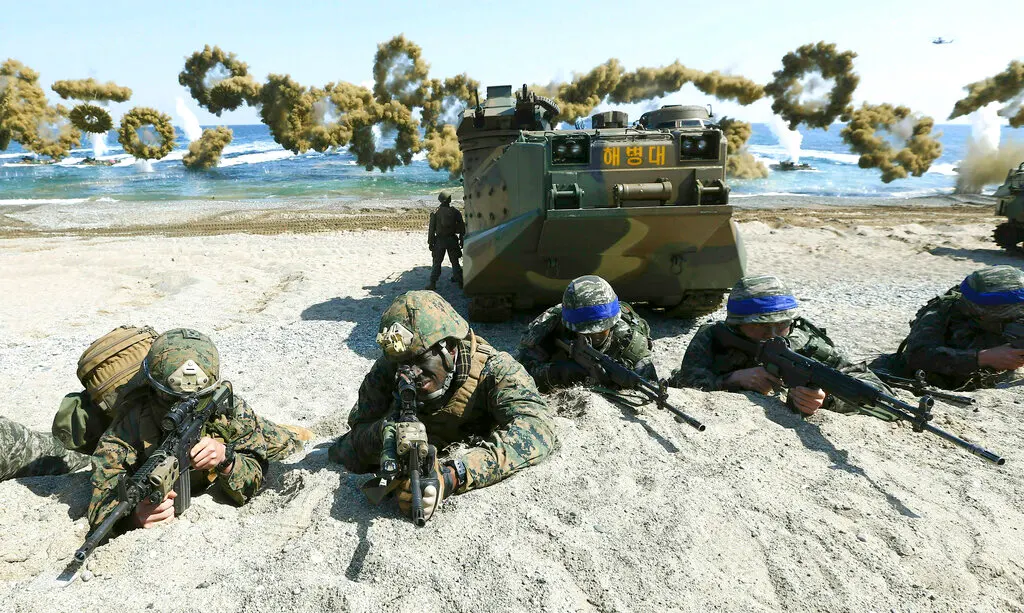
The true human cost of this decision lies in what these exercises actually represent. They are not mere shows of force or provocative flexing of military muscle; they are the intricate, grueling, and essential rehearsals for a potential war that could engulf the peninsula in hours. For the thousands of American and South Korean troops who participate in exercises like Ulchi Freedom Shield, these drills are where they learn to move as a single, cohesive fighting force. They practice coordinating logistics across treacherous terrain, sharing real-time targeting intelligence, and operating under a unified command structure when the fog of war descends. This year’s drills were set to incorporate the brutal lessons learned from the war in Ukraine—the pervasive threat of drone swarms, the chaos of GPS jamming, and the terrifying prospect of losing all communications in a high-tech battlefield. These are not abstract concepts; they are the life-or-death skills that soldiers rely on to survive and to protect the millions of civilians living in the sprawling metropolis of Seoul, which lies just a stone’s throw from the Demilitarized Zone. By cutting these exercises, the President is not just saving money or sending a political signal; he is degrading the readiness and the trust that have been painstakingly built over decades, leaving the alliance more vulnerable and its soldiers less prepared for the unthinkable.
From Pyongyang’s perspective, the reaction to Trump’s overture is far more complex than the White House might hope. While Kim Yo Jong, the North Korean leader’s powerful sister, has acknowledged that her brother retains “good memories” of his personal rapport with Trump, the regime has fundamentally changed its strategic calculus since those failed summits. North Korea has spent the intervening years aggressively expanding its nuclear and missile arsenal, and it has forged a deeply intertwined military partnership with Russia, even sending thousands of troops to fight in Ukraine. This battlefield experience has given Pyongyang a new sense of confidence and a hardened worldview. They have made it abundantly clear that they are not interested in returning to talks that demand their denuclearization; instead, they insist that Washington must first accept their status as a nuclear power. As Jenny Town, a senior fellow at the Stimson Center, points out, the North has not ruled out negotiations, but they see no reason to talk unless the U.S. concedes their nuclear reality. Trump’s decision to cut the drills, therefore, is not seen as a generous peace offering but as a sign of weakness—a reward for a regime that is actively supporting Russia’s war effort and has a long history of cooperation with Iran. It emboldens an adversary while simultaneously undermining the confidence of a loyal ally, a dangerous combination that threatens to destabilize the entire region.
The psychological impact on South Korea cannot be overstated. For decades, the alliance with the United States has been the cornerstone of South Korean security, a guarantee that has allowed the nation to flourish economically and culturally. The joint exercises were the tangible, visible proof of that commitment—a promise written in the synchronized movements of tanks and fighter jets. When that promise is suddenly revoked via a social media post or a hastily arranged press release, it sends a chilling message of unreliability. The “angst” that Town describes is not just a diplomatic buzzword; it is the anxiety felt by South Korean military officers who must now plan for a future where their American counterparts might not be there in a crisis. It is the fear of a business owner in Seoul who wonders if the security umbrella that has protected his family for generations is being folded up. The last-minute, haphazard nature of the announcement only amplifies this uncertainty, making the U.S. appear not as a steadfast guardian but as a fickle partner whose commitments can change with the wind. This erosion of trust is a strategic loss that no amount of diplomatic praise can repair, as it fundamentally calls into question the very foundation of the alliance.
The decision has sparked a firestorm of bipartisan criticism in Washington, where lawmakers from both sides of the aisle recognize the profound implications of the move. Senator Mark Kelly, a retired Navy captain, pointed out the stark reality that North and South Korea are still technically at war, and that the ability to defend the South depends entirely on the seamless coordination honed through these exercises. “Hollowing out these joint exercises is shortsighted and a mistake,” he argued. Republican Senator Thom Tillis framed the decision in the context of the broader global conflict, warning that reducing drills would free up thousands of North Korean troops to support Putin’s brutal war in Ukraine. Senator Elissa Slotkin was even more direct, accusing the President of “playing right into Kim Jong-Un’s hands” and rewarding a regime that sends weapons and troops to fight for Russia. The core of the criticism is that this move represents a fundamental misreading of strength. True strength in international relations comes from the steadfastness of one’s commitments and the reliability of one’s word. By unilaterally scaling back exercises while touting a “very good relationship” with a hostile dictator, the President has signaled to the world that American security guarantees are negotiable, that allies can be discarded when they become inconvenient, and that adversaries can be appeased with unilateral concessions. The ultimate stakes are the lives of millions of people on the peninsula and the credibility of the United States as a global leader, a price that no trade deal or fleeting moment of personal diplomacy can ever justify.