





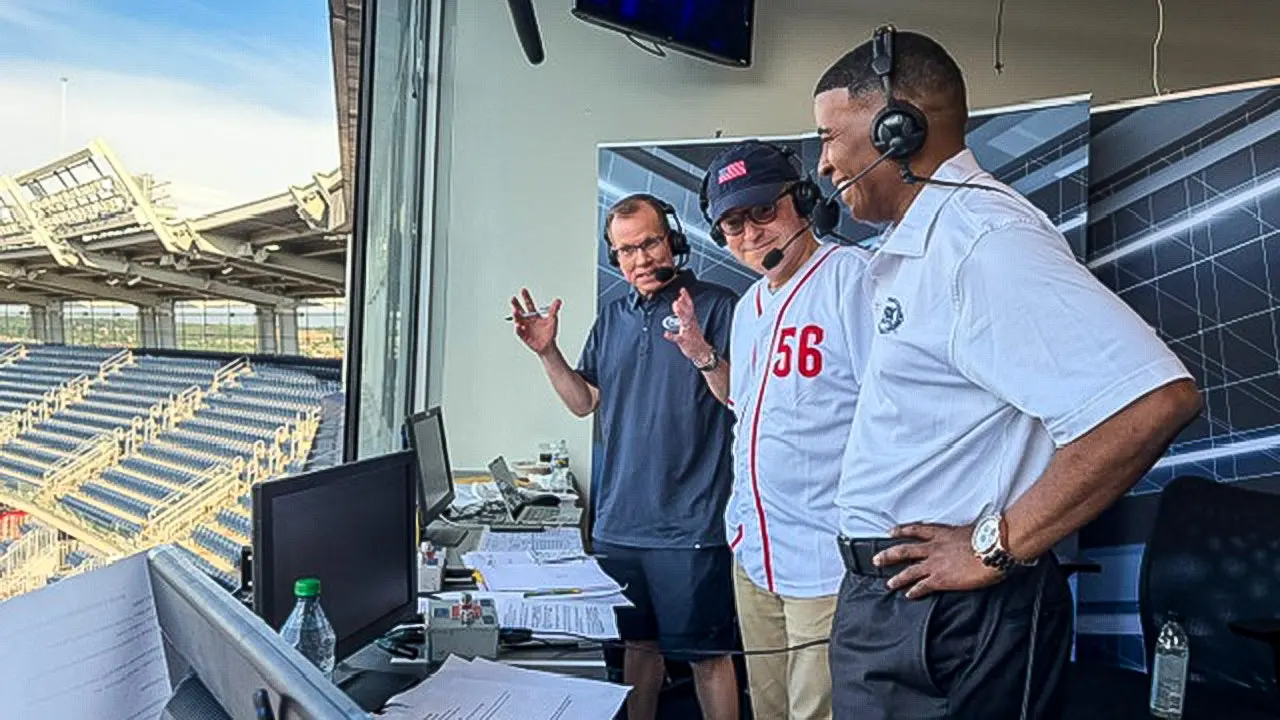
There were two 1s, three 3s, three 4s, and a pair of 7s and 9s roaming the field. At first glance, you might think you were trying to crack a complex computer programming code, decipher a bank routing number, or parse out values in hexadecimal. In reality, I was standing in the broadcast booth at Nationals Park, squinting through binoculars, desperately trying to unravel the chaotic uniform numbers of the Republican roster for the annual Congressional Baseball Game. This bipartisan tradition, which dates all the way back to 1909, is the only athletic event on earth where players on the same team are permitted to wear identical numbers, simply because members of Congress are allowed to wear whatever digits they please. On the Republican side, House Majority Leader Steve Scalise and Representative Brad Finstad both proudly sport number one, while three of their colleagues share number three. The Democrats are not much better, featuring multiple duplications of 3, 11, 15, and 25. Old-time ballpark vendors used to yell that you couldn’t tell the players without a scorecard, but for this game, a scorecard won’t do; you practically need an abacus, a reference sheet, and a healthy dose of patience to figure out who is actually standing on second base.
As the color commentator calling this game on national television for Fox Sports on FS1 alongside my play-by-play partner Kevin Corke, I have learned that no amount of traditional baseball preparation can fully prepare you for this unique challenge. I have spent my life immersed in the rich lore of the national pastime—I was in the stands at Cincinnati’s Riverfront Stadium the night Pete Rose broke Ty Cobb’s all-time hits record, I can tell you exactly who caught Hank Aaron’s historic 715th home run, and I can explain the intricacies of the infield fly rule in my sleep. Usually, calling a Major League Baseball game is a structured affair supported by endless streams of statistical data, scouting reports, and historical box scores. In the Congressional game, however, the playing field is entirely different. We are dealing with amateur athletes whose legislative voting histories are far more extensive and accessible than their batting averages, forcing us to trade traditional run-differential spreadsheets for creative, journalistic digging to find meaningful stories to share with the millions of fans watching at home.
Despite the comedic challenges of duplicate jerseys and political day jobs, the competitive fire on the diamond is incredibly real, often yielding spectacular, highlight-reel moments that rival the professionals. This year’s standout defensive play belonged to Missouri Senator Eric Schmitt, a devoted St. Louis Cardinals fan who holds the highest on-base plus slugging percentage in Congressional baseball history. During a crucial moment in the game, young Democratic Representative Johnny Oleszewski hit a towering, slicing fly ball deep down the left-field line. Schmitt sprinted toward foul territory, tracking the ball to the edge of the warning track before launching his entire body parallel to the ground to make a spectacular, diving catch. He emerged from the cloud of dust with the ball securely in his glove and blood visibly trickling down his face from crashing into the track. The next morning, Schmitt casually texted me that he wasn’t nearly as sore as he expected to be, despite scraping up his forearms—a badge of honor that will instantly become a legendary piece of broadcast lore for next year’s game.
This competitive spirit is fostered by the team managers, both of whom possess deep personal ties to the history of the game. The Republican squad is led by Representative Roger Williams of Texas, a man who actually lived the dream of professional baseball as an Atlanta Braves farmhand in the early 1970s, hitting a stellar .318 in the Appalachian League before a career-ending injury shifted his talents toward scouting. Across the diamond, the Democratic squad is managed by Representative Linda Sanchez of California, a trailblazing former player who is hunting for her first win as the team’s skipper. Sanchez’s deep-seated passion for baseball was forged during her childhood as an Angels fan, which shifted to a lifelong devotion to the Los Angeles Dodgers during the height of “Fernando-mania” in 1981, when rookie sensation Fernando Valenzuela captured the hearts of Southern California. Sanchez runs her dugout with tactical intensity, constantly striving to solve the age-old baseball puzzle of avoiding left-on-base heartbreaks and stringing together timely hits when the pressure mounting under the stadium lights is at its highest.
The deep historical connection between American governance and the national pastime stretches back much further than modern lawmakers might realize, bridging the gap between Capitol Hill and Cooperstown. In the 1930s, Wisconsin Representative Ray Cannon walked the halls of Congress, but before his legislative career, he was a high-profile attorney famously tasked with representing Shoeless Joe Jackson and other members of the Chicago White Sox during the infamous 1919 “Black Sox” scandal. Even more legendary is the story of former New York Representative Jacob Ruppert, who served in Congress around the turn of the twentieth century. Driven by an intense desire to own a baseball team, Ruppert purchased a struggling, second-division franchise known as the New York Yankees after a deal to buy the more prestigious New York Giants fell through. Ruppert subsequently acquired a heavy-hitting pitcher and outfielder named Babe Ruth from the Boston Red Sox, permanently transforming the Yankees into the most iconic franchise in global sports history and earning himself a plaque in the Baseball Hall of Fame.
Balancing the demands of running a country with playing a high-stakes charity game at Nationals Park requires a level of legislative maneuvering that only Congress could pull off. To ensure both teams made it to the stadium on time, Steve Scalise strategically scheduled the day’s final votes for late afternoon, while Appropriations Chairman Tom Cole warned lawmakers that they would need to return to Capitol Hill to vote on a major Homeland Security funding bill just thirty minutes after the final out of the ballgame. This led to comical scenes of representatives debating whether they would have to cast their official votes while still wearing dirt-stained baseball uniforms. Yet, even with all of this careful coordination, the unpredictable nature of the game always finds a way to throw a wrench into the broadcast, as it did when I spotted freshman Representative Christian Menefee pinch-running on first base—a player who was completely omitted from every official roster I had been given. It was a perfect encapsulation of the event: you can prepare all you want, memorize every duplicate number, and study every political biography, but when the lights go up on Congressional baseball, the beautiful chaos of the game will always leave you pleasantly outnumbered.