





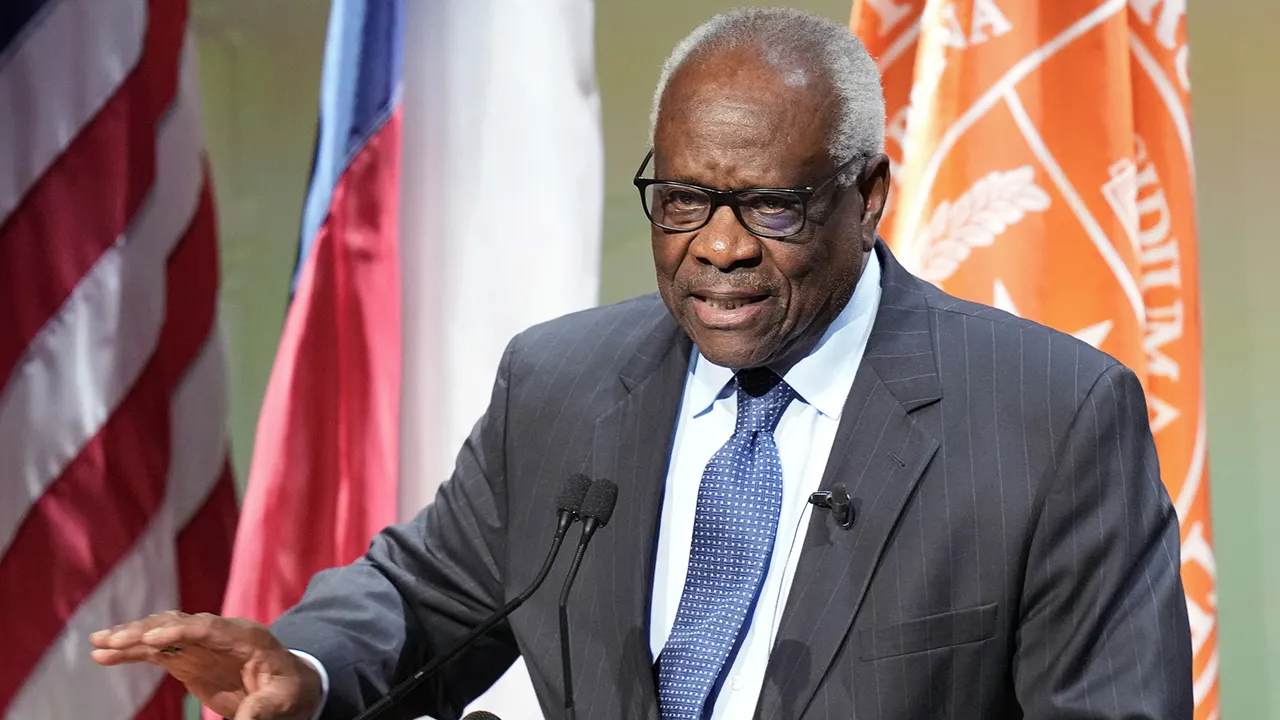
In a remarkably candid and revealing conversation, Supreme Court Justice Clarence Thomas recently sat down with Senator Ted Cruz and delivered a compelling, deeply personal rebuke to the idea that his race should dictate his political philosophy. His words, captured in a now-viral exchange on the Verdict podcast, cut to the very heart of America’s tangled conversation about identity, conformity, and intellectual freedom. “We had this saying [that there are] only two things I have to do: stay Black and die,” Thomas said, dismissing the implicit mandates often placed upon him by critics on the left. For Thomas, this simple proverb is not a surrender to fate, but rather a declaration of absolute autonomy. It is his way of saying that the color of his skin defines his biological reality, but it will never define the contents of his mind, his political allegiances, or his judicial philosophy. By making this statement, Thomas is refusing the narrow box that society, particularly the progressive left, has tried to force him into—a box where a Black man must adhere to a specific set of liberal dogmas or be branded a traitor to his heritage. His response is a profound assertion of self-ownership, a reminder that true liberty begins with the freedom to think independently, even when that independence comes at the cost of personal vilification.
To truly humanize Thomas’s stance, one must travel back to his origins in the oppressive, segregated world of Pin Point, Georgia, a small, impoverished Gullah community founded by freed slaves. He was born in 1948, a time when Jim Crow laws were an omnipresent, brutal reality. His childhood was marked by abject poverty, living in a tiny wooden shack without indoor plumbing, speaking Gullah—a creole language born of the African diaspora—and absorbing the hard-won wisdom of his grandparents, particularly his grandfather, who instilled in him a fierce, unrelenting work ethic and a belief in self-reliance. This environment was defined by the physical segregation Thomas speaks of, yet it was also a place of profound cultural resilience and moral grounding. When Thomas references the segregated Savannah public library, he is not speaking rhetorically; he is recalling a visceral memory of being denied access to books and knowledge simply because of his skin. This experience forged in him a lifelong aversion to any system that delineates human worth or potential by race. Consequently, when modern critics attempt to segregate his thinking—suggesting that a Black man cannot legitimately hold conservative views without being a sellout—Thomas sees the same insidious, paternalistic logic at work. The pain of being denied a book because of his race is inextricably linked to his fierce rejection of being denied a political ideology because of his race.
Thomas’s journey to this philosophical position was not linear; it was a turbulent evolution rooted in personal awakening and profound disillusionment. In his youth, Thomas was a radical. At the College of the Holy Cross in the late 1960s, he was an impassioned Black nationalist, deeply influenced by Malcolm X, and he helped found the school’s Black Student Union. He was angry, righteous, and firmly entrenched in the left-wing ideology of the time. However, a pivotal moment occurred during a violent protest in Cambridge, Massachusetts, in 1970. The details of that confrontation, which turned destructive, left Thomas feeling a deep sense of shame and horror at the chaos he had helped unleash. He later reflected that the anger and ideological rigidity of his peers felt hollow and destructive, lacking a constructive path to uplift his community. It was in the quiet aftermath of that turmoil, searching for a more durable framework, that he began to reconsider the lessons of his grandfather, who believed in hard work and personal accountability rather than government dependence or revolutionary rage. This intellectual pivot was not born of comfort or convenience; it was a painful, introspective reckoning. He chose to abandon the intellectual safety of groupthink, knowing full well that he would be ostracized for it. This is the crucible that forged his conservatism—not a lack of empathy, but a profound, lived understanding that victimhood could become its own prison, and that true dignity comes from self-determination rather than external validation.
The central thesis of Thomas’s library analogy is a masterclass in logical deconstruction, and it serves as the philosophical bedrock of his rebuttal. He asks the listener to consider the manifest injustice of a segregated library: the tyranny of being told you cannot enter a building because of your race. He then turns that question on its head, applying the same principle to the realm of ideas. What is the difference, he asks, between a society that physically prevents a Black man from entering a library to read Adam Smith, and a society that psychologically and socially harasses that same man for choosing to read Adam Smith? Thomas sees none. When he says, “Then my question is, why is it then that you have a problem with me embracing certain ideas in certain books?” he is exposing the hypocrisy of modern liberalism. In his view, the left has simply swapped one form of segregation for another. Instead of water fountains and library doors, they have erected invisible barriers around ideological purity. To be Black and conservative is to violate a sacred, unwritten rule. Thomas argues that this constitutes a modern-day moral and intellectual segregation, where the autonomy of the individual is subordinate to the orthodoxy of the group. His point is not merely political; it is a profound statement about the universality of human reason. It insists that the life of the mind knows no color, and that any attempt to bind intellect to ancestry is a fundamental betrayal of American founding principles.
Predictably, Thomas’s assertion of intellectual freedom has been met with a torrent of visceral hatred, epitomized by a Democratic lawmaker’s deplorable labeling of him as an “Uncle Tom” and, even more grotesquely, a “lynchman.” These slurs are not just insults; they are violent attempts at psychological coercion. The term “Uncle Tom” is designed to isolate him from his racial community, painting him as a traitor who betrayed his people to curry favor with the white establishment. The term “lynchman” is historically inflammatory, seeking to invert his role from a victim of racial terrorism into a perpetrator of it. To humanize Thomas in this context is to recognize the immense moral courage required to withstand such degradation. He has endured decades of this vitriol, culminating in the despicable treatment during his 1991 Senate confirmation hearings, where he was subjected to a high-tech lynching. Yet, he remains stoic, rooted in his principles. This backlash only validates his central argument: the left is utterly incapable of tolerating ideological diversity within the Black community. They demand uniformity, and when they do not get it, they resort to historical caricatures and racist tropes. In this sense, Thomas’s persecutors are proving his point for him. They are demonstrating that for them, a Black man’s value is contingent upon his adherence to their political script, and that independent thought is the ultimate act of defiance.
Ultimately, Clarence Thomas’s message is a timeless testament to the power of the individual over the collective. By re-framing the conversation from racial victimhood to intellectual sovereignty, he issues a challenge not just to Black Americans, but to all Americans: think for yourselves. His life story—from a dirt-poor, Gullah-speaking child in the segregated South to the second-highest court in the land—embodies the American Dream in its truest form. Yet, his greatest legacy may not be his legal opinions, but his unwavering refusal to be defined by the color of his skin or the expectations of others. When he says, “I declined that invitation,” he is rejecting the invitation to be a puppet, to be a caricature, and to surrender his mind to the mob. He embodies the spirit of the Founders who believed that a free government requires free citizens—free in body, but more importantly, free in conscience. By refusing to bend his knee to the altar of identity politics, Thomas offers a powerful, humanizing vision of America where one’s character, principles, and merit matter more than one’s ethnicity. He stands as a living contradiction to the narrow-minded dogmas of his critics, proving that true liberty lies not in marching in lockstep, but in the courage to walk alone when necessary. His famous quote, reduced to its essence, is a poetic declaration: My race is a fact of my birth, but my mind is the sovereign property of my soul.