




Summarize and humanize this content to 2000 words in 6 paragraphs in English
Seven pro-Palestine protesters are on trial in San Francisco this week, accused of bringing one of the nation’s most iconic bridges to a grinding halt, and if convicted, they could spend up to 15 years in prison.
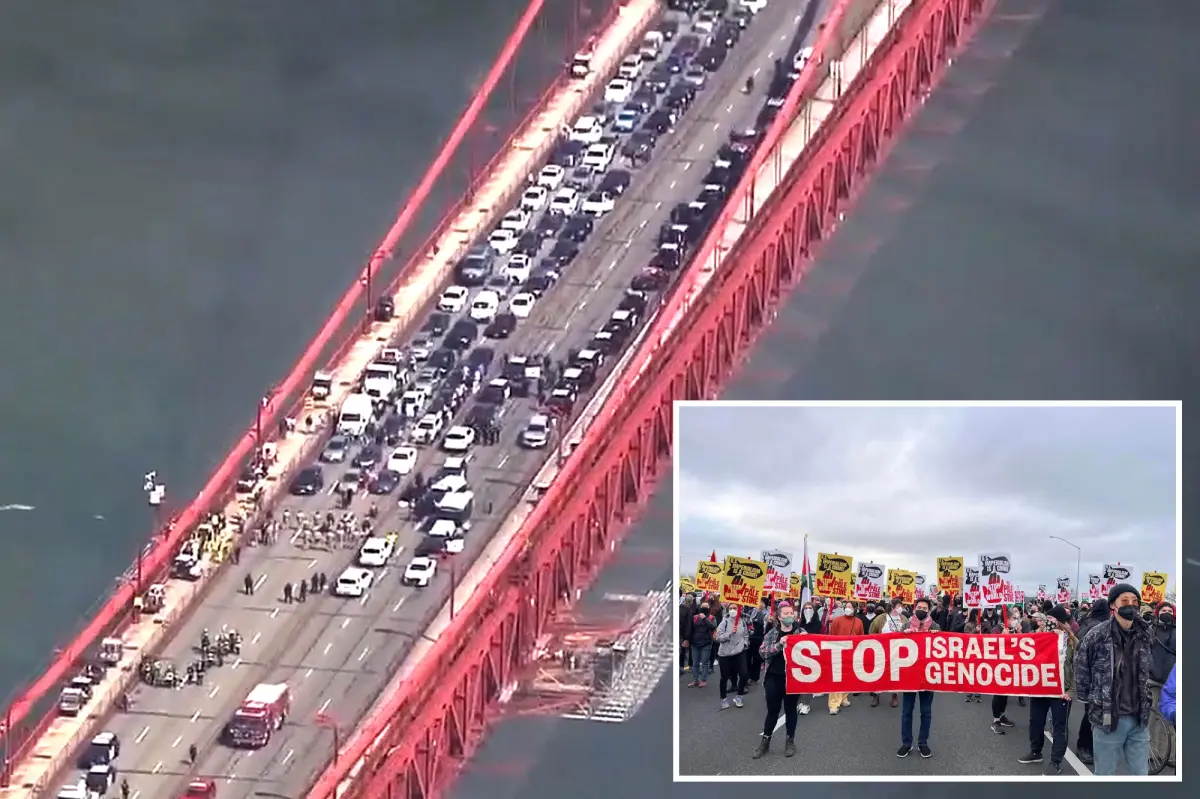
The case centers on an April 15, 2024 demonstration in which all southbound traffic on the Golden Gate Bridge was brought to a standstill for more than four hours, triggering major disruption across San Francisco’s main entry point.
Inside the courtroom Wednesday, prosecutors told jurors the incident was not a peaceful inconvenience but a deliberate obstruction of a major public roadway.
“This case is simple,” Assistant District Attorney Angela Roze told the jury, backing her argument with video evidence from the scene that showed officers on the bridge interacting with Sarah Cantor, who identified herself as the “police liaison” during the protest.
The footage also captured protesters blocking the roadway in vehicles as officers coordinated around the scene.
Roze said the actions were unmistakable. “The evidence that you see is exactly what the defendants did,” she continued. “There is no question that they obstructed a thoroughfare.”
She also drew a firm boundary between political belief and criminal conduct.
“While you may agree with their cause, and it may be an important one, it does not excuse breaking the law.”
The defense is expected to argue the opposite, that the blockade was driven by moral urgency over the war in Gaza and carried out only after other forms of protest failed.
Public defender Nuha Abusamra told jurors, “There was no legal alternative at this point.” She added, “It was time for civil disobedience.”
Abusamra also said her client River Allen and others were willing to “move to make a lane,” referring to the bridge’s movable median barrier, in an attempt to allow emergency access through the shutdown.
Another defense attorney, Katy Isa, said her client Conrad DeJesus “had no other choice but to get involved,” pointing to what she described as constant exposure to conflict imagery “coming through his feed every day, morning, noon and night.”
The legal fight follows a turbulent aftermath from the same protest.
In August 2024, more than two dozen other agitators arrested during the bridge shutdown were released after San Francisco District Attorney Brooke Jenkins said there was not enough evidence to prosecute them.
At the time, Jenkins urged affected motorists to come forward so they could be documented in the case, saying they could “be alleged as a victim” to help build prosecutions.
“Anyone who was falsely imprisoned on the Golden Gate Bridge on April 15, 2024, is urged to contact the California Highway Patrol,” she said.
The financial impact of the blockade also resurfaced in 2025, when the Golden Gate Bridge Highway and Transportation District initially sought $163,000 in restitution for lost toll revenue, before ultimately dropping the demand.
The April 2024 disruption was part of a broader wave of coordinated demonstrations across the country, where activists blocked major infrastructure in Illinois, California, New York and the Pacific Northwest.
The actions disrupted airports, highways, and key crossings including the Golden Gate and Brooklyn bridges.
Tactics utilized by unlawful protesters this morning on I-880 and the Golden Gate Bridge. This is unlawful and will not be tolerated. Arrests were made and the CHP is recommending charges. Thank you to our law enforcement partners for their assistance. pic.twitter.com/Nn4fdqD08m— CHP Headquarters (@CHP_HQ) April 16, 2024
In the Bay Area, the shutdown halted all vehicle, pedestrian, and bike traffic across the span for hours, while additional protesters chained themselves to 55-gallon drums filled with cement on Interstate 880 in Oakland.
In Oregon, demonstrators blocked Interstate 5 near Eugene, stopping traffic for about 45 minutes.