





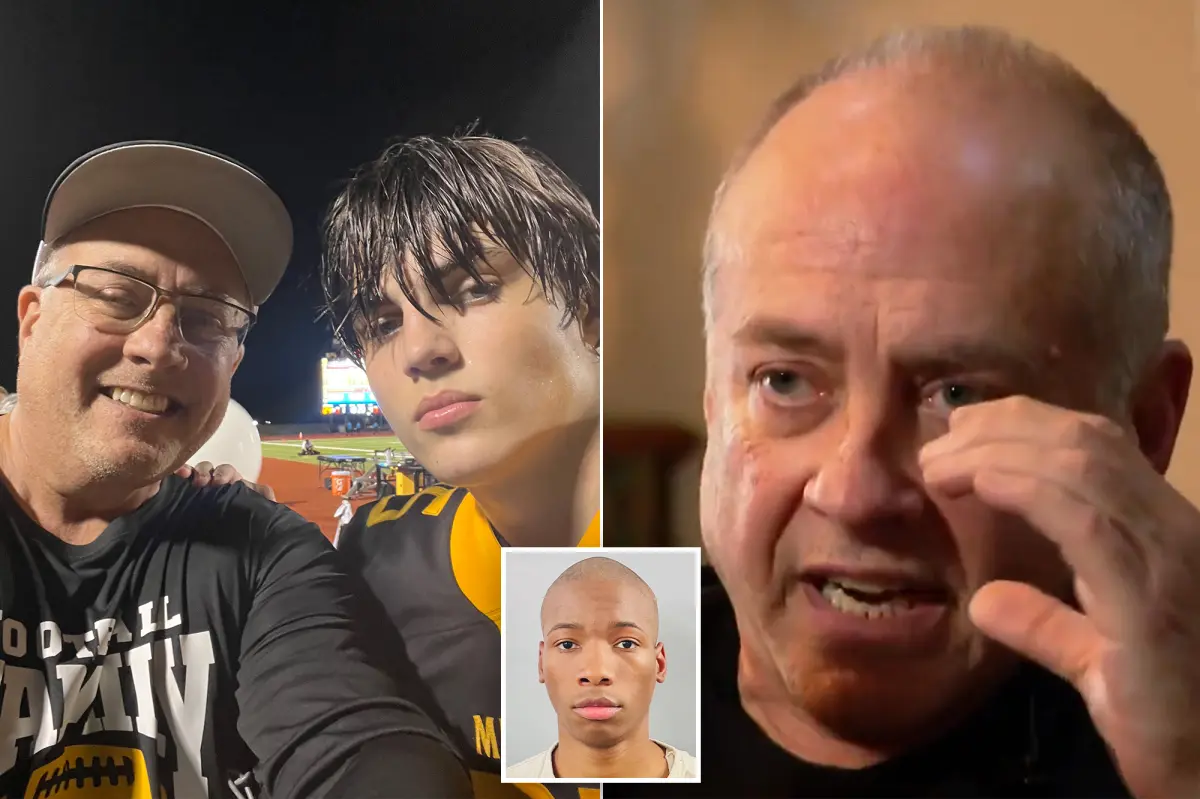
The quiet, sterile environment of a Texas courtroom in Collin County recently became the epicenter of an unfathomable human tragedy as family members, friends, and legal observers gathered to witness the final judicial chapters of a young life cut brutally short. Jeff Metcalf, a grieving father carrying a burden of sorrow that no parent should ever have to bear, sat quietly in the wooden pews of the McKinney courthouse, desperately preparing himself for a devastating sensory assault. On the electronic screens before him, the raw digital reality of police bodycam footage flickered to life, revealing the chaotic, desperate final moments of his seventeen-year-old son, Austin Metcalf. Austin was not just a statistic or a name on a dry legal indictment; he was a beloved local high school football star, a vibrant teenager with a glowing future, and a twin whose life was deeply and structurally bound to his brother, Hunter. The harrowing footage captured the frantic, heart-wrenching scene on April 2, 2025, when a routine high school track meet transformed in an instant into an arena of horror, culminating in Austin dying directly in the trembling arms of his twin brother. For Jeff, watching this video was a secondary execution, a digital repetition of the crime that tore his family apart, ripping open deep psychological wounds that time would never truly heal and forcing him to witness the agonizing intersection of life and death in high-definition. The courtroom was thick with a heavy, collective silence, punctuated only by the soft rustling of legal papers and the quiet sobs of onlookers who found themselves completely overwhelmed by the stark, unvarnished reality of the footage.
The physical and emotional toll of the trial peaked when the audio track of the bodycam footage echoed through the silent courtroom, filled with the raw, guttural panic of a sibling realizing his other half was rapidly slipping away. It was the terrified voice of Hunter Metcalf, crying out to the heavens in a desperate plea for a miracle, that shattered whatever defensive emotional walls his father had built around his heart during the long, agonizing trial. “Oh, God, oh God. My brother, my twin,” Hunter’s voice pleaded through the speakers, a haunting sound that Jeff later described as a weapon that physically “killed” something inside him as it vibrated through the courtroom. There is a primal, biological contract between a parent and a child—an unspoken vow of constant protection, a deep-seated belief that a father can always step in to fix the broken pieces of his children’s lives. To sit in a modern courthouse, paralyzed by the boundaries of space and time, hearing the absolute terror in his surviving son’s voice while being utterly powerless to alter the past or comfort his dying child, was an excruciating form of torture that Jeff struggled to put into words. This visceral experience forced him to confront the ultimate limitation of fatherhood: the reality of not being there when his children needed him the most, trapped in a retrospective look at a nightmare that concluded with a young life bleeding out on a running track while strangers tried in vain to administer life-saving medical aid.
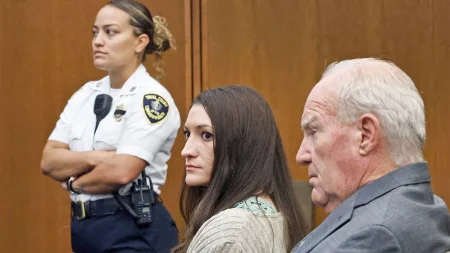
Across the courtroom sat the perpetrator of this immense grief, nineteen-year-old Karmelo Anthony, who seemed visibly unnerved by the glaring mirror of his own actions projected onto the screens for everyone to see. As the graphic details of the stabbing played out, Anthony squirmed in his seat, unable to maintain eye contact with physical manifestation of the violence he had unleashed, his eyes darting away from the screen while his defense attorney offered a comforting pat on his trembling shoulder in an attempt to quiet his visible distress. The judicial system eventually delivered its verdict after hours of deliberation, sentencing Anthony to thirty-five years in a Texas state prison, with the structural opportunity for a parole review in seventeen years—an outcome that Jeff Metcalf accepted but found fundamentally lacking compared to the permanent nature of his loss. For Jeff, a thirty-five-year sentence felt like a temporary interruption for the killer, whereas his own family was serving a lifetime sentence of grief without the possibility of relief or parole. Motivated by an enduring sense of duty to his departed son, Jeff vowed that if he is still alive when Anthony’s parole hearings begin, he will stand before the board in person to advocate against his release, and if his own mortality prevents him from being there, he will leave behind a persistent video testimony to speak for Austin from beyond the grave. This vow represents a lifetime commitment to keeping the memory of Austin’s stolen potential alive in the eyes of the justice system.
Yet, amid the swirling storms of rage and devastation, Jeff Metcalf exhibited a rare, startling dimension of human empathy that transcended the simple narrative of vengeance and punishment. Looking at the young man who had taken his son’s heart, Jeff confessed to feeling a quiet, heavy sorrow for Anthony, recognizing the sheer tragedy of a nineteen-year-old boy who had dismantled his own future and was now destined to grow old behind the razor wire of the Wallace Pack Unit near Houston. This sorrow was not born of weakness, but rather of a sophisticated emotional survival strategy; Jeff understood that carrying a toxic cocktail of hatred and unfiltered rage would eventually consume him from the inside out, acting as a spiritual malignancy far more destructive than physical sickness. His eventual decision to offer forgiveness to Anthony was a deliberate act of self-preservation rather than an endorsement of the act, a conscious effort to untether his own soul from the destructive gravity of the killer’s destiny. “Forgiveness was not for him. Forgiveness was for me,” Jeff explained with profound clarity, choosing to release the venom of resentment so that he could continue to exist for his surviving son, preventing the tragedy from claiming yet another victim within the Metcalf household. By separating the offender from the offense, he managed to preserve his own humanity in a situation designed to strip it away completely.
The fragile peace of forgiveness did not, however, dilute the searing truth of the victim impact statement Jeff delivered directly to Anthony before the young man was escorted away to serve his sentence. With raw, unvarnished honesty, Jeff dismantled the polite social conventions of court-approved mourning, defining grief not as a passive state of sadness, but as a burning, pure, and unfiltered rage that permanently alters a person’s psychological landscape. He commanded the teenager to look up, refusing to allow him the easy escape of shame, and delivered a blistering indictment of a young life wasted through senseless entitlement and cowardly violence. The tragedy began over an absurdly trivial confrontation at a track meet, where Anthony, a student from Centennial High School, stubbornly refused to leave a tent belonging to the rival Memorial High School team despite being explicitly instructed to do so fifteen times by various coordinators and coaches. Instead of choosing the path of peaceful retreat, Anthony pulled out a multi-tool equipped with a jagged, serrated blade and plunged it directly into Austin Metcalf’s chest, creating a physical and literal hole in the athletic teenager’s heart that ultimately ended his life and shattered his family’s reality. Jeff’s words hung heavily in the air, a stark reminder of how a series of small, stubborn choices could escalate into an act of violence that forever destroyed two families.
While the courtroom sought legal resolution through a swift jury deliberation that rejected the defense’s attempt to characterize the stabbing as a crime of “sudden passion,” the world outside the courthouse walls threatened to reduce the tragedy to a battleground of political and racial division. Protesters gathered on the steps of the McKinney courthouse, claiming that the prosecution of the young Black teenager was dripping with racial bias and asserting that Anthony had acted in self-defense, a narrative that his mother, Kala, echoed when she publicly condemned the thirty-five-year sentence as inherently racist and announced plans for an immediate appeal. For Jeff Metcalf, these external debates were a sickening distraction from the fundamental moral reality of the crime, a symptom of a broader societal decay where the boundary between right and wrong has been obscured by ideological warfare. He reminded the public that the loss of his son was never about the color of anyone’s skin, but about the simple, agonizing truth that a young life was violently stolen over a refusal to show basic human respect and compliance. As the case closes and Anthony begins his long sentence in Houston, Jeff is left to navigate a world that is permanently altered, grappling with the quiet, daily reality of surviving his child, carrying the memories of Austin’s laughter, and trying to find a path forward through the quiet spaces where his son’s future should have been.