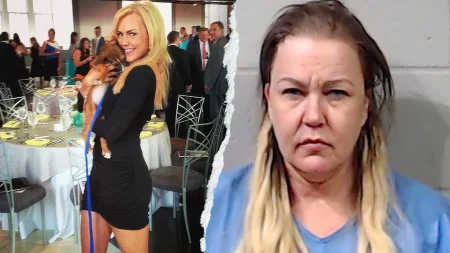






McKenna West, an Alaskan nurse and single mother of two, had agreed to carry a child for a couple who desperately wanted to become parents. It was an act of profound generosity, one that would soon transform into an agonizing legal and moral battle. West is now only weeks away from giving birth to a baby boy she has named Gabriel, due September 2. But instead of joyfully handing the newborn to his biological parents, she is preparing to fight for his life in a Texas courtroom. The baby’s parents, Nausheen Gilkar and Omar Ahmed of California, have asked West to abort the child because he was diagnosed with hypoplastic left heart syndrome, a severe congenital heart defect. West refused, and she traveled to Texas, where state law recognizes her as the birth mother and where legal protections have now been put in place to ensure that Gabriel receives life-saving medical care when he is born. The case has become a flashpoint, raising deeply personal questions about surrogacy, parental rights, and the value of a life diagnosed with serious medical challenges.
The diagnosis came in April, when West was twenty weeks pregnant. Everything had been going smoothly. Genetic testing had come back normal, and there were no signs that anything was wrong. But during a routine ultrasound, the doctor saw something alarming. West’s biological parents were on a FaceTime call from California, watching the scan alongside her. The doctor entered the room and delivered the news in a single devastating sentence: there was no blood flow through the left side of the baby’s heart. He told West she was not qualified to interpret the images, so she would need to see a maternal-fetal medicine specialist for a closer look. The room fell into shock. West described the moment as completely unexpected, a sudden turn from hopeful anticipation to fear and confusion. For West, the baby she was carrying had already become a person, a life she was committed to protecting. But for the intended parents, the diagnosis opened a door that surrogacy agreements often leave open: a clause permitting termination if a serious anomaly was discovered. West immediately understood what that meant. She feared Gilkar and Ahmed would choose abortion, and she could not imagine being part of ending a life she had nurtured through months of pregnancy. In that moment, she resolved that she would not willingly participate in an abortion, regardless of the consequences.
That resolve set her on a collision course with the couple. West refused to terminate the pregnancy in Alaska, where she had been living, and Gilkar and Ahmed sued her, seeking to force the abortion. They wanted her to travel to California, where the surrogacy contract had been signed and where the legal framework, in their view, required her to follow their wishes. West, however, said she would go to California only if the baby’s biological parents agreed to allow him to receive medical treatment after birth. For her, the issue was not simply about obedience to a contract; it was about giving Gabriel a chance to live. She knew that hypoplastic left heart syndrome was serious, but she also knew it was treatable, and she believed that no contract should override a child’s chance at survival. So she made a difficult choice: she left Alaska and settled in Texas, a state with its own laws and a political climate far more protective of unborn life. There, she would be recognized as the child’s legal birth mother under state law, at least until the courts decided otherwise. It was a bold move, one that placed her in the center of a legal storm while she was still carrying the child and preparing for the emotionally and physically demanding arrival of a medically fragile newborn.
The legal battle escalated quickly. Texas Attorney General Ken Paxton stepped in, filing a petition on behalf of the state to protect the baby. On Tuesday, a court granted the petition, issuing an order that made clear Gabriel must receive stabilizing and life-sustaining care upon his live birth. The order explicitly states that no person shall withhold, direct the withholding of, obstruct, or delay that care. It also prohibits anyone from removing Gabriel from the hospital where he is being treated or from the state of Texas pending further court orders. For Paxton, the decision was a victory for the unborn child. He praised the court for acting to protect Gabriel’s life and promised to continue fighting for the baby’s well-being. “Every child in our state deserves to be cared for and protected,” he said. Lawyers for Gilkar and Ahmed have not commented on the ruling, leaving the intended parents’ next steps unclear. The couple is scheduled to appear in a Dallas County court on August 25, just days before Gabriel is due. By then, the world may already have witnessed a birth that will determine not only the future of one child but also the boundaries of surrogacy agreements and the rights of all parties involved.
For babies born with hypoplastic left heart syndrome, the first days of life are critical. The condition causes the left side of the heart to be severely underdeveloped, leaving it unable to pump blood effectively. Without immediate surgical intervention after birth, survival beyond the first week is unlikely. But with treatment, outcomes are far more hopeful. According to NewYork-Presbyterian Hospital, babies who undergo surgery have a 75 percent chance of reaching their fifth birthday, and those who survive to their first birthday have a 90 percent chance of reaching adulthood. These numbers meant everything to West. She saw the diagnosis not as a death sentence but as a medical challenge that modern medicine could address. To her, Gabriel was not a problem to be eliminated but a child with a beating heart and a future worth fighting for. The intended parents may have looked at the same statistics and seen a lifetime of hospital visits, surgeries, and uncertainty. Their perspective is not hard to understand; no parent wants their child to suffer, and a prenatal diagnosis of such a serious condition can be overwhelming. But for West, the calculus was different. She had felt Gabriel move, had seen his face on ultrasound, had named him. She could not be the one to bring about his death out of fear of the road ahead.
As Gabriel’s due date draws near, the case has become a powerful and human story about what it means to protect a vulnerable life. West says she has followed her conscience, even at the risk of being sued and publicly vilified. She is carrying a child who may need immediate and complex medical care, and the courts have for now ensured that no one will be allowed to deny him that care or take him away from Texas. The legal order is an early victory, but the fight is far from over. The biological parents still have standing, and their anguish and disappointment cannot be dismissed. The courtroom in Dallas will soon become the stage for a decision that could define the rights of surrogates and intended parents for years to come. But in the quiet moments, away from legal filings and courtroom arguments, there is a woman about to bring a child into the world, a woman who has already made a promise to protect him. She has named him Gabriel, a name that carries its own biblical weight, and she believes her duty is clear. Whatever the outcome, West’s story has already changed the way many people think about surrogacy, disability, and the choices we make when life arrives with a difficult diagnosis. It asks us to consider not just the letter of a contract but the humanity at its center, and whether a baby’s heart, however imperfect, deserves its own chance to beat.