






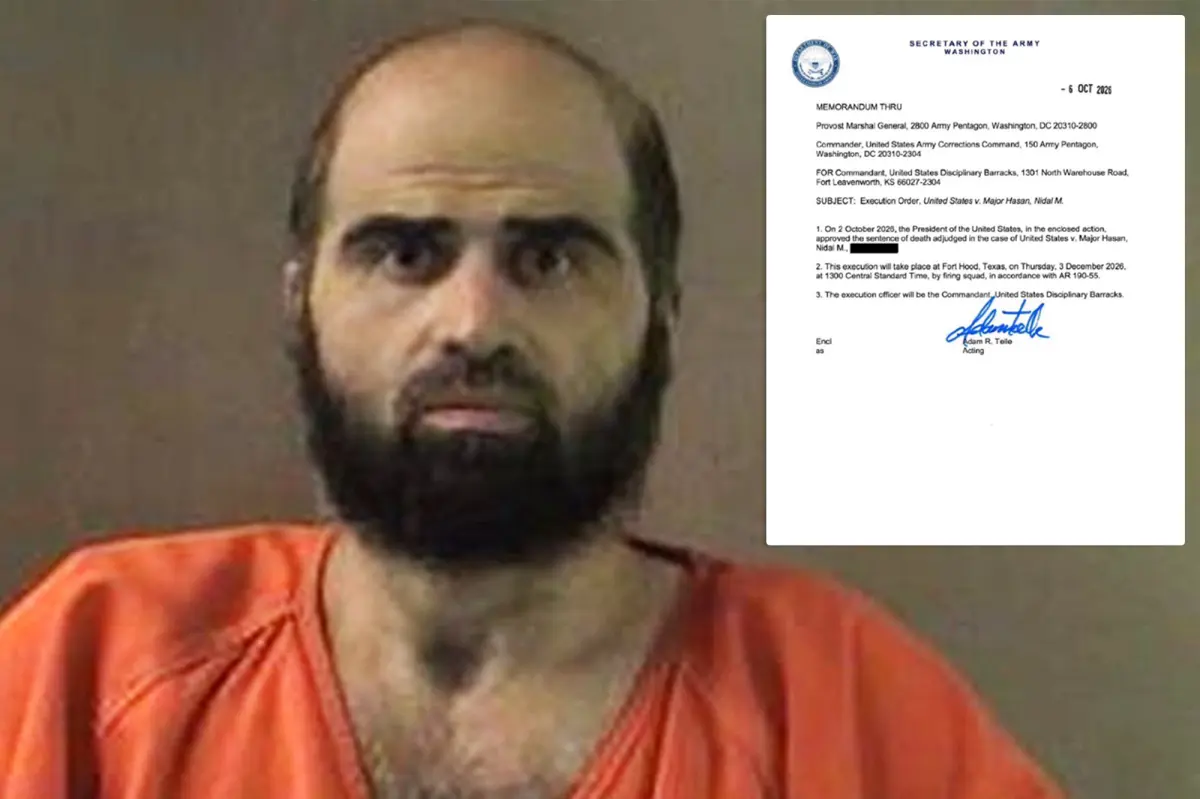
For more than a decade and a half, the name Nidal Hasan has lingered like a shadow over the United States military—a reminder that the greatest threats can sometimes emerge from within. On Tuesday, that shadow was given a final, unyielding form. Officials announced that Hasan, the convicted Fort Hood shooter who murdered thirteen people and wounded more than thirty others in one of the deadliest attacks on an American military installation in history, will be executed by firing squad on December 3 at 1 p.m. at the very base where he committed his crimes. There is a poetic and painful symmetry in this decision: the place that once witnessed his rampage will now witness his final breath. Army Secretary Adam Telle revealed the date and location in a social media post Tuesday night, and Pentagon spokesman Sean Parnell confirmed that the method of death was recommended by Secretary of War Pete Hegseth and approved by President Trump. In a separate post, Parnell called it “judgment day for Hasan,” recalling that Hasan had shouted “Allahu Akbar” during the attack. For those who survived, for the families who buried their loved ones, and for a military community that has carried this weight for so many years, the announcement was not just a bureaucratic detail—it was the closing of a long, agonizing chapter.
Hasan was not a stranger in the ranks, but a familiar face—a former Army major and psychiatrist who had once worn the same uniform as the men and women he targeted. In November 2009, he walked into a crowded medical processing center at Fort Hood, Texas, where soldiers were queued for vaccinations and routine health screenings before deployment. These were not combatants in a war zone; they were young troops preparing for service, many of them unarmed, caught completely off guard in what should have been a safe administrative building. Hasan opened fire methodically, moving through the room with the cold precision of someone who had traded his oath for a twisted ideology. Witnesses described chaos, screams, and the desperate scramble of soldiers trying to protect one another. When a responding police officer shot him in the back, Hasan was left paralyzed from the waist down—a physical confinement that mirrored the moral and psychological prison of his own radicalization. At his trial, he was unrepentant, telling a military judge that he was defending the leadership of the Islamic Emirate of Afghanistan and the Taliban. In 2013, a military court sentenced him to death. Since then, he has waited on death row, living in a controlled environment while the nation argued over the legality, morality, and timing of his fate. Now that patience—both his and the country’s—is finally running out.
But numbers and dates can never fully capture the human cost of that November morning. Behind the cold statistics—thirteen dead, thirty-two wounded—are entire worlds of grief that have unfolded quietly for years. Each victim was someone’s son or daughter, someone’s spouse or parent, someone’s best friend. There were young soldiers who had barely begun their careers, their lives brimming with promise, and there were seasoned service members who had already given so much to their country. There was also a civilian, a man simply doing his job on a military base. Their deaths did not occur in a remote battlefield, but on American soil, in a place that was supposed to be safe. The survivors were not merely wounded in body; many carried invisible scars that would never fully heal. Flashbacks, anxiety, survivor’s guilt, and the ever-present memory of that blood-soaked room followed them through years of therapy, medical appointments, and sleepless nights. Families spent holidays with empty chairs. Children grew up without fathers or mothers. Spouses learned to navigate widowhood in a community that often did not know how to speak about a terrorist attack on home soil. For these people, the execution is not an abstract legal event—it is the final reckoning for a man who tore their lives apart. The announcement that Hasan will face a firing squad on the very ground he desecrated offers a kind of closure that no courtroom verdict could ever provide.
The method of execution, though deeply controversial in modern America, carries its own historical weight. The firing squad is an archaic form of capital punishment, one that conjures images of military justice in an earlier century, when soldiers were held accountable before their comrades in stark and unforgiving rituals. For Hasan, this choice seems deliberate—a return to the martial tradition that he once disgraced. A firing squad typically involves strapping the condemned person to a chair, placing a hood over the head, and positioning a target marker over the heart. A team of sharpshooters, often using live ammunition rather than blanks, fires simultaneously from a short distance, causing nearly instantaneous death if all goes as planned. There are no appeals to soothe the condemned, no quiet oblivion of lethal injection; the method is blunt, visceral, and final. The last service member executed by the U.S. armed forces was in 1961, meaning Hasan will become the first in more than six decades. That alone marks an extraordinary moment in American military history. It also raises profound questions about whether executions belong on military installations at all, and whether Hasan, by his actions and rhetoric, has forfeited not just his life but any claim to the ordinary protections of civil society. The decision was not made lightly; it flowed through layers of review, requiring the approval of the highest officials in the executive branch. For the Pentagon, this is both a legal obligation and a symbolic act—an assertion that the military will protect its own, even when doing so requires a confrontation with the darkest side of justice.
The Hasan case has always been more than a single act of violence. It forced the nation to confront uncomfortable truths about terrorism, radicalization, mental health, and the vulnerabilities within even the most disciplined institutions. In the years before the attack, Hasan reportedly showed signs of increasing extremism, yet those warning signs were either ignored or insufficiently addressed. His colleagues described him as angry, alienated, and openly hostile to the military’s mission in the Middle East, but the chain of command struggled to know how to handle a trained psychiatrist who seemed to be unraveling. Some have argued that his actions were a product of mental illness, while others insist they were the calculated choices of a committed terrorist. The trial settled his guilt, but it did not settle the broader unease. The military has since undergone extensive reviews of security, intelligence sharing, and the handling of insider threats, all in the hope of preventing another tragedy. Yet no policy can fully erase the fact that Hasan was one of their own—a man entrusted with the mental well-being of soldiers, who became the instrument of their destruction. In a strange way, his execution will force a final accounting of that failure as well. It will be a day when the state answers not just for what he did, but for what allowed him to do it. And as the country watches, it will be hard not to feel a complicated mix of anger, sorrow, and relief—anger at the man who caused so much pain, sorrow for the lives that were lost, and relief that the long legal process has finally reached an end.
When December 3 arrives and the bullets tear through Nidal Hasan’s chest, there will be no celebration among those who truly understand the weight of this moment—only a quiet, heavy exhale. Justice will be done, but justice cannot resurrect the dead, heal the wounded, or erase the memories that still haunt survivors and families. The Fort Hood attack was a national tragedy, and the execution of the man who carried it out will not undo that tragedy. It will, however, mark the end of a long and exhausting journey through the American legal system, a journey that has tested the patience of victims, the resolve of prosecutors, and the faith of the public. Some will argue that capital punishment is never the answer, while others will see this as a long-overdue sentence being finally carried out. But beyond the debate, there is a deeper need for closure and a quiet hope that the community can begin to heal. The military base, once soaked in fear and confusion, will be the stage for a solemn and deliberate act of justice. The name Nidal Hasan will fade from the headlines, as all names eventually do, but the memory of the thirteen people he killed will remain etched in the collective consciousness of the nation. They were soldiers and civilians, fathers and mothers, sons and daughters—individuals whose lives mattered far more than the ideology that ended them. As the firing squad takes aim and the nation holds its breath, perhaps the most human thing we can do is remember them, honor their sacrifice, and promise never to forget. That is the most meaningful response to hatred: not merely punishment, but remembrance. And on that day, as the sun sets over the Texas plains, Fort Hood will finally begin to feel like home again.