





We live in a world that has forgotten what silence actually sounds like. Think about your typical day: the persistent, low-grade rumble of traffic on the main road, the distant wail of a siren, the muffled bass thumping from a neighbor’s apartment, or the abrupt, jarring sound of furniture scraping across the ceiling above you. We have grown so accustomed to this constant auditory backdrop that we rarely notice it—until, that is, we step into a space that is genuinely, breathtakingly quiet. It’s a strange and wonderful sensation, isn’t it? The absence of noise doesn’t feel like emptiness; it feels like relief. It’s a deep, soothing breath for the soul. In these moments, we realize how drastically our nervous systems are being taxed by the daily cacophony. We begin to crave that solitude, that pristine acoustic emptiness, even if we don’t always recognize it. We should actively seek out these places, not just for a vacation, but for our own mental health and spiritual restoration. It’s a form of luxury that money can’t always buy, yet the world has more of it than we might think.
Fortunately, for those of us longing to escape the relentless grind of modern life, a new study has mapped out exactly where you can find genuine peace and quiet. Travel experts at Go2Africa have created a comprehensive “Noise-Free Nations Index” designed to identify the quietest countries on Earth. Rather than using literal sound decibel measurements, the index cleverly synthesizes several key physical and infrastructural data points to determine how inherently peaceful a destination is. The methodology considered population density, tourist density, the percentage of rural land coverage, the amount of protected natural land, motor vehicle density, airport density, and train line density. Each country was evaluated across these specific indicators, receiving a score out of 100 for each category, which were then weighted and combined to produce a final overall “quiet score.” The result is a fascinating ranking that reveals a striking disparity in how different nations manage space, population, and development, offering a roadmap for travelers who prioritize tranquility above all else.
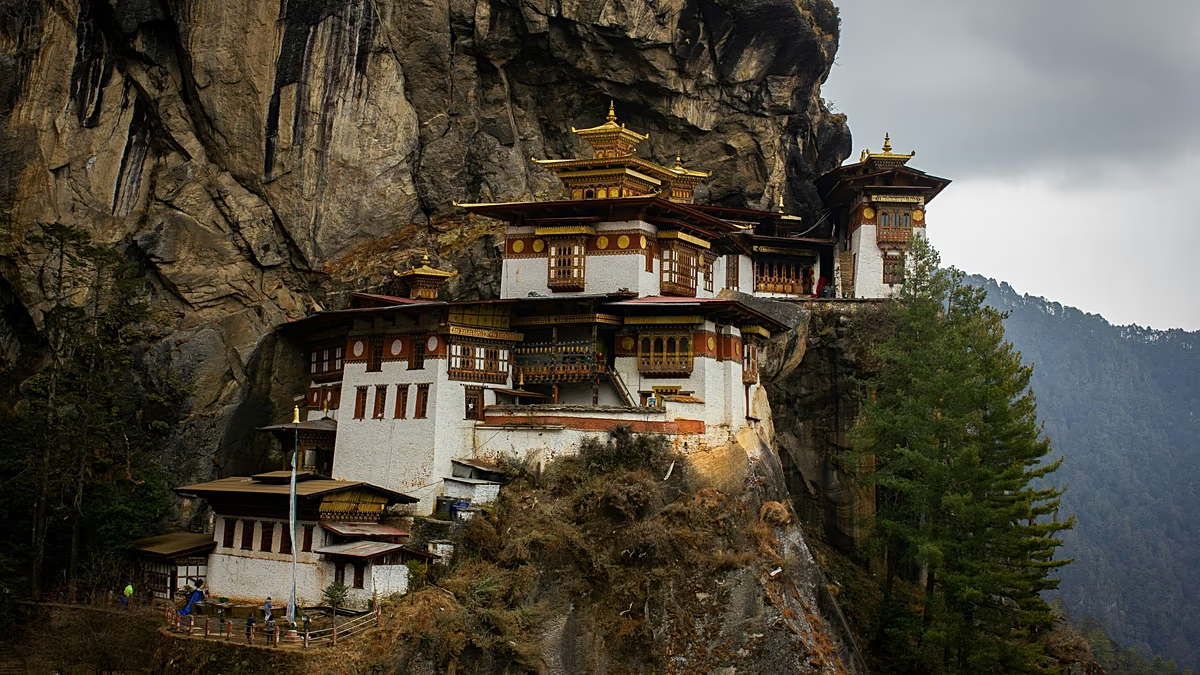
Taking the top spot on the global podium for tranquility is the stunning Himalayan kingdom of Bhutan. Earning an impressive quiet score of 89.44, this small nation—often referred to as the “Land of the Thunder Dragon”—is a sanctuary of unworldly calm. What makes Bhutan so uniquely quiet? Its geography is a natural fortress of silence, with over 39,000 square kilometers of dense, forested mountains, terraced valleys, and rugged highland terrain. But Bhutan’s serenity is not just a matter of geography; it is a deliberate national policy. The government famously prioritizes Gross National Happiness over Gross Domestic Product, and this philosophy extends to its tourism model. To protect its pristine environment and unique culture from the crushing weight of mass tourism, Bhutan charges a hefty Sustainable Development Fee for visitors. This intentionally high barrier keeps tourist numbers incredibly low, ensuring that the country’s trails, monasteries, and towns remain uncrowded and serene. The result is a place where the loudest sounds you’re likely to hear are the flutter of prayer flags in the wind, the distant chant of monks, and the trickle of mountain streams.
Africa emerges as the undisputed continent for those seeking acoustic peace, with over half of the top 25 quietest countries located on its vast and wild terrain. In fact, African nations dominate the top five positions. Namibia claims the silver medal with a quiet score of 86.69, and it’s easy to see why. This breathtakingly beautiful country has one of the lowest population densities on earth, with just 3.83 people per square kilometer. It is home to the Namib, the world’s oldest desert, where towering dunes create a landscape of profound solitude. There is virtually no light pollution, and almost no tourist congestion, with just 0.67 tourists per square kilometer. Botswana follows closely in third place, thanks to its “low-volume, high-value” tourism strategy, which encourages exclusive, high-end safaris while severely limiting the number of visitors allowed into its pristine wilderness. Closing out the top five are Zambia and Gabon. Zambia boasts one of the highest proportions of protected land in the world, creating a haven for wildlife and silence, while Gabon, located on the equator, is a treasure trove of pristine, untouched rainforest—one of the last places on earth where you can hear the true, unaltered symphony of the jungle.
While Africa and Asia offer extreme isolation, the data tells a sobering story for travelers in Europe. In this ranking, no single European country managed to break into the top 25. The highest-ranked European nation is Estonia, which languishes in 34th place, followed by Finland in 39th and Sweden in 40th. This is a stark reflection of the continent’s reality: dense historical populations, an extensive network of roads and high-speed rail, and some of the highest tourism inflow numbers in the world. Europe is a tapestry of interconnected cities, airports, and infrastructure, making vast stretches of empty, silent land a rare commodity. While you can certainly find remote cabins in Scandinavia or isolated coves in Greece, the overall national “noise footprint” remains high. So, where should adventurous travelers go if they want the absolute pinnacle of quiet? The top ten list after the top five includes Venezuela (80.20), Chad (79.82), the Central African Republic (78.18), Mongolia (75.53), and Bolivia (75.40). These are the places where roads run out, where deserts meet the sky, and where the biggest concern you have is the sound of your own heartbeat rather than a car horn.
On the opposite end of the spectrum, the index also reveals the loudest countries on the planet—places where peace is practically unattainable. Unsurprisingly, the list is dominated by small, dense, highly urbanized nations. Singapore takes the unenviable title of the loudest country in the world, with a paltry quiet score of just 6.78. In this city-state, rural land covers a mere 30% of the total area, and the island is packed with a staggering 23,609 tourists per square kilometer. The consistent buzz of commerce, construction, and transportation creates a relentless auditory environment. Taking the second spot is the Maldives, which comes with an irony. While the exclusive resort islands promise absolute paradise and silence, the capital city of Malé is one of the most densely populated places on earth, throbbing with the noise of life packed into a tiny landmass. Barbados snags third place, its small size punctured by two active airports and a constant stream of cruise ship traffic. Qatar and Lebanon round out the top five loudest nations. These places are vibrant, dynamic, and exciting, but they are the antithesis of quiet, reminding us that noise is often a byproduct of economic density and geographic compression.
Ultimately, the Noise-Free Nations Index is far more than just a travel gimmick; it is a profound reminder of what we are sacrificing in the name of progress. Silence is becoming a finite resource, just like fresh water or old-growth forests. The places that preserve it—like Bhutan, Namibia, and Botswana—are making conscious, difficult choices to value ecological integrity and cultural preservation over sheer visitor numbers. They understand that the value of a place lies not in how many people visit, but in how deeply those who do visit can actually connect with it. As we navigate our increasingly noisy, hyper-connected world, we owe it to ourselves to intentionally carve out spaces for quiet. Whether that means jetting off to the remote deserts of southern Africa or simply turning off the television and taking a long walk in a local park, the pursuit of silence is a pursuit of self. So, the next time you find yourself overwhelmed by the chaotic soundscape of your daily life, remember that there are entire countries out there, waiting under vast empty skies, where the only thing you’ll hear is the gentle whisper of the wind, reminding you that peace is always an option.