





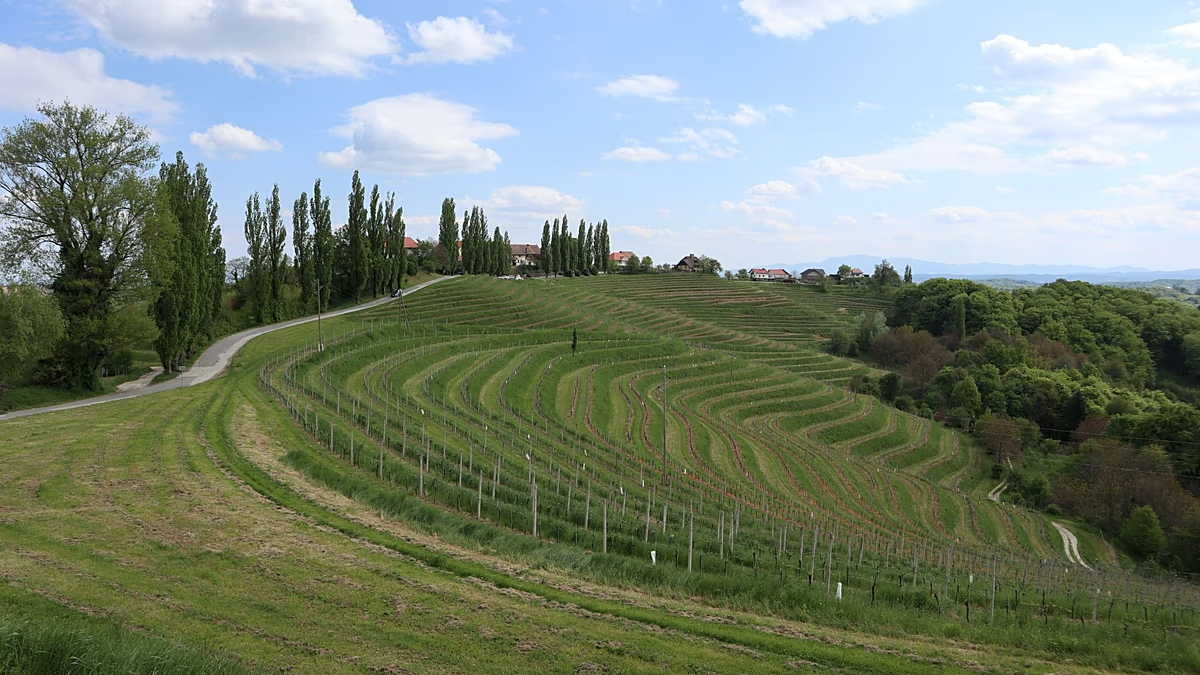
For many travelers, the idea of a perfect European wine getaway starts in the same familiar places: the sun-soaked hills of Tuscany, the grand châteaux of Bordeaux, or the terraced vineyards of Rioja. But a new ranking from European Best Destinations has just shaken up those assumptions, and the results are delightfully unexpected. The organization, which specializes in identifying the most compelling travel experiences across the continent, evaluated more than ninety leading wine territories from countries as celebrated as France, Italy, Spain, Portugal, Germany, Austria, Hungary, Greece, and Georgia. The judging criteria went far beyond just the quality of the wine itself, taking into account the diversity of grape varieties and wine styles, the number of cellars, tasting rooms, and wine rooms, the sheer beauty of the landscape, sustainability practices, and how accessible the regions are for visitors. When all those elements were weighed together, the number one spot did not go to a famous French appellation or a legendary Italian DOCG. Instead, it went to Štajerska, a stunning wine region in Slovenia that many international oenophiles may not yet have on their radar. The choice is a reminder that Europe’s wine map is far richer and more surprising than the classic guidebooks suggest, and that some of the continent’s most remarkable wine experiences are hiding in plain sight, waiting for curious travelers to discover them.
Štajerska, which encompasses the diverse areas of Maribor, Ptuj, Jeruzalem Slovenija, Haloze, Slovenske gorice, Ravno polje, and Pohorje, earned the crown thanks to what the judges called its “remarkable wine stories.” These are not just stories about grapes and fermentation; they are stories about place, tradition, and a deep sense of continuity. In Maribor, visitors can stand before the World’s Oldest Vine, a living treasure that has been producing grapes for more than four hundred years, while in Ptuj, the historic wine cellars feel like cathedrals to centuries of craftsmanship. The region is threaded with wine roads and vineyards that climb gentle hills, overlooked by small villages where winemaking is not a performance but a way of life. Maximilien Lejeune, the director of European Best Destinations, captured the region’s appeal perfectly: “Štajerska represents exactly what today’s travellers in Europe are increasingly looking for: authenticity, exceptional landscapes, centuries of wine culture, outstanding expertise and, above all, a very strong regional identity.” He added, “From the World’s Oldest Vine in Maribor to the historic wine cellars of Ptuj, from wine roads and vineyards to the people who keep these traditions alive, wine here is much more than a product.” That phrase is key: wine is much more than a product. In an era of mass tourism and homogenized experiences, Štajerska offers something rare—a place where the wine is inseparable from the land and the people who make it.
While the top honor went to Slovenia, the rest of the ranking reads like a masterclass in Europe’s extraordinary wine diversity. Italy’s Langhe-Roero-Monferrato took second place, and it is easy to see why. This corner of Piedmont is home to the Nebbiolo grape, the noble variety behind both Barolo and Barbaresco, and European Best Destinations specifically highlighted the region’s truffles as a compelling reason to visit, especially in the autumn. There is something almost unbearably romantic about the Langhe in the fall: the fog rolling over vineyard-draped hills, the smell of earth and ripe grapes, the aroma of white truffles shaved over fresh pasta. Third place went to Ribeira Sacra in Spain, a region that feels less like a vineyard and more like a miracle. Its vineyards are carved into the steep canyon walls of the Sil and Miño rivers, with terraces that have been cultivated for millennia. The judges described it as “one of Europe’s most dramatic wine landscapes,” and that is no exaggeration. Standing at the edge of a Ribeira Sacra canyon, watching the river far below and the vine-covered terraces clinging to sheer rock, is an awe-inspiring experience that rivals any architectural wonder. Fourth place went to Kamptal in Austria, a paradise for lovers of Riesling and Grüner Veltliner, where the cool climate and distinctive terraced slopes produce some of the world’s most precise, mineral-driven white wines. And rounding out the top five is Chianti Rufina in Tuscany, which the ranking lovingly described as the “quieter, more intimate sibling of Chianti Classico.” For those who know Tuscany’s crowded hotspots, Chianti Rufina offers a more peaceful, authentic taste of the region’s storied Sangiovese tradition.
The middle of the top twelve continues this celebration of hidden gems and beloved classics alike. In sixth place, Sancerre and Pouilly-Fumé in France’s Loire Valley remind us why the world fell in love with Sauvignon Blanc in the first place. These two appellations, sitting across the Loire River from one another, produce wines that are simultaneously refreshing and profound, with their signature flinty, smoky character and vibrant citrus notes. Seventh place went to Etna in Sicily, one of the most dramatic wine regions on earth. Here, vines are planted on the slopes of an active volcano, in soils of black volcanic ash and lava stone, yielding wines of incredible tension, minerality, and volcanic energy. It is a place where the idea of terroir becomes almost literal—the mountain itself is in every bottle. Eighth place went to Saumur and Anjou, also in France’s Loire Valley, a region that has long been beloved by sommeliers for its Cabernet Franc and Chenin Blanc. These are wines that pair beautifully with food, with gentle, contemplative flavors that reward patience and curiosity. Ninth place went to Wachau in Austria, a breathtaking stretch along the Danube River where steep, terraced vineyards produce some of Europe’s most elegant white wines. The Wachau is not just a wine region; it is a UNESCO-listed cultural landscape, where medieval monasteries, apricot orchards, and ancient stone terraces create a setting of almost storybook beauty. For anyone who has ever sailed down the Danube and watched the sun set over these hills, it is no mystery why the region continues to captivate wine lovers.
The final three entries in the top twelve round out an already impressive list with even more diversity. In tenth place, Valle d’Aosta in Italy shows that great wine can emerge from the most extreme conditions. This small, mountainous region in the shadow of Mont Blanc produces wines from native grapes like Petite Arvine and Fumin, often from tiny vineyards tucked into the steepest alpine valleys. The wines are rare, characterful, and deeply tied to the dramatic landscape that surrounds them. Eleventh place went to Alentejo in Portugal, a region of rolling cork forests, whitewashed villages, and warm, sun-drenched plains. Alentejo is known for full-bodied reds made from indigenous varieties like Alicante Bouschet and Touriga Nacional, often at remarkably accessible prices. It is a region that feels both ancient and welcoming, where wine is best enjoyed with slow meals, smoked meats, and the unhurried rhythm of rural Portuguese life. Finally, twelfth place went to Naoussa in Greece, one of the country’s most historic and exciting wine regions. Located in the northern hills of Macedonia, Naoussa is the home of Xinomavro, a grape that is often compared to Nebbiolo for its tannic structure, aromatic complexity, and remarkable ability to age. The wines of Naoussa are deep, savory, and wildly expressive, with flavors of dried cherry, tomato, olive, and spice. This final stretch of the ranking, from the alpine vineyards of Italy to the sun-baked plains of Portugal to the ancient hills of Greece, reveals that Europe’s wine culture is not a monolith. It is a vast, living mosaic of grape varieties, climates, and traditions, each region offering its own distinct interpretation of what wine can be.
In the end, this ranking from European Best Destinations is far more than just a list of places to drink well. It is a reflection of how travel tastes are shifting. Modern travelers are no longer satisfied with generic tourist experiences; they want authenticity, meaningful connections, and a sense of place. They want to meet the winemaker who tends the vines with their own hands, to taste a wine that cannot be found anywhere else, to walk through landscapes that have been shaped by centuries of human care. The success of Štajerska, and of the other regions that made this list, is evidence that the future of wine tourism lies in these deeper, more personal experiences. Sustainability and accessibility were major criteria in the ranking, which signals that travelers are also thinking about the environmental and social impact of their visits. They want wine regions that are preserved for future generations, not just exploited for profit. For wine lovers, this ranking is an invitation to venture beyond the familiar labels and explore the less-traveled paths of Europe. Whether it is sipping a mineral-rich white in an Austrian vineyard overlooking the Danube, tasting a volcanic red on the slopes of Mount Etna, or standing beneath the ancient vine in Maribor, these twelve regions offer something that no supermarket shelf can capture: the living, breathing story of a place, bottled and shared. So the next time you plan a trip, consider raising a glass to Štajerska, not just for the wine it produces, but for the reminder that the best journeys are often the ones that surprise us most.