






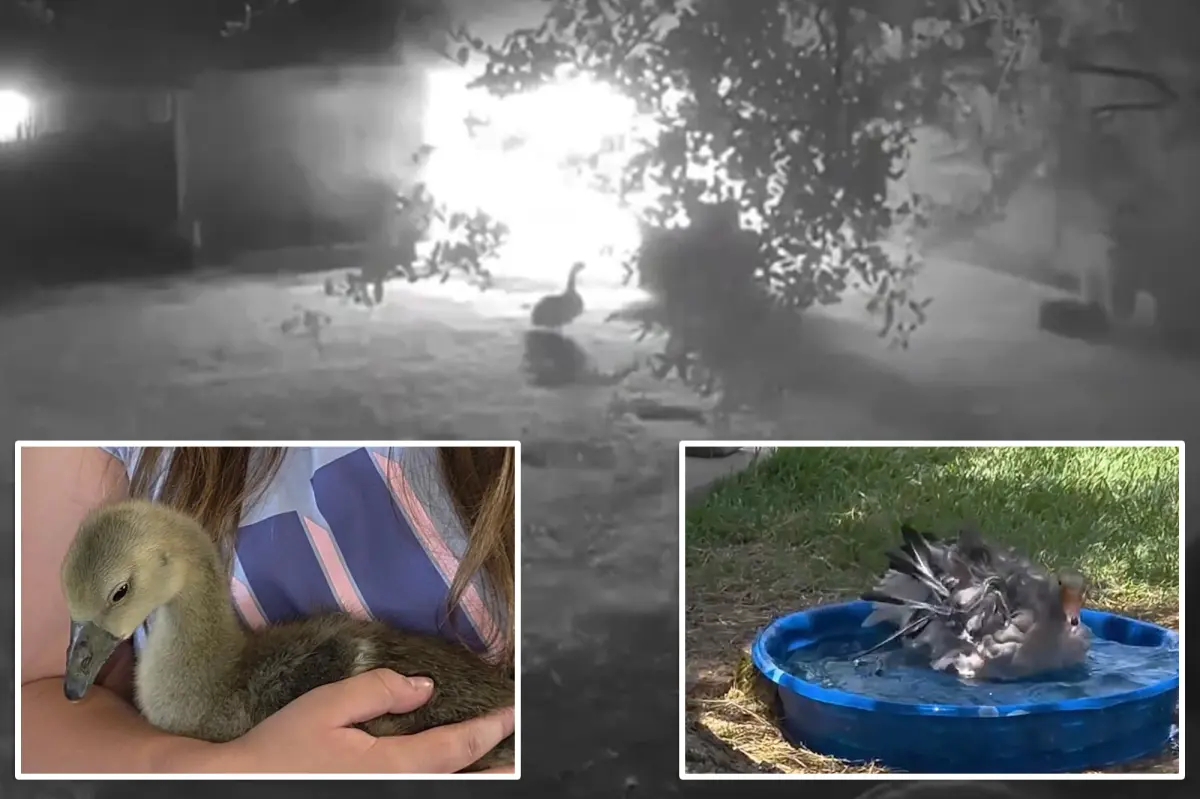
In the hushed, velvet darkness of a Texas night, where the only sounds are the rhythmic chirping of crickets and the distant hum of the freeway, an unlikely hero broke the silence. In the Gerber household, deep in Fort Bend County, the calm was shattered not by a smoke alarm, but by a series of frantic, piercing honks—a sound so raw and urgent that it pierced the veil of deep sleep. This was the voice of Goosey, a mere four-month-old gosling who had only graced the family with his presence since Mother’s Day. Typically, Goosey was a quiet, reserved presence, keeping to himself and observing the world from a safe distance. But on this particular Tuesday, as the clock crept past midnight, Goosey transformed. He wasn’t just a pet anymore; he was a sentinel, a feathered guardian whose instincts had detected a catastrophe unfolding in the shadows of the family’s beloved property. His honks weren’t the gentle, conversational sounds of a contented goose; they were alarm bells, a desperate SOS that vibrated with an intensity the Gerbers had never heard before, a sound that was both terrifying and profoundly moving. It was a call to action, a cry that signaled that the mundane peace of the night was about to be violently interrupted by the unforgiving wrath of fire.
Bert Gerber had drifted off to sleep on the living room couch, lulled by the lateness of the hour and the comfort of his home. It was an ordinary doze, the kind of light rest that settles over a tired body. But that rest was brutally severed by Goosey’s unnerving chorus. At first, Bert’s sleep-addled mind struggled to place the sound. It was unfamiliar, aggressive, and relentless. His first instinct was confusion, a disoriented search for the source of the noise. Then, a chill of dread ran down his spine. He knew it was Goosey, and he instinctively knew something was wrong. Stepping outside into the cool, smoke-tinged air, Bert was met with a gut-wrenching sight: the family’s barn, a structure housing their precious animals, was engulfed in a torrent of flames. The fire was billowing out of the structure, licking at the wooden frame, casting grotesque, dancing shadows across the yard. The adrenaline hit him like a wave. “I just casually came outside and I saw a fire billowing out of there,” Bert later recalled, the memory still raw. He didn’t hesitate. Without a second thought for his own safety, he grabbed the nearest water hose, a flimsy piece of vinyl against a raging inferno, and charged toward the blaze. It was a moment of pure, instinctive courage. He aimed the stream of water at the base of the flames, fighting a desperate battle against time and destruction, driven by the terrifying thought of what could be lost within those burning walls.
Miraculously, Bert managed to extinguish the blaze before it could spiral completely out of control. The smoke cleared to reveal a scene of charred wood and lingering heat, but crucially, the interior of the barn had survived the worst of it. All the animals inside—the goats, the chickens, the other livestock that called the barn their home—were accounted for, safe, and remarkably unharmed. The relief that washed over Bert was immense, a crushing weight lifted from his shoulders. But the gravity of the situation remained. If not for Goosey, the outcome could have been unthinkably tragic. “If I hadn’t been woken up, I think in a couple more minutes, it would have been… out of control,” Bert reflected, his voice heavy with the realization of how narrowly they had escaped a total catastrophe. The barn, a hub of life and labor, could have been reduced to ashes. The animals, beloved members of the family, could have perished. But Goosey, this small, fluffy creature with webbed feet and a curious gaze, had seen the danger and had refused to remain silent. His honks were not the unfortunate byproduct of a scared bird; they were a calculated, desperate attempt to save his human family and his animal friends. It was an act of selfless bravery that defied the expectations of his species, cementing his place not just as a pet, but as a bona fide hero.
To truly understand the magnitude of Goosey’s heroism, one must delve into the unlikely backstory of how he came to be a Gerber. Chelsea Gerber, Bert’s wife, had never wanted a webbed-foot friend. She had imagined a life free from the mess and noise of waterfowl. But their daughter, young Elaine, had a different vision. Four months prior, the family had attended a “hug a goose” event—a whimsical, pastoral gathering meant for gentle fun. It was there that Elaine encountered Goosey. He was just a tiny, fluffy gosling then, and the connection was instantaneous and profound. “When we got him, he was so small and he was just so fluffy,” Elaine recalled, her eyes lighting up at the memory. “When I got to pet his head, he would just rest his head on my arm and it just made me tear up.” That tender moment of connection, that overwhelming wave of affection, shattered her mother’s resistance. They took Goosey home that day, a decision that would eventually save their lives and their livelihood. The family often joked about the absurdity of having a goose, about the mess and the noise. But in the quiet aftermath of the fire, all those jokes faded away, replaced by a profound sense of gratitude and awe for the creature they had welcomed into their fold almost by accident.
The emotional resonance of Goosey’s act goes far beyond the mere prevention of property damage. It speaks to the profound and often underestimated intelligence and loyalty of animals. Goosey, who had only been with the Gerbers for a short time, had already developed a fierce sense of ownership over his territory and his people. In the animal kingdom, a goose is often seen as a symbol of vigilance and courage, guarding its flock with ferocious determination. Goosey embodied this primal instinct to its fullest. He wasn’t just honking out of fear; he was honking to warn his flock, to mobilize his humans into action. The fact that he recognized the danger of the fire and understood that he had to alert the sleeping family is a testament to a cognitive ability that we often fail to attribute to birds. For Elaine, Goosey is more than a hero; he is a kindred spirit. Their bond, forged in a moment of gentle petting, has now been sealed in fire and smoke. She sees in Goosey a reflection of her own love and vulnerability. The family is now contemplating adding another companion, a fellow goose named Lucy, to keep Goosey company. Elaine, ever the entrepreneur, has already started dreaming big. “And then we’re going to get babies. I can start my own business,” she says, her imagination already running wild with the prospect of a growing, thriving flock.
In the end, the story of Goosey is a profound parable about the unexpected nature of heroism and the silent bonds that tie us to the natural world. It’s a story about a girl’s innocent wish for a fluffy friend that turned into a guardian angel with wings. It is a reminder that heroes don’t always wear capes; sometimes, they are covered in feathers and communicate in honks. The Gerber family looks at Goosey with a new reverence now. He is no longer just the goose they brought home on a whim; he is the sentinel who watches over their dreams, the brave soul who risked his own safety to sound the alarm. The fire may have been a terrifying ordeal, but out of the ashes came a deeper appreciation for the fragile miracle of life and the incredible animals we share our homes with. As the family moves forward, perhaps with a new companion in Lucy, the legacy of that Tuesday night will linger in the air like the faint scent of smoke—a permanent reminder that sometimes, in the quietest moments of our lives, the most ordinary creatures can perform the most extraordinary feats, proving that bravery has no size, no age, and certainly no species. Goosey, with his honks of warning, saved a barn, saved the animals, and perhaps most importantly, gave his family a story of gratitude that they will carry in their hearts forever.