




The high-stakes race for the California governor’s mansion has taken an intensely visceral and dramatic turn, vividly illustrating the growing divide between elite progressive rhetoric and the raw, unvarnished exhaustion of marginalized working-class communities. At the heavy center of this political storm is Tom Steyer, the progressive billionaire, philanthropist, and former 2020 presidential candidate who has redirected his substantial resources and energy toward leading the nation’s most populous state. Last Saturday, Steyer sought to solidify his standing with influential Black voters by hosting an intimate campaign gathering at the ORA Cafe in Leimert Park, a historic neighborhood widely celebrated as the beating cultural and political heart of Black Los Angeles. Amid the rich aroma of artisan coffee and the shared anticipation of a highly engaged crowd, Steyer leaned heavily into his platform of systemic equity, attempting to build a bridge of trust. He spoke passionately to the attendees, declaring with conviction that the United States owes its Black population a “gigantic debt” for centuries of systemic oppression and asserting that this community serves as the irreplaceable “moral leader of the United States.” For a brief moment, the interior of the cafe felt like a sanctuary of mutual understanding—a wealthy, well-meaning white benefactor acknowledging historic wounds in a neighborhood that has long borne their scars. Yet, just outside the large glass windows, a very different kind of reality was brewing on the concrete, fueled by decades of unfulfilled institutional promises and a deep-seated distrust of seasonal political theater that treats local trauma as a mere campaign stop.
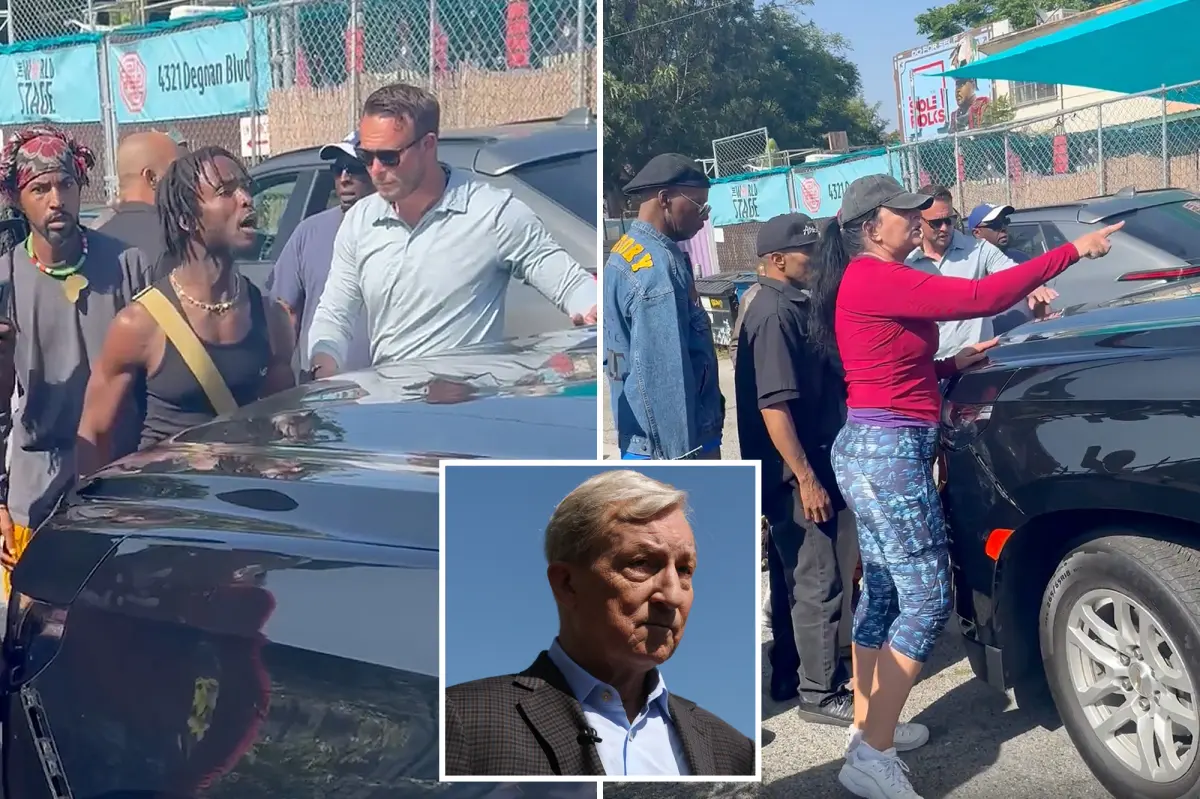
The fragile warmth of the indoor gathering evaporated almost instantly the moment the event drew to a close and Steyer attempted to make his exit. Outside, a group of highly organized, deeply passionate, and angry local activists had assembled, instantly transforming the optimistic, structured atmosphere into a chaotic, high-stakes confrontation. As Steyer’s advance team and staff sought to guide him safely away from the venue, they opted to use a narrow alleyway behind the cafe, aiming to avoid a highly visible public scene on the main street. Instead of a quiet escape, they walked directly into a tactical bottleneck where several protesters were waiting, their anger palpable, immediate, and raw. The confrontation quickly escalated from fiery verbal sparring to physical menace when one of the demonstrators suddenly pulled out a knife, brandishing it directly at Steyer’s vulnerable campaign staff. The unexpected flash of a weapon instantly stripped away the polite, intellectual veneer of typical political campaigning, replacing it with the raw, terrifying human instinct of survival. In the scramble that followed, Steyer’s security and staff rushed him into his waiting SUV, desperate to shield the billionaire from a volatile situation that was rapidly spiraling out of control. Interestingly, despite the direct threat of violence and the presence of a weapon, Steyer’s campaign team made the conscious decision not to officially contact the California Highway Patrol or request an emergency security escort, highlighting a delicate reluctance on the part of a wealthy, progressive campaign to involve law enforcement in a highly charged racial and social justice environment.
Huddled inside the locked passenger cabin of his large, dark SUV, Steyer became the captive audience to a barrage of furious grievances shouted directly through the glass. The heavy vehicle was completely marooned, blocked by a human barricade of protesters who refused to let him retreat back into the quiet comfort of his privileged life without facing the music of their demands. The central theme of their anger was not merely random frustration, but a burning desire for tangible, material accountability that goes beyond simple symbolic gestures. “What’s your position on reparations, Tom Steyer? How are you going to cut the check?” one protester roared, directing his voice squarely at the vehicle, referencing Steyer’s previous support for paying financial reparations to the descendants of enslaved Africans during his failed 2020 Democratic presidential primary bid. The crowd made it abundantly clear that empty ideological alignments and pleasant rhetorical agreements were no longer accepted as legal tender in Leimert Park. As the SUV attempted to slowly and carefully maneuver through the crowd, another voice warned him never to return to “Africatown,” drawing a firm, protective boundary around their community. The confrontation grew intensely personal and confrontational when another individual walked up to the driver’s side window, staring down the candidate and warning him directly: “Hey Tom Steyer, I better not catch you over here with those devil blue eyes.” This raw, unscripted display of human fury exposed a deep, painful chasm—the vast distance between a billionaire’s conceptual empathy and a community’s urgent, material demand for survival, recognition, and respect.
To dismiss this disruption as mere directionless vandalism or senseless agitator behavior would be to completely miss the profound human weariness that fuels modern activism in America’s underserved urban centers. Dennae Wright, a 44-year-old local social worker who witnessed the demonstration first hand, articulated a sentiment that resonates deeply with millions of non-white voters across the country who feel politically abandoned. Wright explained to reporters that she was not at all shocked by the volatile protest, framing it instead as the natural, inevitable consequence of years of political exploitation and extraction. She pointed out that Black voters have grown thoroughly exhausted by the predictable, cyclic pattern of the Democratic Party, whose high-profile candidates routinely descend upon historically Black neighborhoods specifically during high-stakes election seasons in search of easily won votes, only to vanish entirely once the ballots are cast and the victory speeches are delivered. “It’s a brand new day,” Wright asserted, emphasizing that the era of relying on patronizing gestures has officially come to an end in her community. “You can’t come over here offering us symbolism, dancing, singing, pats on the back, and think we’re gonna vote for you.” Her words underscore a major, structural shift in the political landscape: a demand for transactional clarity, where marginalized communities refuse to settle for cultural flattery and instead demand concrete policies, physical resources, and legislative action that directly improve their daily lives.
This complex dynamic was also acknowledged by local political leaders who understand the delicate, highly combustible nature of community organizing in Los Angeles. Democratic State Senator Lola Smallwood-Cuevas, who co-hosted the ORA Cafe event alongside Steyer, offered a perspective that was both realistic and supportive of the candidate’s efforts. Smallwood-Cuevas expressed no surprise at the aggressive nature of the protest, candidly noting that Leimert Park is widely recognized as the epicenter of grassroots activism in the local African-American community. “This is Leimert Park and this is where Africatown protests, so we knew that going in,” she explained. However, she went on to praise Steyer for having the fortitude to put himself in a position where he would have to face the community’s unrest directly. In her eyes, Steyer’s willingness to show up in a space known for its fierce, uncompromising political demands demonstrated a commendable level of courage that set him apart from other elite politicians who prefer the sanitized, tightly controlled environments of private fundraisers and high-end galas. This duality reveals the fine line that modern progressive leaders must walk: they must navigate the authentic, sometimes terrifying anger of the people they seek to represent while proving they have the stomach to sit with that discomfort rather than run away from it.
Ultimately, this chaotic incident highlights the profound personal stakes of the upcoming California gubernatorial race, where Steyer is currently fighting a hard-fought battle to secure a place in the top tier of candidates. According to a recent poll conducted by Emerson College, the progressive billionaire finds himself tied for second place at 17 percent support alongside Republican candidate Steve Hilton, with both men trailing closely behind the current frontrunner, Xavier Becerra, who commands 19 percent. With the crucial June 2 primary rapidly approaching, the election remains a highly volatile and unpredictable contest, with Steyer facing the difficult task of convincing skeptical voters that his immense wealth can be effectively channeled into genuine advocacy. The blockade in the alleyway of Leimert Park, which only ended after a passing California Highway Patrol officer arrived to help clear a path for his vehicle, serves as a powerful metaphor for his entire campaign. If Tom Steyer wishes to successfully navigate the path to the governor’s office, he must do more than simply survive these intense, physical confrontations; he must find a way to dismantle the deep structural cynicism of an electorate that is no longer willing to wait for a check that has been delayed for generations.