






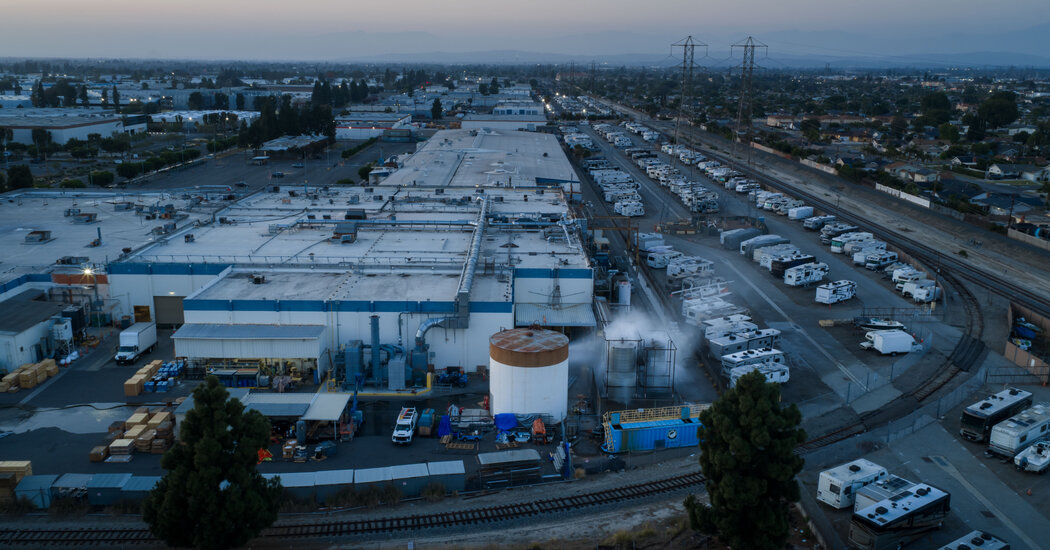
For tens of thousands of families living in the quiet suburbs of Orange County, California, the peaceful rhythm of a normal weekend was suddenly shattered by an invisible, escalating emergency. Inside the cities of Garden Grove, Cypress, and Anaheim, the air should have been filled with the ordinary sights and sounds of neighborhood life, but instead, it was charged with building tension as local police and emergency personnel began knocking on doors with urgent evacuation orders. Over forty thousand residents were forced to make hasty, stressful calculations about what to pack and what to leave behind, herding confused children and anxious pets into vehicles to join a massive, sudden exodus. Children clung to stuffed animals, parents clutched folders of birth certificates and passports, and elderly neighbors were carefully guided into the backs of waiting cars, all leaving behind homes that suddenly felt incredibly vulnerable. Some of these displaced families spent their second consecutive night in makeshift public shelters, staring at gym ceilings or sleeping uneasy hours in their vehicles, suspended in a painful state of limbo. They were running from a threat they could neither see nor completely comprehend: an industrial chemical tank located at a local aerospace manufacturing facility that hovered dangerously close to a catastrophic explosion. The physical displacement was only part of the trauma; the psychological weight of knowing that their homes, livelihoods, and possessions sat directly in the potential blast zone of a massive, devastating fireball kept many awake through the long, quiet hours of the night. Local high school gyms transformed into bustling hubs of nervous conversation, where neighbors exchanged rumors, checked on vulnerable friends via phone, and searched social media for any shred of updates, unified by a shared sense of uncertainty. It was a stark reminder of how quickly the predictable comfort of modern suburban life can be disrupted by the volatile, invisible chemical components of industrial production. This was not a natural disaster creeping in from the horizon, but a localized, man-made crisis that turned their quiet neighborhoods into an active, barricaded perimeter of extreme danger. For municipal leaders and health officials, the priority was clear: protect human life at all costs, even if it meant displacing an entire community under a dark cloud of profound dread.
At the absolute center of this unfolding nightmare is a single, heavily pressurized industrial storage tank sitting within the manufacturing complex owned by GKN Aerospace in Garden Grove. Inside this large metal cylinder rests approximately seven thousand gallons of methyl methacrylate, an organic chemical compound that serves as a vital precursor in the global manufacturing of various plastics, acrylic sheets, and advanced resins. Under normal operating conditions, this clear, pungent liquid is a highly valuable industrial asset, but it possesses a remarkably low boiling point, meaning it can easily overheat, vaporize, and transition into an incredibly volatile and expanding gas if left unchecked. In this specific crisis, an uncontrolled runaway chemical reaction began inside the tank, causing the internal contents to self-heat at an alarming and dangerous rate. As the liquid rapidly vaporized into gas inside the sealed environment, the internal pressure began to build exponentially, transforming the heavy metal container into a metaphorical pressure cooker with no structural escape valve. By the time emergency responders arrived on the scene, the physical structure of the tank had already begun to bulge dangerously—a highly visible and terrifying indicator that the steel was reaching its absolute structural limits under the immense stress of the expanding gas. This outward swelling is the final physical warning sign before a catastrophic mechanical failure, where the metal skin of the tank tears open in a sudden, explosive release of energy. The sheer volume of the chemical—seven thousand gallons—means that any sudden rupture would launch an immense amount of pressurized, superheated material into the open air instantly. For the chemists and engineers watching the situation unfold from a safe distance, the sight of a bulging industrial tank is a deeply distressing visual, representing a physical tipping point where the invisible laws of chemical kinetics threaten to destroy everything in the immediate vicinity in a matter of milliseconds.
In an ideal industrial landscape, crises of this magnitude are prevented by a series of redundant mechanical safeguards engineered specifically to neutralize runaway thermodynamic reactions before they can cause damage. However, when the highly specialized emergency response team from GKN Aerospace arrived at the tank to intervene, they were met with a baffling and critical mechanical failure: the valves designed to grant access to the tank’s interior were completely gummed up with solidified chemical residue, rendering them utterly useless. This unexpected obstruction prevented the crews from injecting a neutralizing inhibitor directly into the liquid—a standard, high-priority safety measure that would have chemically halted the volatility and cooled the interior immediately. Denied this primary defense, the Orange County Fire Authority, under the experienced leadership of Incident Commander Craig Covey, had to pivot to a far more dangerous and prolonged tactical strategy. Firefighters were forced to set up high-volume water monitors to continuously douse the exterior of the bulging steel cylinder from a defensive distance, hoping to absorb enough radiant heat to slow the reaction. This relentless deluge of water became the community’s primary shield against disaster, a literal wall of water meant to cool the superheated metal shell and keep the internal pressure from crossing the fatal threshold of complete structural collapse. Working in rotating shifts through the humid day and cold night, these first responders stood their ground, fully aware that they were standing in the shadow of a potential blast that could vaporize their positions in a heartbeat. It was a tedious, high-stakes battle of attrition between the cool, steady force of humanity’s water lines and the chaotic, accelerating molecular energy trapped within the failing steel vessel. The constant hiss of water striking the scorching metal frame served as a regular, rhythmic reminder of the thin line separating safety from catastrophe.
If the firefighting teams’ defensive cooling water lines fail to keep the building pressure at bay, the potential outcomes outlined by emergency officials and scientific experts paint a horrifying picture of destruction. Craig Covey warned that the worst-case scenario resembles a classic Boiling Liquid Expanding Vapor Explosion (BLEVE)—a phenomenon familiar to accident investigators where a closed storage vessel fails catastrophically under extreme internal heat and pressure. He compared the potential fallout to historical railroad disasters, where heavily armored tank cars exploded with such terrifying force that they launched massive, house-sized fireballs into the atmosphere while throwing shredded, multi-ton metal fragments half a mile into nearby communities. Dr. Faisal Khan, a leading chemical engineering authority at Texas A&M University, noted that while typical vehicle collisions produce ground-hugging fireballs, this specific pressurized industrial rupture could launch a massive, mushrooming sphere of fire high into the California sky, scattering burning debris and ignited liquid over a wide geographical area. This sudden, explosive projection of fire is precisely why emergency directors were forced to establish such a massive, seemingly excessive evacuation zone across several municipalities; they simply could not predict where the winds or the kinetic energy of an explosion might carry active fireballs or scorching metal shrapnel. Furthermore, the physical danger of fire is deeply compounded by a silent chemical hazard: as pointed out by Dr. Elias Picazo of the University of Southern California, a physical rupture would instantly aerosolize the remaining toxic methyl methacrylate into a massive, drifting chemical plume. If inhaled, this dense cloud of vapor would cause severe respiratory distress, acute airway damage, and potential systemic organ damage to anyone caught downwind, turning a localized fire emergency into a widespread public health catastrophe. This dual threat of a physical explosion and toxic gas cloud made the situation an absolute worst-case scenario for emergency managers.
Amidst the dark predictions and exhausting standoffs, a fragile glimmer of scientific hope emerged on Saturday afternoon as incident commanders observed a subtle, encouraging shift in the tank’s thermal dynamics. Commander Craig Covey announced that the temperature of the internal liquid was rising at a slow, predictable rate of roughly one degree per hour, allowing engineers to hypothesize a highly favorable chemical scenario. There is a distinct, real possibility that the intense, relentless deluge of water spraying the tank’s exterior has succeeded in slowing the runaway reaction enough to allow the chemical to undergo a process known as curing, effectively transitioning from a volatile liquid into a stable, solid polymer. Covey compared this phenomenon to an ice cube freezing from the outer edges inward, where the heavily cooled outer metal walls encourage the chemical touching them to solidify first, creating a protective, dense layer that absorbs pressure and stabilizes the remaining liquid core. If this curing process continues safely, the physical capacity of the tank might just prove sufficient to handle the residual pressure without rupturing, effectively turning the ticking chemical bomb into a harmless block of solid plastic. Yet, this hopeful theory is tempered by the sobering realities of chemical engineering; Dr. Faisal Khan pointed out that the reason officials cannot simply open a relief valve to bleed off the excess pressure is that the interior is likely already highly vaporized and under such astronomical pressure that opening any portal could trigger the very explosion they are desperately trying to avoid. Thus, the strategy remains a delicate game of patience and observation, as emergency crews watch their thermal imaging cameras, hoping the chemical solidifies before the stressed metal of the bulging tank finally gives way. Every degree recorded, every hiss of steam analyzed, became a crucial data point in a slow-motion scientific drama.
As the tense standoff continues, public scrutiny has inevitably turned toward the corporate entity responsible for the site: GKN Aerospace, a massive, United Kingdom-based engineering firm that serves as a major cornerstone of the global aviation supply chain. This multinational giant employs over sixteen thousand workers worldwide, including more than five hundred skilled personnel at the troubled Garden Grove facility, where they design and manufacture critical aerospace structures, military landing gear, and high-performance components for commercial aviation giants like Airbus, Boeing, and Bombardier, as well as the international space industry. The sheer scale and economic might of the company’s operations stands in stark contrast to the small, disrupted lives of the forty thousand local citizens currently waiting in community centers, wondering if their neighborhoods will remain intact when they are finally allowed to return. This dramatic juxtaposition highlights a recurring, sobering theme of the modern industrial age: the highly sophisticated, hidden chemical processes that enable global air travel and advanced technology are often situated right in the backyards of ordinary, unsuspecting communities. When these complex systems fail due to something as simple as a gummed-up safety valve, it is the surrounding families and brave local first responders who must bear the immediate, terrifying burden of that failure. As the night deepens over Orange County and the tireless sound of rushing water continues to echo through the evacuated streets of Garden Grove, the crisis serves as a powerful reminder of our shared physical vulnerability. It emphasizes the absolute necessity of rigorous industrial oversight, uncompromising maintenance of safety systems, and the profound debt of gratitude owed to the emergency workers who risk their lives to stand between a sleeping community and a catastrophic rain of fire and toxic smoke. Ultimately, the survival of these neighborhoods rests not on corporate assurances, but on the bravery of firefighters holding a steady hose line in the dark.