







A Fragile Peace Splinters: How Rising Hostilities in Lebanon Threaten the Tenuous Middle East Cease-fire
The Collapse of a Precarious Calm in Southern Lebanon
  _________
 /
|   MAP    |  <- Southern Lebanon & Bekaa Valley
|  *Tyre   |     Targeted in intensive dual-front airstrikes
|  *Nabateh|     raising fears of regional escalation.
 _________/
The deafening rumble of fighter jets and the concussive shockwaves of heavy munitions returned to the valleys of southern Lebanon with devastating force late Friday and early Saturday, shattering the fragile quiet of a weeks-old truce and threatening to plunge the region back into a state of unrestricted warfare. Dozens of Israeli airstrikes pounded towns, villages, and critical infrastructure across the south, a region deeply scarred by months of conflict and currently occupied in significant portions by the Israel Defense Forces (IDF). These latest bombardments have severely strained the delicate cease-fire brokered in mid-April, which international mediators had hoped would serve as a stepping stone toward temporary stability, if not a permanent diplomatic settlement. Instead, the resurgence of violence has triggered panic among tens of thousands of displaced Lebanese civilians who are caught in a agonizing limbo—unable to return to their ruined homes, yet finding no safety in the overcrowded shelters of adjacent cities. As the Israeli military issued sweeping new evacuation orders on Saturday afternoon, instructing residents of several southern municipalities to flee immediately, regional diplomats warned that the sophisticated international backchannels built to sustain this pause are rapidly eroding under the weight of daily violations, raising the specter of a broader, more destructive escalation involving both regional proxy networks and global superpowers.
The Perilous Frontline of Humanitarian and Medical Workers
       +-----------------------------------+
       |    MEDICS UNDER CROSSFIRE         |
       |  - Over 120 first responders dead |
       |  - 6 paramedics killed in 24 hrs  |
       |  - Frontline facilities damaged   |
       +-----------------------------------+
Among the most alarming aspects of this recent escalation is the increasingly perilous environment for humanitarian and medical personnel, who have found themselves directly in the crossfire of this highly mechanized theater of war. Just twenty-four hours prior to Saturday’s daylight raids, a series of Israeli strikes killed six Lebanese paramedics in two separate incidents, drawing fierce condemnation from Lebanon’s Ministry of Public Health and international human rights watchdogs who argue that such actions constitute blatant violations of international humanitarian law. In the first incident, located in the southern town of Deir Qanoun an-Nahr, Israeli missiles struck a rescue convoy; the IDF later stated it was targeting Hezbollah operatives traveling on motorcycles, adding that it was “examining” reports of civilian casualties in the aftermath of the strike. The second fatal strike occurred in Hanouiyeh, where Israeli authorities claimed they targeted a Hezbollah command installation, though local health officials countered that the strike demolished a volunteer ambulance depot. These deaths have pushed the total number of medical personnel killed since the onset of this current cycle of violence to over 120, a grim statistic that highlights the systemic breakdown of the protected status traditionally granted to first responders. This erosion of safety was further highlighted on Thursday when an Israeli airstrike severely damaged the three-story Tibnin Government Hospital—a critical medical lifeline located immediately adjacent to the occupied zone—leaving its structural integrity compromised and its ability to treat combat casualties severely diminished.
Tyre Under Siege: The Devastating Impact on Civilian Sanctuaries
                  [ HIRAM HOSPITAL ]
                          |
   (Airstrike Nearby) --->* <--- Windows Shattered
                          |
                [ NEWBORN EVACUATION ]
                4 Infants Moved to Safety
The localized focus of Saturday’s operations centered heavily on the historic coastal district of Tyre, a dense urban and agricultural hub where the demarcation between military installations and civilian life is incredibly narrow. Shortly after midnight, an Israeli airstrike completely leveled a multi-story residential building in Deir Qanoun an-Nahr, killing four non-combatants instantly and leaving rescue teams digging through the smoking rubble with baseline hand tools. Hours later, an Israeli reconnaissance drone launched precision munitions into a mature citrus grove in the nearby town of Bazourieh, wounding several migrant Syrian agricultural laborers who were performing routine field maintenance. The violence reached a dramatic crescendo when a strike exploded adjacent to Hiram Hospital, one of the few fully functioning medical referral centers remaining in the Tyre governate. The blast wave shattered the facility’s reinforced glass windows, collapsed ceiling tiles in the primary operating theaters, and severed emergency backup power lines, forcing medical staff to work under the glow of mobile phone screens. In the chaotic moments following the explosion, nursing supervisor Mohammad Salem led a harrowing effort to evacuate four newborn infants from the hospital’s neonatal intensive care unit to a secure basement storage facility. Salem, visibly shaken, later reflected on the compounding trauma of working under constant aerial surveillance, noting that this was the third time the hospital’s immediate perimeter had been targeted, underscoring a growing sentiment among staff that no sanctuary—regardless of its humanitarian designation—is respected by the warring parties.
The Multi-Front Escalation and Retaliatory Dynamics
WESTERN/SOUTHERN FRONT EASTERN/BEKAA FRONT[Israeli Precision Strikes] <=====> [Underground Weapons Sites]
| |
[Hezbollah Rocket Launches] <=====> [IDF Air Patrols & Drones]
As the air campaign intensified, the military landscape expanded beyond localized skirmishes into a highly coordinated, multi-front confrontation that saw both sides testing the strategic boundaries of the mid-April agreement. In the southern city of Nabatieh, a long-range Israeli strike targeted an established military barracks, moderately wounding a sovereign Lebanese Army soldier—an incident that threatens to draw the official state military, which has largely remained on the sidelines of the Hezbollah-Israel dynamic, deeper into the active theater of war. Concurrently, Israeli warplanes bypassed coastal defenses to strike deep within the eastern Bekaa Valley, a fertile agricultural corridor bordering Syria that has long served as a vital logistical artery for military transport. The IDF defended the eastern incursions by asserting that its fighter-bombers had successfully neutralized an expansive underground military compound specifically engineered for the high-end manufacture of precision-guided rocketry and uncrewed aerial vehicles (UAVs). Hezbollah, in turn, demonstrated its enduring retaliatory capabilities by launching coordinated salvos of heavy Katyusha rockets and explosive-laden kamikaze drones at Israeli military command centers, radar arrays, and staging grounds located across the northern border. This intense circular dynamic of action and reaction highlights the central paradox of the current truce: while both factions declare a formal adherence to the cease-fire framework, their daily operational choices reflect a commitment to a war of attrition that leaves little room for diplomatic compromise.
Geopolitical Foundations and the Elusive Search for a Permanent Resolution
  THE REGIONAL GEOPOLITICAL TRIANGLE

            [ UNITED STATES ]
                 /
                /        Mediators
               /
         [ISRAEL] <======> [HEZBOLLAH / IRAN]
                Conflict Axis
To fully comprehend the fragility of this moment, one must examine the broader geopolitical framework that precipitated the mid-April truce and the complex network of international alliances that govern it. This phase of the conflict has its roots in early March, when Hezbollah launched a series of cross-border attacks into northern Israel in response to a major joint military action executed by the United States and Israel against Iranian military assets days earlier. Since that initial spark, more than 3,100 people have been killed in Lebanon alone, while tens of thousands of homes have been reduced to dust, effectively crippling an already fragile Lebanese economy that has been reeling from a prolonged financial collapse. The mid-April cease-fire was designed by international negotiators from France, the United States, and several Arab nations as a temporary cooling-off period, intended to allow humanitarian aid to reach isolated populations while diplomats hammered out a permanent security arrangement. This proposed long-term solution would require the withdrawal of Hezbollah forces north of the Litani River, the deployment of additional Lebanese Army troops to the border, and the cessation of Israeli airspace violations. However, with Israel demanding unrestricted enforcement rights and Hezbollah refusing to disarm its front-line units while Israeli troops occupy Lebanese soil, the diplomatic process has stalled, leaving regional players to fear that a complete collapse of the truce could trigger a massive, direct confrontation involving Iran and the United States.
Lament for the Fallen: Mourning in the Shadow of War
           ====================================
            IN MEMORIAM: AHMAD HARIRI (32)
            Emergency Responder & Photojournalist
            "Ahmad is everything beautiful..."
           ====================================
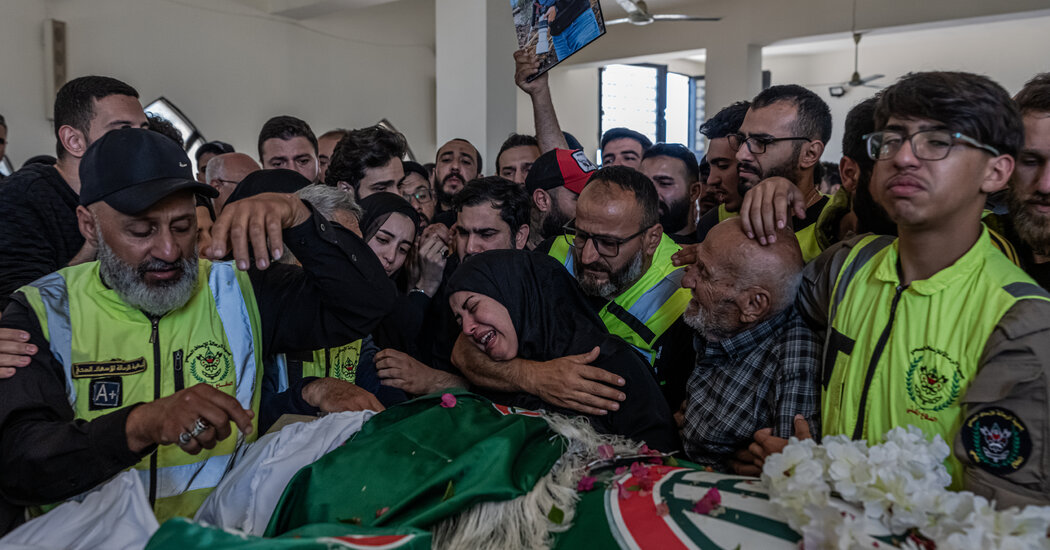
Beneath the grand strategies of military commanders and the high-stakes maneuvering of international diplomats lies the profound human tragedy that continues to redefine daily life across Lebanon. On Saturday afternoon, hundreds of grief-stricken mourners Gathered in the dusty streets of southern villages to bury the paramedics who had been killed in the previous day’s strikes. As the coffins, draped in the symbolic flags of their rescue organizations, were carried through the crowd, mothers and siblings leaned over the wooden crates to scatter red roses and jasmine petals, their voices of lamentation occasionally drowned out by the metallic buzz of Israeli surveillance drones hovering directly overhead. Among those laid to rest was Ahmad Hariri, a 32-year-old volunteer paramedic and photojournalist whose camera had documented both the destruction of his homeland and the resilience of its people before his life was cut short in Deir Qanoun an-Nahr. Standing near the grave site, his cousin Brahim Diab spoke softly of a young man who had dedicated his final months to the exhausting, thankless task of pulling survivors from collapsed buildings. “Ahmad is everything that is beautiful in this life,” Diab remarked, his eyes reflecting a mixture of deep sorrow and quiet defiance. “He always made sure he gave everyone their time; he was exhausted, but he was happy.” It is this human cost—the quiet, permanent loss of young lifesavers, teachers, and children—that remains the most enduring signature of a conflict that seems perpetually poised on the edge of the abyss, waiting for a peace that remains as distant as ever.