






The Ascent of Europe’s Defense Titan
The geopolitical landscape of Europe is undergoing a seismic shift, and at the epicenter of this transformation is Helsing, a German defense technology pioneer that has officially become mainland Europe’s most valuable startup. In a sweeping show of investor confidence, the company recently announced a massive $1.8 billion funding round, catapulting its valuation to a staggering $18 billion. This milestone has not only solidified Helsing’s dominance in the tech sector but has also propelled its three cofounders—co-CEOs Gundbert Scherf and Torsten Reil, alongside President and Chief Product Officer Niklas Köhler—into the ranks of multi-billionaires. Forbes estimates that each cofounder now holds a fortune of $2.3 billion, thanks to their respective 12.6% stakes in the company. This represents a significant jump from their $1.9 billion net worths calculated during a major funding round in 2025, signaling the rapid rate at which the defense firm’s market value is compounding.
Redefining the European Startup Landscape
At $18 billion, Helsing currently wears the crown as the most valuable private tech company on the European mainland, a testament to the surging relevance of national security technology. While this crown is highly coveted, the competition in Europe’s broader tech ecosystem remains fierce. French artificial intelligence champion Mistral, which was valued at $14 billion in September, is reportedly in negotiations to raise capital at a $23 billion valuation, which could soon eclipse Helsing’s lead. Meanwhile, across the English Channel, the United Kingdom’s digital banking giant Revolut dominates the continent’s wider startup landscape; the fintech leader was valued at $75 billion in November and is currently eyeing a secondary share sale that could push its valuation to an unprecedented $115 billion. Despite these rivalries, Helsing’s unique positioning in the defense sector gives it a distinct utility and strategic importance that traditional consumer tech firms simply cannot replicate.
The Visionaries Behind the Machine
The foundation of Helsing’s success lies in the disparate yet complementary expertise of its three founders, who united in 2021 with a shared, urgent realization: modern warfare was evolving faster than traditional military hardware could keep up. Torsten Reil brought the creative and scaling expertise of the gaming world, having previously cofounded and successfully sold the gaming software company NaturalMotion. Niklas Köhler contributed deep technical prowess as the cofounder of Hellsicht, an AI research firm that was subsequently integrated into Helsing. Gundbert Scherf provided the crucial geopolitical and bureaucratic bridge, having served as an advisor to Germany’s defense ministry before working as a partner at McKinsey, where he specialized in aerospace and defense technology. Together, they recognized that the future of sovereignty would be decided not just by steel and gunpowder, but by the sophistication of the software guiding them.
From Software to the Realities of War
In its infancy, Helsing focused almost exclusively on building cutting-edge artificial intelligence software designed to synthesize chaotic battlefield data. By fusing information from various sensors and weapons systems into a single, cohesive, real-time interface, the platform allowed military commanders to identify threats and make split-second decisions with unprecedented clarity. This visionary approach caught the eye of Spotify cofounder Daniel Ek, who became an early champion of the company, investing over $100 million in 2021 through his investment firm. At the time, Ek passionately argued that Europe had a historic opportunity to lead the world in developing dynamic AI systems that were not only powerful but also ethical, transparent, and legally responsible.
Adapting to a Dangerous New World
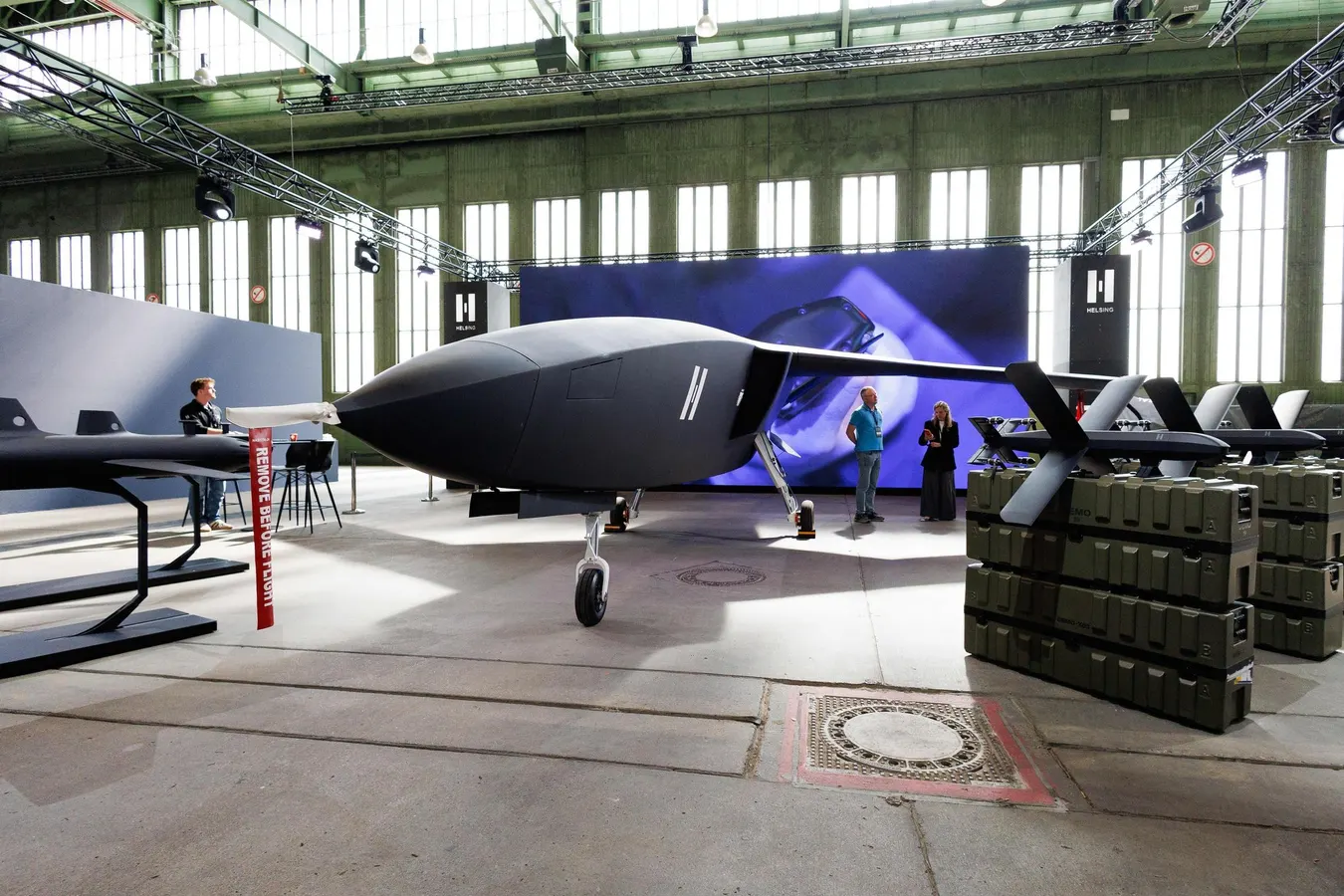
The theoretical necessity of Helsing’s mission became an stark reality in February 2022 with Russia’s full-scale invasion of Ukraine. The outbreak of conventional warfare on European soil shattered decades of geopolitical assumptions, driving an immediate, insatiable demand for automated and intelligent defense systems. To meet the exigencies of the modern battlefield, Helsing made the pivotal decision to expand beyond pure software development into physical manufacturing. Today, the company produces highly sophisticated autonomous military hardware, including the acclaimed Altra battlefield intelligence platform and the HX-2 strike drones. By February 2025, Helsing committed to producing 6,000 of these drones for Ukraine and established its first “Resilience Factory” in Germany, a facility capable of churning out over 1,000 autonomous aircraft per month to secure the continent’s eastern flank.
An Independent European Powerhouse
This rapid operational scaling has caught the attention of both governments and global capital allocators. The German government recently signaled its trust in the company, with reports revealing plans to procure approximately $640 million worth of drones from Helsing and its rival Stark Defence as part of a massive $4.9 billion military modernization framework. Such lucrative state contracts have made Helsing a darling of the venture capital world, with the company noting that demand for its latest investment round far exceeded the allocation it was willing to give away. Yet, even as some of Silicon Valley’s most prominent institutional investors clawed their way into the round, Helsing’s leadership remains fiercely patriotic. In their latest announcement, the founders emphasized that the company “remains predominantly European-owned,” reinforcing their commitment to ensuring that Europe retains technological sovereignty over its own defense in an increasingly fragmented world.