





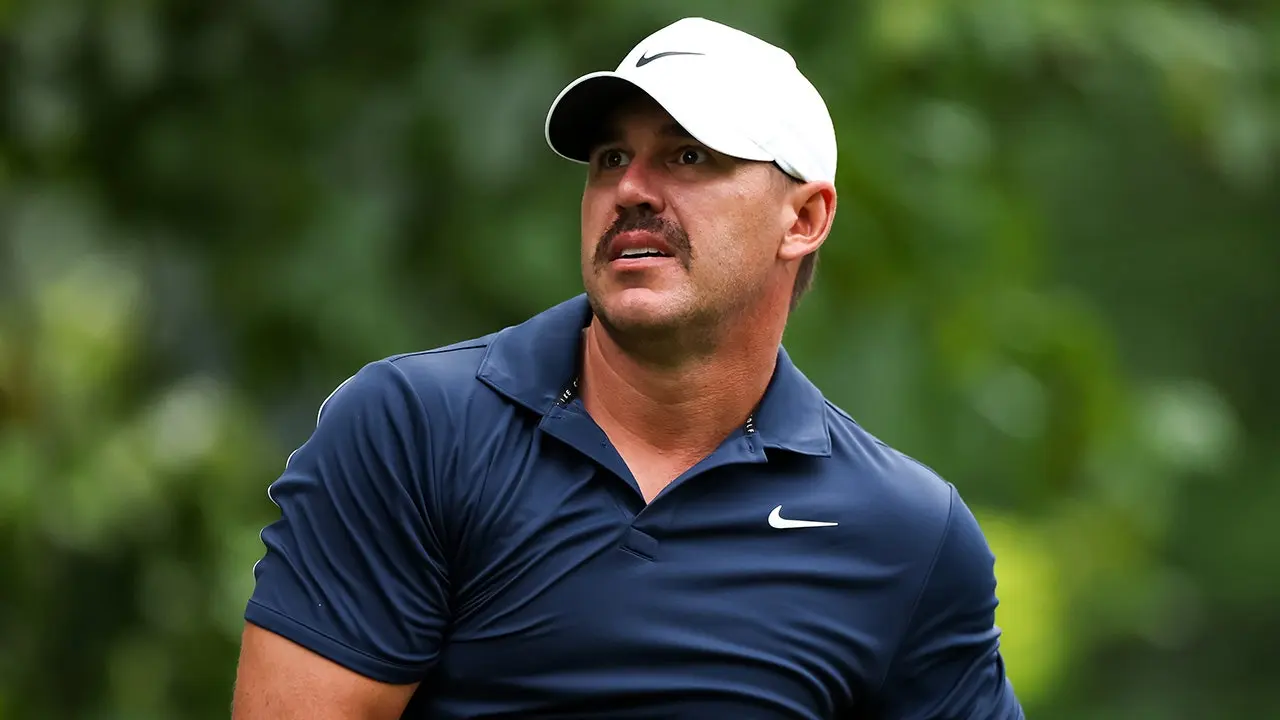
The humid August air at Sedgefield Country Club hung heavy over Brooks Koepka as he walked off the final green of the Wyndham Championship, marking a quiet and bittersweet end to his highly scrutinized return season on the PGA Tour. For a golfer whose brand has long been defined by an aura of cool invincibility and an almost dismissive dominance over his competitors, the final scoreboard was a harsh reality check. A final-round 70 left him at a modest 3-under par for the tournament, securing a lackluster tie for 67th place and leaving him a staggering 19 strokes behind the champion, Michael Brennan. However, the true sting of the afternoon lay not in his single-week performance, but in the mathematical finality of the season-long standings. Koepka’s disappointing showing cemented his position at 94th in the FedExCup Playoffs standings. Because the PGA Tour’s postseason format strictly limits entry to the top 70 players, his season was officially over, barring him from the upcoming St. Jude Championship in Memphis and the subsequent playoff events. For a five-time major champion accustomed to peaking on the grandest stages when the pressure is highest, watching the postseason unfold from the sidelines is an unfamiliar and deeply sobering experience, highlighting how quickly the margins of success can vanish in modern professional golf.
In the immediate aftermath of his final round, Koepka bypassed the usual diplomatic platitudes and delivered an agonizingly honest assessment of his season that stunned onlookers with its raw vulnerability. Rather than pointing to physical fatigue or bad luck, he labeled his failure to qualify for the playoffs as “pretty pathetic,” a term that carried the immense weight of his own sky-high expectations. For an elite athlete who has spent his career chasing legendary status, admitting to a two-year drought without a single true top-10 finish feels like a betrayal of his own identity. Koepka voiced the profound internal conflict of being in the absolute physical prime of his career, possessing the deep-seated belief that he remains one of the best players in the world, while simultaneously watching his scorecards fail to reflect that reality. This psychological gap between self-perception and actual performance can be torturous for a competitor of his caliber, transforming his post-round press conference into a humanizing portrait of a champion wrestling with self-doubt. By publicly calling his performance “pathetic” and “disappointing,” Koepka stripped away the protective armor of his public persona, revealing the deep, bruising impact that prolonged athletic underperformance has on a mind built exclusively for winning.
This competitive disappointment is further magnified by the immense personal and financial sacrifices Koepka made to secure his return to the PGA Tour after his controversial defection to the rival LIV Golf circuit. Walking away from the breakaway league was not a simple transition; the PGA Tour extracted a steep price for his homecoming, turning his return into a high-stakes gamble. Industry estimates suggest that Koepka walked away from a staggering $85 million in potential earnings by leaving LIV Golf, a sum of guaranteed generational wealth that most people cannot fathom rejecting. To compound the financial sting, the Tour restricted his event participation and officially barred him from eligibility in the massive $100 million FedExCup bonus program for the 2026 season. These severe financial penalties meant that Koepka’s decision to return was driven entirely by a desire for legacy, prestige, and the authentic, cutthroat competition that only the traditional tour could offer. To sacrifice such astronomical wealth only to miss the playoffs in his first year back adds a layer of profound irony and pressure to his journey, illustrating that his comeback was never about convenience, but rather a grueling quest to reclaim his sporting soul at an extraordinary personal cost.
Despite the dark cloud of his self-criticism and the heavy financial narrative surrounding his season, a closer examination of the numbers suggests that Koepka’s year was not a complete failure. Across 16 starts, he demonstrated that his fundamental talent remains elite, successfully making the cut in 11 events and proving that he can still compete with the best in the world. His major-championship pedigree shone through in April at Augusta National, where he navigated the treacherous winds of the Masters to secure a highly respectable tie for 12th place. Furthermore, his season reached a temporary high-water mark in March at the Cognizant Classic, where a tied-for-9th finish offered fans and analysts a tantalizing glimpse of the dominant, vintage Koepka. These performances were crucial markers of hope, proving that his swing and physical capabilities have not deserted him; rather, his struggle was a battle against the exhausting lack of consistency that plagues even the greatest players. These glimmers of brilliance served as a double-edged sword, teasing his immense potential while highlighting just how close—and yet how painfully far—he was from reclaiming his spot at the pinnacle of the sport.
In a beautiful twist of human complexity, Koepka’s intense professional frustration is contrasted by an overwhelming sense of personal peace and joy regarding his daily life on Tour. He surprised many by declaring that his happiness is a perfect “10 out of 10,” explaining that he has loved every single moment of being back in the traditional golfing fold. The warm reception he received from galleries, volunteers, and fellow competitors provided an emotional nourishment that went far beyond what any leaderboard could offer, helping to heal the fractures caused by the sport’s recent geopolitical divide. This profound sense of gratitude suggests a mature evolution in Koepka, who now seems capable of separating his worth as a human being from his performance as a professional golfer. Rather than retreating into isolation to nurse his wounded pride, he expressed genuine excitement about his future schedule, which includes traveling overseas to compete in DP World Tour events in Europe before diving back into the PGA Tour’s fall grind. This eagerness to keep playing, despite his struggles, reveals an authentic love for the game and a resilient spirit that refuses to let a bad season define his outlook.
Ultimately, Koepka diagnosed his competitive shortcomings with absolute simplicity, pointing to his agonizing struggles on the putting greens as the singular barrier holding him back from success. He admitted with striking candor that he currently possesses “zero confidence” with the flatstick, describing a feeling of total helplessness once he steps onto the putting surface. For a golfer, losing your putting stroke is akin to an artist losing their vision; it is a deeply psychological and intimate struggle where mechanical adjustments often fail to cure the underlying anxiety of a tentative stroke. When a player cannot trust their putter, even the most magnificent drives and precise iron shots are rendered meaningless, creating a cycle of frustration that can quickly derail an entire round. Yet, by identifying this specific weakness, Koepka has stripped away the mystery of his struggles and established a clear, tangible focus for his upcoming training. His journey into the autumn months is no longer about defending past major championships or justifying the millions of dollars he left behind, but rather a profoundly human quest of a humbled champion standing on a quiet practice green, searching for the feel, the rhythm, and the confidence to make the ball roll into the cup once again.