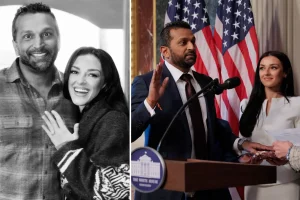





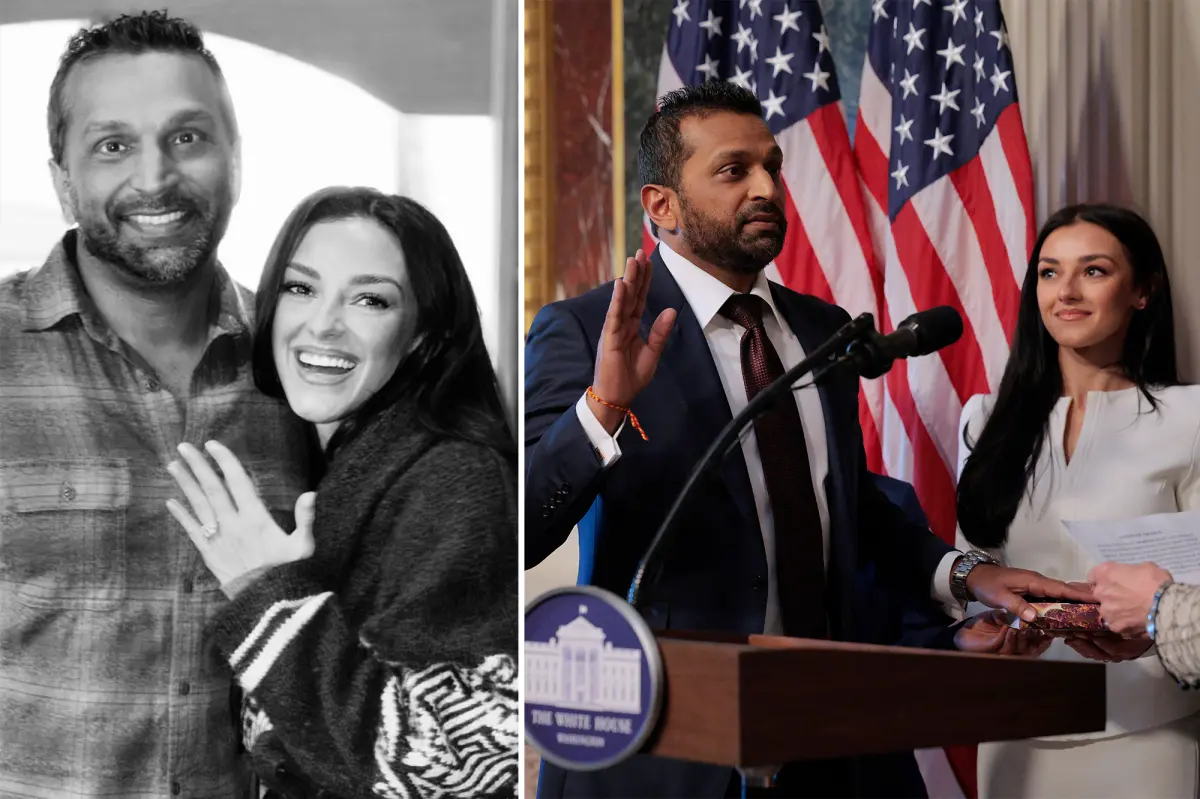
On an otherwise quiet Sunday, a photograph appeared on social media that turned a private moment into a public celebration. It showed Alexis Wilkins, a 27-year-old country singer, beaming next to FBI Director Kash Patel, 46, with a diamond ring on her finger. The image was the first confirmation that the two were engaged, and Wilkins chose to announce it with the kind of playful, confident caption that fits both her personality and the couple’s law-and-order world: “Went and got the law involved.” The phrase was vintage Wilkins—lighthearted, sharp, and aware of the symbolism. There she stood, a Nashville musician who found her way into the heart of one of the most powerful and controversial law enforcement figures in the country, holding hands with a man whose professional life is defined by rules, investigations, and the weight of federal authority. The photograph itself was simple: no red carpet, no elaborate setting, just two people smiling broadly at each other and at the camera. In that single frame, the distance between Washington’s institutional power and Nashville’s music scene seemed to shrink. For those who have followed Patel’s career through courtrooms, congressional hearings, intelligence battles, and a constant flow of media attention, the image of him looking unguarded and plainly happy was a reminder that even public figures carry private lives. The engagement announcement did not come with a press release or a formal statement. It arrived the way many modern relationships do: through a personal social media post, shared with friends and followers, then amplified across the internet until it became news. In a world where political figures carefully control every message, this one felt refreshingly direct. It was an announcement less about power and more about connection, and it invited the public into a moment of genuine joy.
Patel and Wilkins did not meet in the corridors of government or at a political fundraiser. Their story began in Nashville in 2022, at a friend’s event, where the two were simply introduced. At that point, Wilkins was building her career as a country singer and songwriter, a path that had already taught her how to work hard, perform under pressure, and navigate a competitive industry. Patel, for his part, was already a well-known figure in conservative circles, but far from the FBI directorship that would later place him at the center of national debates. Their first meeting did not lead to an immediate romance. They crossed paths again and began dating in early 2023. In a way, the slow beginning may have been part of the reason the relationship lasted. Neither one was rushing. They had the chance to know each other away from cameras, and by the time their relationship became a topic of public curiosity, they had already built a foundation. When the inevitable questions came—especially about the nearly two-decade age gap between them—Wilkins responded with calm confidence. In an interview on the “Megyn Kelly Show,” she brushed aside the notion that age matters. “We just happened to meet,” she said, as if to say that love rarely consults arithmetic. That attitude captured something essential about their partnership: it is grounded in a sense of inevitability and chosen connection, not in checking boxes. Nashville, of course, is a city built on stories of love and heartbreak, and Wilkins’s own life began to echo the ballads she performed. The couple’s early days were kept relatively private, perhaps out of awareness that Patel’s enemies would use any detail against him, or perhaps simply because the relationship was still young. Either way, their connection deepened during a period of enormous professional transition. By the time Patel’s FBI nomination became a political battle, Wilkins was already a source of steady support behind the scenes. Friends described a couple that laughed often, traveled when possible, and found a shared sense of humor in absurd situations. The engagement, then, was not a sudden decision but the natural endpoint of a courtship that had survived distance, scrutiny, and the strange reality of dating a person whose name was in newspapers almost daily. It was a love story that developed not in a vacuum, but in the loud, sometimes hostile arena of American public life.
Perhaps the most revealing words in the entire announcement came from Wilkins herself, recalling what first drew her to Patel. “I have always liked [him], when I met him, I just liked that he was so, so honest,” she said. “He’s exactly who he is all the time. His character is incredible. His values are incredible.” There is a particular sweetness in that testimony. Washington is a city where people often perform different versions of themselves depending on the audience. To hear a country singer describe a controversial federal official as someone who is exactly who he is all the time is to see a side of Patel that rarely makes it into the news. Wilkins was not praising him for his legal strategy or his political positions. She was praising his integrity—the thing that can be hardest to verify and hardest to fake. For Patel, whose public image has been shaped by fierce partisan battles, those words may mean more than any endorsement from a senator. In a relationship, to be seen accurately and loved nonetheless is a rare gift. Wilkins, who grew up around music and storytelling, understood instinctively that character is the melody underneath all the noise. She saw past the title and the controversy to the man. That does not mean she ignored the pressure. It means she chose to focus on the core of who he is. Her testimony also offered a glimpse into what their partnership is built on: honesty, values, and a kind of constancy that can be hard to find in entertainment and politics alike. In her own career, Wilkins has fought to define herself on her own terms, and she seems to see a similar independence in Patel. She has described him as someone who does not waver, who says what he believes, and who stands by it even when the cost is high. In a culture that often rewards moral flexibility, that steadfastness is what made him attractive to her. The way she talks about him—with directness, humor, and unembarrassed admiration—suggests a relationship in which both people feel free to be entirely themselves. That kind of partnership, especially under the microscope of Washington, is not just romantic. It is an anchor. And in her public words, Wilkins has made it clear that she is not simply engaged to the FBI director; she is engaged to the man she fell for before the title existed. That clarity, perhaps, is why the photograph felt so unforced. She was not posing with a job description. She was posing with her future husband.
Being the director of the FBI is a consuming role under any circumstances. But for Patel, the position has come with an especially intense spotlight. He has faced criticism from opponents, praise from supporters, and constant media coverage that has rarely allowed much room for personal life. In the midst of that pressure, Wilkins has been a presence that offers something else: a world outside work, a shared meal, a familiar voice at the end of a long day. Their relationship developed alongside his complicated nomination and his transformation from a relatively private conservative lawyer into a cabinet-level official whose every move is analyzed. That could have been overwhelming. Instead, Wilkins appears to have provided a kind of ground floor for Patel, a place where he does not have to explain or defend himself. In interviews, she has spoken about the difficulty of watching someone she loves be attacked in public. But she has also insisted that she knows the man behind the headlines, and that knowledge gives her a confidence that critics cannot shake. “He’s exactly who he is all the time,” she said in the same conversation where she dismissed the age gap. The repetition of that theme suggests how central it is to their bond. When the world is full of distortions and caricatures, the ability to come home to someone who tells the truth about you is invaluable. It is easy to imagine Patel, after hours of briefings and bureaucratic battles, finding refuge in a Nashville melody or a late-night conversation with a woman who sees the human being rather than the office. That dynamic does not appear one-sided. Wilkins has also been forging a media career of her own, hosting a show on Rumble and speaking out on the political issues she cares about. The two are not just partners in love; they are ideological fellow travelers. That shared worldview likely deepens their connection in ways that outsiders can only guess. But the emotional support they give each other is perhaps even more important. For a public figure like Patel, the private arena is the one place where he can be vulnerable. Wilkins, by all accounts, provides that sanctuary. The engagement announcement, joyful as it was, hinted at the strength underneath. To commit to marriage while navigating a political minefield is a statement of certainty. It says that their relationship is not a distraction from the world but a way of surviving it.
Their public lives have always moved in parallel currents. Patel is a lawyer, intelligence official, and now FBI director—a figure associated with law, order, and the hard edges of national security. Wilkins is a country singer, a genre steeped in classic values, small-town stories, and plainspoken expression. Country music, after all, has always been friendly to conservative themes, and Wilkins herself is openly conservative, hosting a Rumble show and using her platform to express her views. In that sense, their engagement is not the joining of opposites but the union of two people from different corners of the same cultural world. The joke in her caption—“Went and got the law involved”—spoke to their shared sense of humor. It was a wink at Patel’s profession, a pun that also made it clear she is comfortable with the security details, official responsibilities, and scrutiny that come with his life. It was also a way of controlling the narrative. Rather than letting the news leak out in fragments, Wilkins announced it on her own terms, with a caption that showed wit, affection, and a certain fearless charm. That is the kind of confidence that probably makes her a good match for Patel, a man who inspires strong feelings and has learned to hold his ground. The couple’s ideological alignment is likely to be scrutinized further now that they are engaged. Wilkins’s media presence and political commentary mean that she is not a conventional political spouse. She has opinions, a platform, and a willingness to defend her beliefs. For Patel, that may be an asset. He has built his career on conviction, and a partner who shares those convictions is likely to be a source of strength rather than a complicating variable. There is also a simpler, more human element: they come from the same emotional language. They both understand what it is like to be in front of microphones, to face questions that are not always friendly, and to hold on to their roots in a world that asks them to be someone else. That mutual understanding can create a bond that is difficult to replicate. When they are together, they do not need to explain the public side of their lives to each other. They already know. And in a marriage, that kind of shared experience is worth more than any formal compatibility. It is perhaps why their engagement announcement felt so relaxed. They know what they are stepping into. They have already been living it.
On Sunday, after the world began to react to the news, Patel added his own public confirmation. He shared his fiancée’s post, pairing it with a red heart emoji and a diamond ring emoji. It was a small gesture, but in the context of his carefully guarded public image, it spoke volumes. The couple, who have been together since early 2023, had chosen to make their engagement official in the bright light of social media, aware that every reaction would be mixed with politics. They celebrated anyway. The announcement is, of course, a developing story. No wedding date has been announced. No details about the proposal have been shared. The news cycle will move on, but for the two people involved, this moment marks a beginning. For readers, the engagement is a reminder that even the most polarizing public figures experience the universal human desire to love and be loved. Kash Patel, the FBI director who has been at the center of so many battles, is also just a man who proposed to the woman he loves. Alexis Wilkins, the country singer with a growing platform, is also just a young woman who said yes. Her caption may have been playful, but the emotion behind it was real. In a photograph and a few words, they managed to communicate something that political discourse often forgets: that public servants have private lives, and that those lives matter. The path ahead for the couple will not be simple. A wedding involving the FBI director would require security considerations, public attention, and likely an endless stream of commentary. But they have already weathered the hardest part of coming together in a divided city. They met by chance, chose each other one day at a time, and made it to the point where a question had to be asked and answered. The ring on Wilkins’s hand says what happened next. It says yes. And as the story continues to unfold—with more details likely to emerge in the coming days—the image of those two smiles stays near the heart of it all. It is a small, bright truth in a noisy world: love found a way, and law got involved. For now, that is enough. For the rest, there will be more updates, more photographs, and eventually, perhaps, a wedding that unites country music and the federal government in a way no one expected. The headline will move on, but the engagement will remain. And somewhere, in a photograph on a phone, a diamond will catch the light.