





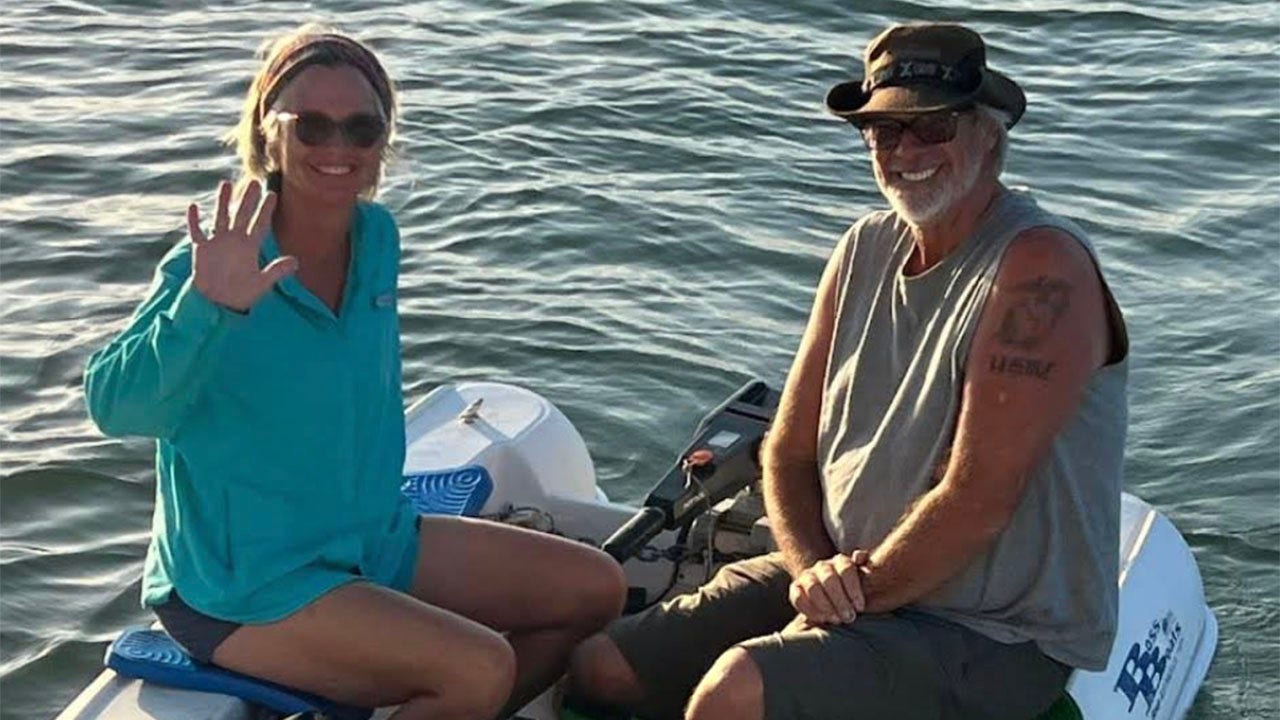
For six months now, the question has lingered in the air like a fog that will not lift: Where is Lynette Hooker? She was a 55-year-old mother from Michigan, a woman with a life, a family, and a future, and then one night in the Bahamas, she simply vanished. It was April 4, and she and her husband Brian had gone out for drinks in Hope Town, a quaint and colorful settlement in the Abaco Islands. According to Brian, they were returning to their sailboat, a vessel fittingly named Soulmate, when Lynette went overboard from a small dinghy in the dark. That is the story. That is the only story. No one else saw her fall. No one else heard a splash. There was only Brian, the water, and the sudden, crushing absence of his wife. He was detained by Bahamian authorities, questioned, and eventually released. He has not been charged with a crime, and he has maintained his account of what happened that night. But for Lynette’s loved ones, for the investigators still sifting through evidence, and for the public that has become captivated by her disappearance, the case is far from closed. It has settled into the bones of all who follow it, an unresolved ache that refuses to heal.
The official machinery of justice, though quiet, has been anything but idle. The U.S. Coast Guard Investigative Service has taken a central role, seizing the couple’s sailboat Soulmate in May, a dramatic and telling act that signaled this was no longer a simple maritime rescue operation. In early June, a team of divers plunged into the waters around the Bahamas, searching for any trace of Lynette beneath the surface. They came away without a body, but they did bring something else home: the dinghy, the very vessel from which Lynette allegedly went overboard. It was sent to a forensics laboratory, and certain pieces of evidence have been forwarded to the FBI lab in Quantico for analysis. Nicole Parker, a Fox News contributor and former FBI special agent, has been careful to temper public expectations, explaining that this kind of evidence is not examined overnight. It is subjected to rigorous testing, to hours of scrutiny, to the painstaking science of reconstructing a scene that no one can see. As Parker put it, investigators are “trying to reconstruct a potential crime scene that occurred in the waters.” That is not a simple task. Water washes away particles, and the open ocean keeps secrets with disturbing efficiency. Yet Parker insists that the silence from official channels should not be mistaken for stagnation. “Just because the public doesn’t exactly see what’s happening, doesn’t mean that it’s not happening behind the scenes,” she said. It is a reminder that justice often moves through the shadows, slowly, deliberately, but with a purpose that should not be underestimated.
For Lynette’s mother, Darlene Hamlett, the official silence has been a particular kind of torture. She has stepped forward publicly, carrying a mother’s burden of grief and conviction, and she has said plainly that she believes her daughter never died in the water that night. In her mind, Lynette made it back to Soulmate, and what happened after that was not an accident. “She made it back to the boat, and there was foul play,” Hamlett told Fox News Digital. She has not laid out the details of how she reached that conclusion, and she has acknowledged that the Coast Guard has limited what she can say publicly. But the weight of her words is undeniable. A mother’s intuition is not evidence, but it is not nothing either. It is a signal, a warning flare sent from a heart that knows the person it brought into this world. Nicole Parker, who spent years investigating crimes that unfolded on the high seas, echoed a chilling point: “Remember, there was no one else on the water with them.” That simple sentence carries the entire mystery. If Lynette did not fall overboard by accident, then someone must have done something, and the only other person present was her husband. That is not an accusation. It is an arithmetic of absence, a way of counting the possibilities when the only surviving witness is the one person who says he did not see what happened. Parker stressed that the limited release of information does not mean investigators are not working, and that the case remains very much alive. But for Hamlett, every day without answers is a wound reopened.
There is something deeply human, deeply relatable, about the frustration that comes with waiting for justice. Nicole Parker knows that frustration from the inside. She served as the FBI’s crimes on the high seas coordinator, and she has been where the investigators are now, staring at evidence that does not yet add up, knowing that somewhere in the silence there is a truth waiting to be uncovered. “There were times when even I myself as an investigator, I wanted things to move more quickly. I wanted results, I want it to happen, but these types of cases, they do take time,” she said. That confession is reassuring in one sense, because it comes from someone who has lived through the grind of real investigations, where breakthroughs are rarely like they are in the movies. There are no sudden confessions, no dramatic courtroom scenes, no last-minute witnesses emerging from the mist. Instead, there are endless forensic reports, chain of custody forms, laboratory results, and the slow consolidation of circumstantial evidence into something stronger. But Parker also made clear that the work is relentless. Investigators are not going home at five o’clock and leaving Lynette’s case on a filing cabinet. “They’re doing everything that they can to bring answers,” she said. “At the end of the day, that’s what Lynette deserves.” Those words matter. They remind us that behind the legal jargon and the investigative protocol, there is a woman who is missing, a family that is broken, and a life that deserves to be remembered not just as a case number, but as a person whose disappearance has left a hole in the lives of everyone who knew her.
And then there is Brian Hooker, the husband, the one person who knows more than he has said, or at least the one person who was there. He has returned to the United States and appears to be living a quiet, almost unsettlingly ordinary life at his mother’s home in Citrus Heights, California, a suburb northeast of Sacramento. Fox News Digital spotted him walking dogs, chatting with neighbors, making trips to the local pharmacy, and even gathering trash items up and down the street. There is something jarring about that image: a man whose wife has been missing for six months, whose name is attached to a mystery that has consumed the nation, calmly collecting stray bottles and pieces of paper along a residential street. Is it therapy? Is it nervous energy? Is it a man trying to distract himself from an unbearable reality? Or is it something else entirely? The public cannot know. He has made no recent public statements about his wife’s disappearance, and through his attorney, he has not responded to the latest requests for comment. His stepmother, in reports that have added another layer of tension to the family situation, has been quoted as saying she suspects he “lied about everything.” Those are harsh words from a family member, and while they are not proof of anything, they underscore how deeply this mystery has fractured even those closest to it. Brian Hooker has not been charged, and under the law he is presumed innocent. But innocence and suspicion are two different things, and in the court of public opinion, silence is often read as guilt. Whether that is fair or not, it is the reality of a case that offers no other narrative, no other explanation, no other door through which the truth might walk.
As the investigation continues, legal experts have noted that federal charges could potentially be brought in the case even without a body ever being found. It has been done before, and it may be done again. The FBI and the Coast Guard have declined to comment, leaving the public to piece together clues from granule moments of official action. But for those who love Lynette, the practicalities of prosecution are secondary to the deeper need for closure. They want to know what happened to her. They want to know why she never came home. They want to honor her memory with the dignity of truth, not the ambiguity of an open file that will never be closed. Nicole Parker’s words offer a kind of fragile comfort: the investigation is proceeding, evidence is being analyzed, and the effort is genuine. But comfort does not erase pain. It does not bring Lynette back. It does not answer the question that has echoed through six months of uncertainty. Where is Lynette Hooker? Is she lost in the ocean, claimed by the unforgiving sea, her story ended on a night of drinks and a dinghy ride? Or is she somewhere in the vast unknown, a victim of something far darker than an accident? The public may never know the full truth, but until then, the case remains open, the search continues, and a mother waits by the phone with a grief that cannot be contained. Lynette deserves more than mystery. She deserves an answer, no matter how long it takes, no matter how deep the waters. And as the days stretch on and the world moves forward, her family holds onto the hope that justice, however slow, will eventually come.