






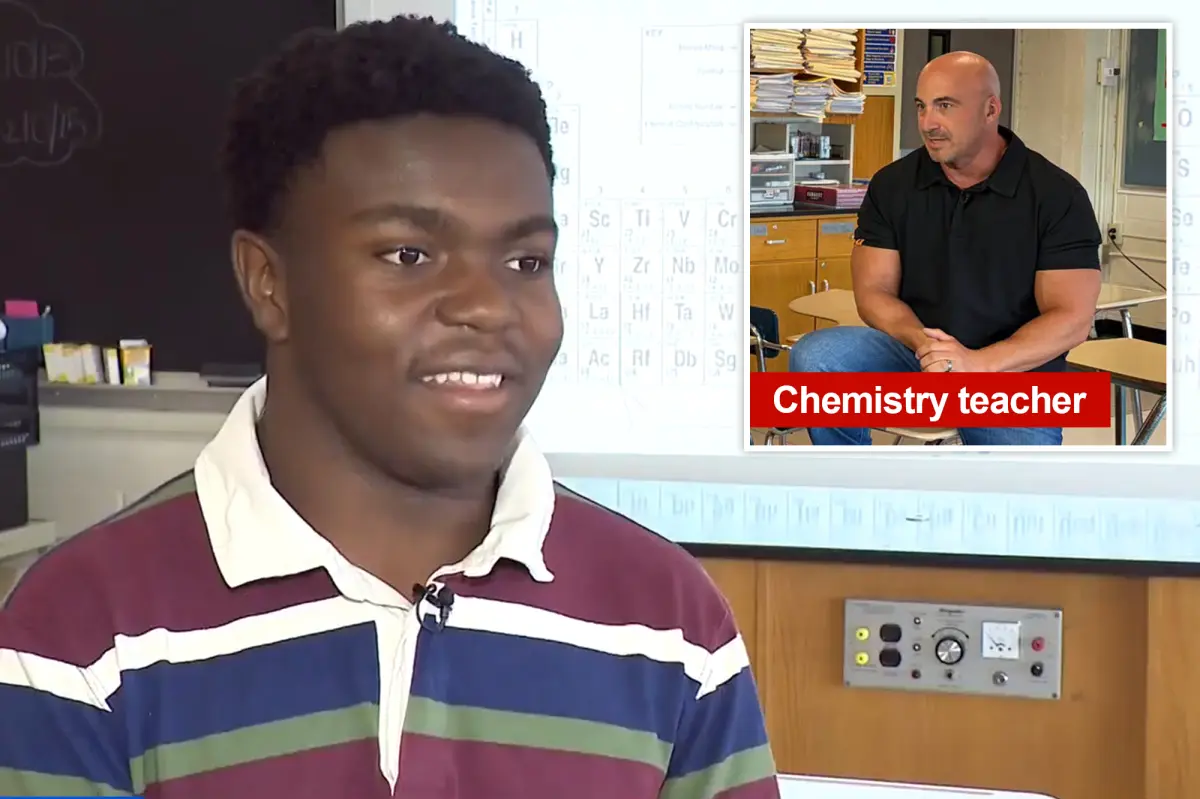
It was the kind of late-June moment that teachers live for but rarely get to experience. On Long Island, inside Baldwin High School, Anthony Simonelli was working through a stack of Chemistry Regents exams, the final hurdle for students before summer break. For 25 years, Simonelli had made the same offer to every class: score a perfect 100 on the notoriously difficult state test, and he would personally hand-deliver a crisp $100 bill to your front door. It was a standing dare, a bit of theatrical motivation, and over the years it had become something of a legend. No one had ever collected. Then he reached the last test in the pile. The name on the paper was Jojo Yawson, a then-sophomore who had walked out of the exam hall convinced he had failed. Yawson had gone home dejected, replaying every question in his mind, certain he had made at least a few mistakes. But when Simonelli looked at the score, his jaw almost hit the floor. It was a 100. The last kid. The final exam graded. A perfect score after 25 years of waiting. Simonelli later told CBS New York that he literally could not believe it. The moment was almost too perfect to be true, as if the universe had saved the best for last. For Yawson, the news was just as stunning. He had spent the days after the test convinced he had blown it, and now he was being told he had done something no student in Simonelli’s long career had ever done. It wasn’t just a passing grade or even a high score; it was flawless, every question answered correctly, every section mastered. The achievement was remarkable enough on its own. But the fact that it happened on the very last paper graded, in the final years of the exam’s existence, made it feel like a piece of school folklore in the making.
The challenge had always been Simonelli’s way of cutting through the fear that surrounds the Chemistry Regents. For a quarter of a century, he had watched students tremble at the test, which is widely considered the hardest Regents-level exam in New York State. It demands not only memorization but precise calculation, careful reading, and the kind of steady nerves that can easily desert a teenager on a hot June afternoon. Simonelli knew that fear could freeze his students, so he gave them something to aim for beyond a passing grade. “I said, all right, here’s some motivation. I’ll give you 100 bucks. Any kid who gets 100,” he told CBS New York. It was a simple bet, but it changed the psychology of the room. Instead of hoping to survive the exam, students could dream of conquering it. Yawson took the challenge to heart. He was motivated by the money, and he was honest about that. “It did matter a lot. It wasn’t in the back of my mind, it was in the front of my mind,” he said. But he also understood what the challenge really required. “I definitely believed it was possible,” he told the Long Island Herald. “You know, you just have to get all the questions right. Like, it’s not impossible.” The hard part, he added, was not the chemistry itself but the discipline of avoiding mistakes. “It’s mostly about being just very careful and not making any mistakes. That’s the hard part.” That insight—that perfection is less about brilliance than about vigilance—became the key to his success. While other students rushed through the exam, anxious to finish, Yawson treated every question as a trap. He checked his work, revisited his calculations, and refused to let his confidence turn into carelessness. He didn’t know it at the time, but that carefulness was exactly what Simonelli had been hoping to teach for 25 years. The $100 was bait, but the real lesson was that excellence is a choice made one question at a time.
Yawson’s perfect score was not his first taste of Regents glory. During his freshman year, he had also aced the Biology Regents, proving that his success on the Chemistry exam was no fluke. But what made his achievement even more meaningful was the fact that he had done it while navigating learning accommodations. His mother, Ama Karikari, spoke with pride about her son’s journey. “I believe that it should really inspire students with accommodations and their families to recognize that having a learning difference can mean learning with excellence,” she told the Long Island Herald. Her words carried a powerful message: a student who needs extra support in testing is not a student who cannot excel. Yawson’s story upends the assumption that accommodations are a crutch. He used the tools available to him, worked around his challenges, and still managed to outperform the vast majority of test-takers. His mother’s pride was not just about the perfect score; it was about what the score represented. It was proof that her son had learned to turn his perceived weakness into a source of strength. For Yawson, the accommodations were simply part of how he learned, not a limitation. He didn’t let them define him, and he didn’t use them as an excuse. Instead, he focused on what he could control: his preparation, his attention to detail, and his determination to get every question right. The result was a rare and remarkable double: perfect scores on two different Regents exams in two consecutive years. It was the kind of achievement that would make any student proud, but for a student with learning differences, it carried an extra layer of significance. It sent a message to every young person who has ever felt held back by their own brain: you are not broken, and you are not limited. You can be excellent. Yawson’s mother hoped that his story would inspire other families to believe in that possibility. She saw her son not as an exception but as an example of what happens when a student is given the right support and chooses to rise to the challenge.
When the time came to deliver the prize, Simonelli made good on his promise. He arrived at Yawson’s front door with a $100 bill that he had signed and inscribed with a personal note of thanks. It was a small gesture, but it carried the weight of 25 years of anticipation. For Simonelli, handing over that money was not a loss; it was a triumph. He had finally seen a student meet the standard he had been setting for his entire career. For Yawson, the money was a tangible reward, but his feelings about it were refreshingly honest. “Of course, it’s about the money,” he said. “Getting a perfect score—if they gave me $100 for getting a 50, I would have got a 50. It’s about the money.” The comment drew laughs, but it also revealed something important about his personality. He was not pretending to be above the incentive. He saw the challenge for what it was: a game, a bet, a test of focus with a cash prize at the end. And he played it perfectly. Still, he admitted that he had thought about framing the $100 bill, preserving it as a memento of his improbable achievement. But he might just spend it, he said, because it wasn’t his first perfect score on a Regents exam. That casual attitude made the story even more endearing. Here was a teenager who had done something extraordinary, and he was treating it with the same nonchalance he might use to describe a good meal. He valued the money, but he wasn’t defined by it. The signed bill was a symbol of a moment in time, a connection between a teacher and a student that would outlast the cash itself. Simonelli, for his part, seemed almost giddy about the outcome. After 25 years of issuing the same challenge, he had finally been forced to pay up. And he couldn’t have been happier to do it.
Yawson’s perfect score came at a bittersweet moment in New York’s educational history. The state is in the middle of a major transition, moving to a new exam that aligns with the P-12 Science Learning Standards. The Chemistry Regents that Yawson conquered is being redesigned, and the entire Regents system is being phased out as a requirement for high school graduation by 2028. That means Simonelli’s 25-year challenge may never be offered again. The teacher recognized the significance of the timing. “There’s no way that the last kid that I’ll ever have the chance to have a 100 literally did it,” he said. His words were filled with wonder, as if the universe had conspired to give him one final perfect score before the old exam disappeared. For Yawson, that made his achievement even more special. He wasn’t just the first student to beat the challenge; he was also the last. The exam he mastered was a dying breed, a relic of an older educational era. The new standards are designed to be more inquiry-based and aligned with modern science education, but they also represent a shift away from the high-stakes, end-of-year exams that have defined New York schooling for generations. For supporters of the old system, the change feels like a loss. The Regents exams were a common standard, a way to measure students across the state and hold schools accountable. For critics, they were a source of stress and a narrow measure of ability. Either way, Yawson’s perfect score stands as a final tribute to the old exam. He did what no student in Simonelli’s class had done in 25 years, and he did it on the eve of the exam’s retirement. It was a fitting farewell, a reminder of what the Regents could inspire when a teacher knew how to use them. Simonelli will always have that memory: the last stack of tests, the last paper, the last kid, and the perfect score that made it all worthwhile.
The broader debate over the Regents exams has been loud and contentious. Former New York Governor George Pataki did not mince words when he criticized the state’s decision to phase out the tests. “Getting rid of the Regents is incredibly stupid,” he told The Post. He argued that the Education Department’s real motive is to hide failure. “It seems like the Education Department’s main function right now is to disguise the fact that too many New York State schools are failing to educate our kids,” he said. “So instead of doing the appropriate testing so that corrective measures could be taken to improve [performance], they simply get rid of the tests to hide their failure.” Pataki’s comments reflect a broader anxiety about the future of public education. If the Regents exams are no longer required, how will the state know what students are learning? How will schools be held accountable? How will parents know if their children are prepared for college or careers? These are not easy questions, and the Board of Regents is still searching for alternative graduation requirements. But Yawson’s story offers a counterpoint to the doom and gloom. It shows that tests, when used well, can be more than instruments of punishment. They can be challenges that push students to discover what they are capable of. Simonelli’s $100 bet was a small act of pedagogical creativity, but it transformed the Chemistry Regents from a dreaded ordeal into a game worth winning. Yawson rose to the occasion, not because he was forced to, but because he was inspired to. His perfect score is a reminder that excellence is still possible, even in a system that is changing. The exam may be disappearing, but the lessons it taught—care, precision, resilience, and the joy of meeting a difficult challenge—will not disappear with it. As New York moves toward a new era of assessment, educators would do well to remember Simonelli’s example. The best tests are not the ones that sort students into winners and losers. They are the ones that invite students to surprise themselves. Jojo Yawson did exactly that, and his teacher was there to see it, $100 bill in hand.