





It began like countless other traffic stops on a busy California afternoon, the kind that officers conduct every day without fanfare or headlines. Along Valley Boulevard near the 710 Freeway, in the city of Alhambra, a patrol officer’s attention was drawn to an SUV that seemed almost comically overloaded. The vehicle was packed with cardboard boxes, stacked high and crammed into every available inch of space. There were boxes on seats, boxes in the cargo area, boxes so numerous that the SUV looked less like a personal vehicle and more like a moving van that had lost its way. The Alhambra Police Department later noted that the driver was transporting “more cardboard boxes than Amazon on Prime Day,” a joke that would quickly become part of the story’s charm. What exactly prompted the initial stop was not disclosed by authorities, but it is not hard to imagine the officer’s thought process: a car riding low under the weight of mysterious cargo, windows perhaps tinted, the driver’s hands gripping the wheel a little too tightly. In police work, ordinary traffic violations often reveal something far more serious, and this particular stop was about to take a turn that nobody on the scene could have predicted. The officer approached the vehicle, made the usual introductions and requests for license and registration, but all the while, the mountain of cardboard boxes seemed to loom in the background, raising questions that would soon demand answers.
At first, the driver offered a story that sounded simple enough. He said he was heading home to Huntington Park after visiting his cousin’s house, and he insisted that the boxes were not his. It was the kind of explanation that might make sense in a casual conversation but falls apart under the weight of scrutiny. If the boxes were not his, then whose were they? Why would someone allow another person to drive a car packed with their belongings? And why would a visit to a cousin’s house involve transporting an entire warehouse of cardboard? The officer listened patiently, taking in the details while noticing the small inconsistencies that so often betray a lie. Then came the second version of the story, which police later described with a touch of sarcasm as “version 2.0 of his lore.” The driver changed his tune entirely, now claiming that he was transporting diesel parts to a shop owned by a friend. Gone was the cousin’s house in Huntington Park; in its place was a diesel repair shop and a business errand that supposedly explained the absurd amount of cargo. The officer must have wondered how a man who had just said the boxes were not his could now know exactly what was inside them. The shifting narrative was enough to raise the level of suspicion from mild curiosity to genuine concern. This was no longer a simple traffic stop; it was a puzzle, and the officer needed help solving it. Fortunately, help was on the way in the form of a four-legged partner with an extraordinary sense of smell.
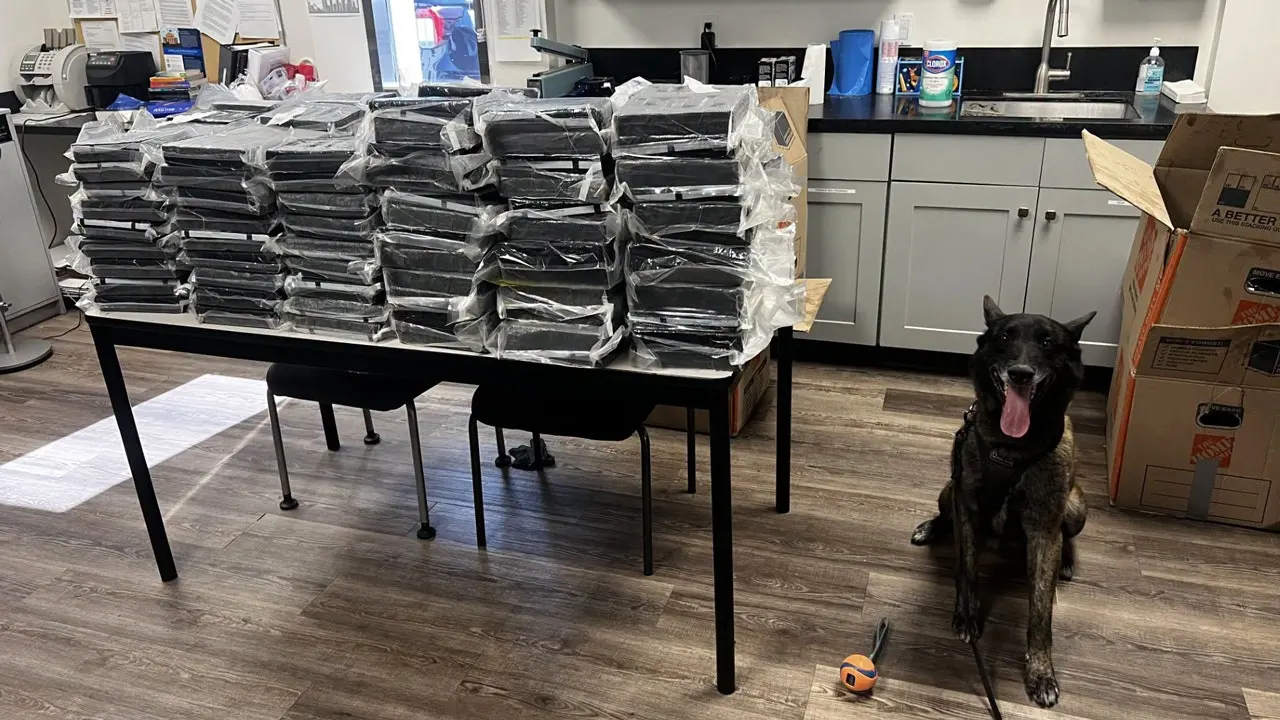
Enter K-9 Otis and his handler, a duo trained to detect the one thing that can turn a routine stop into a major drug bust. Otis, a police dog with a reputation for sharp instincts and an unrelenting work ethic, was brought to the scene to conduct a free-air sniff around the vehicle. The procedure is standard in many departments: the dog walks around the car, sniffing seams, windows, doors, wheel wells, and any place where air might escape from inside. For Otis, this was not just work; it was a game, a familiar ritual in which his nose was the star player. He moved with purpose, his tail wagging, his nostrils flaring with each step. Then, at a certain point, Otis made his decision. He alerted to the vehicle, giving his handler and the other officers the signal they needed to act. Police described Otis as having a “top-tier nose,” and that nose had just found something. It is impossible to know exactly what went through the driver’s mind at that moment, but one can imagine a sinking feeling as the reality of the situation set in. The cardboard boxes, the contradictory stories, the suspicious behavior—it all pointed to something hidden. With the K-9’s alert, the officers now had probable cause to search the vehicle. What they discovered inside would make headlines and earn Otis a round of well-deserved praise from people far beyond the Alhambra Police Department.
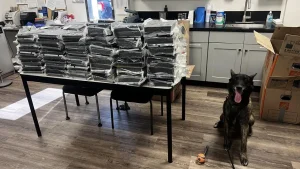
When the officers peeled back the layers of cardboard and opened the boxes, they found them packed with something far more valuable and far more illegal than diesel parts: cocaine. In total, the SUV contained approximately 200 kilos, or roughly 440 pounds, of the drug, a staggering amount by any measure. The cocaine was packaged in bricks, each one carefully wrapped to conceal its contents, then hidden among the boxes as if trying to blend in with ordinary household goods. The street value of such a haul would likely run into the millions of dollars, and the impact of removing it from circulation was significant. This was not a small-time operation; this was a substantial trafficking load that had been intercepted by a sharp-eyed officer and a determined dog. The driver, identified as Julio Rangel of Huntington Park, was arrested on the spot and booked into the Alhambra Police Department jail. The charges he would face were not detailed in the initial report, but for a drug seizure of this magnitude, the legal consequences are severe. For the officers, it was a moment of triumph after a confusing and suspicious traffic stop. For Otis, it was another day of doing what he was born to do. The dog had found the truth hidden beneath a mountain of cardboard, and in doing so, he had become the hero of the operation. The Alhambra Police Department would not let that moment go unnoticed.
Following the bust, the department took to social media to celebrate their furry colleague in a way that perfectly captured both the seriousness of the achievement and the lighthearted affection that police officers often have for their K-9 partners. “A round of a-paws for our good boy, K9 Otis,” the department wrote, and the post quickly caught the attention of the public. Social media users were delighted by the news, flooding the comments with praise for Otis and jokes about his future career. Many argued that the dog had earned a promotion, perhaps even to the rank of police chief someday. Others said he should be given a bone or, at the very least, a big steak dinner. One user, playing on the phrase “long arm of the law,” quipped, “No One escapes from the Long Paw of …. The DOG.” The comments captured something that people naturally love: a story in which a good dog does a good job, catches the bad guy, and gets rewarded with affection. Otis, of course, had no idea that he had become an internet celebrity. He was probably more interested in the next toy, the next treat, or the next chance to run his nose over another vehicle and find something hidden. But to the officers and the community, he was more than just a dog; he was a partner, a protector, and a symbol of the vigilant work that happens on the streets every day. The lighthearted tone of the social media post did not diminish the weight of the arrest; it simply added a human touch to a story that might otherwise have been another statistics-heavy drug bust.
In the end, this traffic stop in Alhambra is a reminder that the world of law enforcement is filled with both extraordinary moments and everyday realities. The officers likely went home that night with a good story to tell their families, and Otis probably collapsed into a well-earned sleep, his nose having done its job with characteristic precision. But beyond the jokes and the praise lies a deeper truth: the men and women in uniform, and the K-9s who work alongside them, are constantly on the lookout for the hidden dangers that many people never see. A traffic stop that begins with a suspicious car full of boxes can end with hundreds of pounds of cocaine off the streets, preventing who knows how many lives from being touched by addiction and violence. The driver’s ridiculous explanations—the cousin’s house, the diesel parts—were no match for the careful observations of a police officer and the incredible instinct of a trained dog. It takes years of experience to know when a story does not add up, and for K-9 Otis, it takes just a few seconds of sniffing to find the truth. The Alhambra Police Department’s ability to share the story with humor and humanity only strengthens the bond between the force and the community it serves. So, yes, Otis deserves a round of a-paws, maybe a bone, perhaps a steak dinner, and definitely a nap. In the long and storied history of police work, there are few heroes quite like a good dog with a great nose and a tail that never stops wagging. This time, that good dog helped take an enormous amount of cocaine off the streets, and the entire nation got the chance to celebrate him.